

Sign In
Notification
Font ResizerAa
  • Latest
    • Supreme Court
    • Madras High Court
    • Madurai Bench
  • Quick Recall
    • Arms Act
    • BNSS
    • BNS
    • BSA
    • Evidence
    • Drugs Act
    • Cr.P.C
    • IPC
    • N.I.Act
    • PMLA
    • NDPS
    • Corruption Laws
    • General
    • Passports Act
    • Pocso
    • MCOP
    • Writ
  • Acquittal
    • S.C
    • Madras High Court
  • 3 judge bench
  • Resources
    • Notes
      • Cr.P.C 1973
      • Crimes
    • Articles
      • P.G.Rajagopal (Judge Rtd)
      • Ad. Ramprakash Rajagopal
      • Ad. Karunanithi
      • Ad. Ravindran Raghunathan
      • Ad. James Raja
      • Ad. M.S.Parthiban
      • Ad. Rajavel
      • Ad. Azhar Basha
      • Mr. Lokkeshvaran
      • Prasath
    • Digest
      • Monthly Digest
      • Weekly digest
      • Subject wise
    • Bare Acts
      • BSA 2023
      • BNS 2023
      • BNSS 2023
    • Legal Drafting
  • Must Read
  • Author’s note
  • E-Booklet
    • Legal words
  • About
    • Terms
    • Privacy policy
    • Cancellation & Refund Policy
    • Team
  • Civil
    • s. 91 cpc
  • My Bookmarks
Reading: Dying declaration: Section 304-B IPC – Wife poured kerosene and the husband taking undue advantage lighted with matchstick and hence murder
Share
Font ResizerAa
  • Latest
  • Acquittal
  • Digest
  • Resources
Search
  • Latest
    • Madras High Court
    • Madurai Bench
    • Supreme Court
  • Quick Recall
    • Evidence
    • Cr.P.C
    • IPC
    • N.I.Act
    • Pocso
    • PMLA
    • NDPS
    • Corruption Laws
    • General
    • Passports Act
  • Acquittal
    • S.C
    • Madras High Court
  • Digest
    • Monthly Digest
    • Weekly digest
  • Resources
    • Notes
    • Articles
  • 3 judge bench
  • Must have
  • Author’S Note
  • E-Booklet
  • Legal words
  • About
    • Terms
    • Privacy policy
    • Cancellation & Refund Policy
    • Team
  • Mobile APP
  • My Bookmarks

Get Notifications

Notification
Follow US
> Quick Recall> Evidence> Dying declaration: Section 304-B IPC – Wife poured kerosene and the husband taking undue advantage lighted with matchstick and hence murder

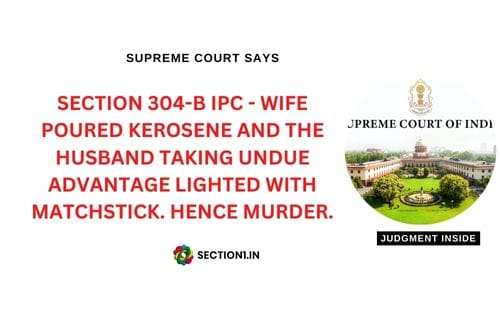
Dying declaration: Section 304-B IPC – Wife poured kerosene and the husband taking undue advantage lighted with matchstick and hence murder

Both the above statements, if read together, would reveal that on the fateful day, the appellant had assaulted the deceased wife under the influence of alcohol. He even struck a blow on her chest and pushed her. At the time of the said incident, the children were playing in the courtyard. When the assault of the appellant became unbearable, she took the cane of kerosene from kitchen and poured it on her body whereupon her husband lighted a matchstick and burnt her.
Ramprakash Rajagopal November 10, 2023 8 Min Read
Share
Appeal

1. The appellant Anil Kumar has been convicted under Sections 302 and 498A of the Indian Penal Code1 by both the courts below and has been sentenced to life imprisonment and to pay fine of Rs.50,000/, and in default to undergo simple imprisonment for one year under Section 302 IPC and rigorous imprisonment of one year under Section 498A IPC with direction that both the sentences would run concurrently.

Contents
AppealFactsDefence set up by the accusedFacts on dying declarationNarration of facts by the deceased and 96% burn injuriesHusband took undue advantage of the situation and lighted a matchstick: HomicideParty
Facts

2. The incident is of 26.09.2010 and had taken place at 9:00 am in the morning at the house of the appellant. The allegation is that the appellant, with the intention to kill his wife, lighted a matchstick and threw it upon her when she had already poured kerosene upon herself due to the quarrel with the appellant.

4. On the basis of the aforesaid FIR, the appellant was charged for uxoricide.

Defence set up by the accused

6. In the trial court as well as before the High Court, the defence of the appellant was that he is not at all guilty of burning his wife. She had the suicidal tendency and had tried to immolate herself on one earlier occasion and had once even tried to cut her veins. She herself had poured kerosene upon herself and set herself on fire. The appellant had simply tried to douse the fire by pouring water from the bucket.

7. The defence so set up by the appellant was not accepted by either of the courts below in view of the overwhelming evidence on record regarding their frequent quarrel and the harassment meted out to the deceased wife. The ocular evidence of the witnesses clearly proved that on the date of the incident, there was again a quarrel between both of them though on a petty matter but the deceased wife, in order to avoid torture at the hands of the appellant and to deter him, went inside the kitchen and poured kerosene on herself. Thereafter, the appellant took advantage of the situation and set her on fire.

Facts on dying declaration

11. In the case at hand, admittedly, there are multiple dying declarations on record. The first dying declaration is in the form of the statement Ext.P1. This statement of the deceased wife before her death was made before the Judicial First Class Magistrate, Ernakulam, i.e. PW5. The said statement clearly reveals the cause and circumstances of the death of the deceased wife.

12. The other statement which can be read as a dying declaration is Ext.P10 recorded by PW16, Head Constable, Kuruppampady Police at General hospital, Ernakulam, wherein also the deceased wife repeated the same narration as in Ext.P1 in relation to the incident of her death.

13. Both the above statements, if read together, would reveal that on the fateful day, the appellant had assaulted the deceased wife under the influence of alcohol. He even struck a blow on her chest and pushed her. At the time of the said incident, the children were playing in the courtyard. When the assault of the appellant became unbearable, she took the cane of kerosene from kitchen and poured it on her body whereupon her husband lighted a matchstick and burnt her.

xxx

Narration of facts by the deceased and 96% burn injuries

15. The statement of the deceased wife further categorically states that the appellant was in habit of drinking alcohol and used to assault her frequently in inebriated condition. She also stated that various criminal cases are pending against the appellant in connection with similar kind of assaults. The above aspect, as stated by the deceased, was corroborated by the testimony of PW21 (Investigating Officer). Even the DW1 (Saji Mathew) also proved that the deceased, at the time of the admission in the hospital, narrated about her burn injuries and alleged that her husband assaulted her and that she had poured kerosene on herself whereupon her husband had set her on fire. The medical report reveals that the deceased had suffered 96% burn injuries.

19. In support of his above argument, learned counsel for the appellant relied upon Kalu Ram v. State of Rajasthan (2000) 10 SCC 324 which was case of a similar kind in connection with uxoricide by burning. However, it would be relevant and material to refer to Exception 4 to Section 300 IPC which defines “Murder” before extending the benefit of the above decision to the appellant.

Husband took undue advantage of the situation and lighted a matchstick: Homicide

21. The exception clearly in unequivocal term states that it would be applicable where culpable homicide is committed not only without premeditated mind in a sudden fight or quarrel but also without the offender taking “undue advantage” of the situation. In the instant case, the appellant upon seeing the deceased drenched in kerosene clearly took advantage of the situation and lighted a matchstick and threw it upon her so that she can be burnt. The appellant having taken “undue advantage” of the situation cannot be extended the benefit of Exception 4 to Section 300 IPC so as to bring the case within the ambit of PartII of 304 IPC.

22. In view of the above legal position, the ruling cited above, viz. Kalu Ram (supra) would not benefit the appellant.

23. The First Information Report and the dying declarations on record clearly contain the statement of the deceased that when she had poured kerosene upon herself to deter the appellant from fighting and assaulting, he lighted a matchstick and with the intention to kill her, threw it upon her by saying “You Die”.

24. The aforesaid evidence clinches the issue and establishes beyond doubt that the appellant is guilty of the offence of culpable homicide amounting to murder and is not entitled to benefit of the Exception 4 to Section 300 IPC.

25. Accordingly, we are of the opinion that the courts below have not committed any error of fact or law in convicting and sentencing him to a maximum punishment of life imprisonment.

Party

ANIL KUMAR vs. THE STATE OF KERALA – CRIMINAL APPEAL NO.2697 OF 2023 – 2023 INSC 965 – NOVEMBER 01, 2023.

https://main.sci.gov.in/supremecourt/2023/22932/22932_2023_9_1501_47851_Judgement_01-Nov-2023.pdf
Anil Kumar vs. The State of Kerala

Further Study

Multiple Dying Declarations – No stereotypical approach can be adopted by courts

Appellants went to deceased’s house armed demonstrating premeditation and intention to cause injury and thus not qualifying for any exceptions under section 300 IPC

A confessional FIR given by one accused cannot be used against the other accused including the maker further contents of such FIR cannot be read in evidence

Sudden provocation: Not a premeditated murder or the appellant had the intention to commit the murder.

Stop saying custody death or custody murder Ajith kumar’s case is a murder and no prefix is attached to it

TAGGED:96%believing dying declarationburn injuriesddkerosenemurderundue advantage
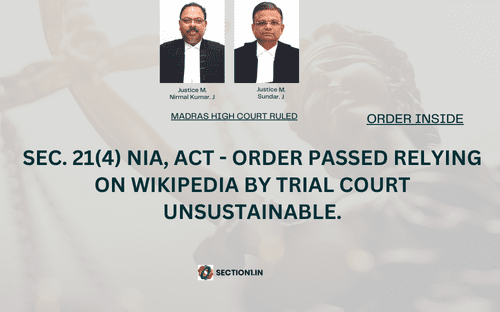
Previous Article S. 21(4) NIA, Act: Order passed relying on Wikipedia by court unsustainable
Next Article Section 11 Evidence Act: Appreciation of plea of alibi
Leave a Comment

Leave a Reply Cancel reply

Your email address will not be published. Required fields are marked *

Popular Study

bail

Accused were permitted to leave the court without any formal order of release or even without taking a bond under section 88 of the Code

Ramprakash Rajagopal September 30, 2025
Accused is armed and the deceased is unarmed hence exception 2 (private defence) to section 300 IPC not applicable
The Sessions Court has no power to sentence the accused to life without remission
Legal Drafting-1: The Grammar Toolbox: How to Use ‘Would,’ ‘Should,’ and ‘Could’ Correctly
POCSO: Victim’s contradictory statements cannot form the basis for quashing criminal proceedings but Trial court must careful on misusing this Act

Related Study

Section 313 Cr.P.C: If the defence provided by the accused under section 313(1)(b) and the court did not considers it then the conviction does not stand
March 22, 2023
Dying declaration: Section304-B IPC – In dowry death cases prosecution has to prove the initial burden
April 16, 2023
Impact of non-examination of witnesses
April 13, 2023
Whether Judgments/orders uploaded in the court (judicial) website can be downloaded and presented for reference before authorities.?
January 10, 2025
Cancellation of bail: Cancelling the bail which granted by another single judge by examining the merits tantamount to judicial impropriety/indiscipline
February 24, 2024
Police summons under section 160 Cr.P.C cannot be sent against the accused
July 3, 2023
Section 319 Cr.P.C parameters explained
March 20, 2023
Section 45(1) PMLA: Bail: Special benefit for woman and when denying such benefit court is required to give specific reasons for denial
September 8, 2024
Class 3 – CRIMINAL PROCEEDINGS – GENERAL PROVISIONS – CRIMINAL COURT POWERS.
January 28, 2023
Timely Quash order
September 10, 2025

About

Section1.in is all about the legal updates in Criminal and Corporate Laws. This website also gives opportunity to publish your (readers/users) articles subject to the condition of being edited (only if necessary) by the team of Advocates. Kindly send your articles to paperpageindia@gmail.com or WhatsApp to +919361570190.
  • Quick Links
  • Team
  • Terms
  • Cancellation Policy
  • Privacy Policy
  • My Bookmarks
  • Founder

section1.in is powered by Paperpage.             A product of © Paperpage Internet Services. All Rights Reserved. 

Subscribe Newsletter for free

Subscribe to our newsletter to get judgments instantly!

Check your inbox or spam folder to confirm your subscription.

About

Section1.in is all about the legal updates in Criminal and Corporate Laws. This website also gives opportunity to publish your (readers/users) articles subject to the condition of being edited (only if necessary) by the team of Advocates. Kindly send your articles to paperpageindia@gmail.com or WhatsApp to +919361570190.
  • Quick Links
  • Team
  • Terms
  • Cancellation Policy
  • Privacy Policy
  • My Bookmarks
  • Founder

section1.in is powered by Paperpage.             A product of © Paperpage Internet Services. All Rights Reserved. 

Subscribe Newsletter for free

Subscribe to our newsletter to get judgments instantly!

Check your inbox or spam folder to confirm your subscription.

ஓர்ந்துகண் ணோடாது இறைபுரிந்து யார்மாட்டும் தேர்ந்துசெய் வஃதே முறை [541].

_திருவள்ளுவர்
Welcome Back!

Sign in to your account

Username or Email Address
Password

Lost your password?