
Sign In
Notification
Font ResizerAa
  • Latest
    • Supreme Court
    • Madras High Court
    • Madurai Bench
  • Quick Recall
    • Arms Act
    • BNSS
    • BNS
    • BSA
    • Evidence
    • Drugs Act
    • Cr.P.C
    • IPC
    • N.I.Act
    • PMLA
    • NDPS
    • Corruption Laws
    • General
    • Passports Act
    • Pocso
    • MCOP
    • Writ
  • Acquittal
    • S.C
    • Madras High Court
  • 3 judge bench
  • Resources
    • Notes
      • Cr.P.C 1973
      • Crimes
    • Articles
      • P.G.Rajagopal (Judge Rtd)
      • Ad. Ramprakash Rajagopal
      • Ad. Karunanithi
      • Ad. Ravindran Raghunathan
      • Ad. James Raja
      • Ad. M.S.Parthiban
      • Ad. Rajavel
      • Ad. Azhar Basha
      • Mr. Lokkeshvaran
      • Prasath
    • Digest
      • Monthly Digest
      • Weekly digest
      • Subject wise
    • Bare Acts
      • BSA 2023
      • BNS 2023
      • BNSS 2023
    • Legal Drafting
  • Must Read
  • Author’s note
  • E-Booklet
    • Legal words
  • About
    • Terms
    • Privacy policy
    • Cancellation & Refund Policy
    • Team
  • Civil
    • s. 91 cpc
  • My Bookmarks
Reading: Protest petition: Even in a case where the final report of the police under section 173 crpc is accepted and the accused persons are discharged the magistrate has the power to take cognizance of the offence on a complaint or a protest petition on the same or similar allegations
Share
Font ResizerAa
  • Latest
  • Acquittal
  • Digest
  • Resources
Search
  • Latest
    • Madras High Court
    • Madurai Bench
    • Supreme Court
  • Quick Recall
    • Evidence
    • Cr.P.C
    • IPC
    • N.I.Act
    • Pocso
    • PMLA
    • NDPS
    • Corruption Laws
    • General
    • Passports Act
  • Acquittal
    • S.C
    • Madras High Court
  • Digest
    • Monthly Digest
    • Weekly digest
  • Resources
    • Notes
    • Articles
  • 3 judge bench
  • Must have
  • Author’S Note
  • E-Booklet
  • Legal words
  • About
    • Terms
    • Privacy policy
    • Cancellation & Refund Policy
    • Team
  • Mobile APP
  • My Bookmarks

Get Notifications

Notification
Follow US
> Quick Recall> Cr.P.C> Protest petition: Even in a case where the final report of the police under section 173 crpc is accepted and the accused persons are discharged the magistrate has the power to take cognizance of the offence on a complaint or a protest petition on the same or similar allegations

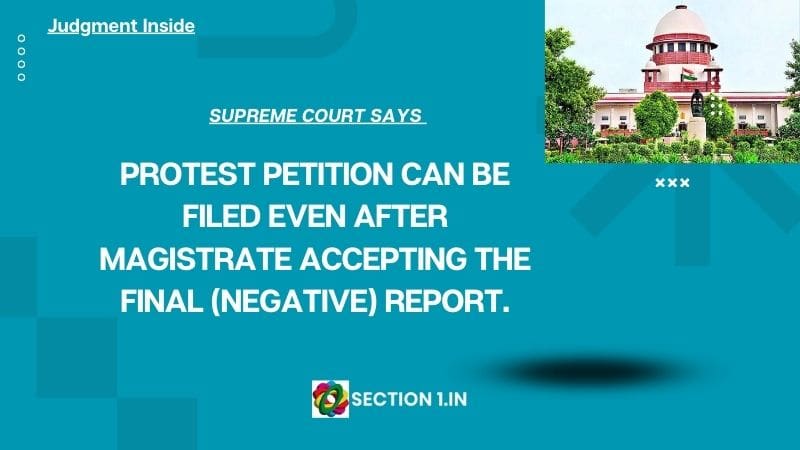
Protest petition: Even in a case where the final report of the police under section 173 crpc is accepted and the accused persons are discharged the magistrate has the power to take cognizance of the offence on a complaint or a protest petition on the same or similar allegations

Protest petition: Even in a case where the final report of the police under section 173 crpc is accepted and the accused persons are discharged the magistrate has the power to take cognizance of the offence on a complaint or a protest petition on the same or similar allegations.
Ramprakash Rajagopal September 12, 2023 8 Min Read
Share
SLP ground
  1. The two appeals arise out of the orders passed by the High Court of Judicature at Allahabad in the Application No.14899/2022 filed by the respondents-accused under Section 482 of the Code of Criminal Procedure, 1973 (for short, ‘Cr.P.C.’). These two appeals have been filed by the appellant-complainant challenging the order dated 21.07.2022 by which the High Court had granted the prayer made by the respondents-accused to amend the application filed under Section 482 Cr.P.C. and challenging the order dated 22.07.2022 by which the High Court has set aside the orders dated 15.11.2018 and dated 11.01.2022 passed by the Chief Judicial Magistrate (for short, ‘CJM’) in Misc. Case No.06/11/2018 arising 2 out of Case Crime No.907/2017. The High Court vide the impugned order further directed the concerned Magistrate to pass a fresh order on the Protest Petition filed by the appellant-complainant in the light of observations made by it in the impugned order.

XXX

  1. The High Court while passing the impugned order, observed as under: –

“20. When the findings recorded by concerned Magistrate as noted above, are examined in the light of the observations contained in paragraph 28 of the judgement in Hari Ram (supra) do not fulfill the mandate of law which the Magistrate is required to comply while exercising jurisdiction under Section 190 (1) (b) Cr.P.C. No finding has been recorded by concerned Magistrate with regard to the papers accompanying the police report. Without recording any finding that there is no evidence against applicants in the papers accompanying police report, the conclusion drawn by Magistrate to treat the protest petition as a complaint is not only illegal, but also arbitrary. Once the Magistrate came to 4 prima facie conclusion that investigation of concerned case crime number is unsatisfactory or is the outcome of lackadaisical approach of investigating Officer, then in that eventuality, concerned Magistrate ought to have directed further investigation in the matter. The findings recorded by concerned Magistrate in support of his conclusion to treat the protest petition as a complaint are by themselves insufficient to proceed with the protest petition as a complaint.”
9. In our opinion, the above observations recorded by the High Court are absolutely erroneous in view of the catena of decisions of this Court. 10. In Rakesh & Another Vs. State of Uttar Pradesh & Another1, it is observed as under: –
“…………………..”

XXX

11. In view of the above, there remains no shadow of doubt that on the receipt of the police report under Section 173 Cr.P.C., the Magistrate can exercise three options. Firstly, he may decide that there is no sufficient ground for proceeding further and drop action. Secondly, he may take cognizance of the offence under Section 190(1)(b) on the basis of the police report and issue process; and thirdly, he may take cognizance of the offence under Section 190(1)(a) on the basis of the original complaint and proceed to examine upon oath the complainant and his witnesses under Section 200. It may be noted that even in a case where the final report of the police under Section 173 is accepted and the accused persons are discharged, the Magistrate has the power to take cognizance of the offence on a complaint or a Protest Petition on the same or similar allegations even after the acceptance of the final report. As held by this Court in Gopal Vijay Verma Vs. Bhuneshwar Prasad Sinha and Others [(1982) 3 SCC 510], as followed in B. Chandrika Vs. Santhosh and Another [(2014) 13 SCC 699], a Magistrate is not debarred from taking cognizance of a complaint merely on the ground that earlier he had declined to take cognizance of the police report. No doubt a Magistrate while exercising his judicial discretion has to apply his mind to the contents of the Protest Petition or the complaint as the case may be.


  1. So far as the facts of the present case are concerned, the concerned CJM vide the detailed order passed on 15.11.2018 had rejected the final report submitted by the Investigating Officer and had accepted the Protest Petition, and decided to proceed further under Section 200 Cr.P.C. Such a course opted by the CJM was absolutely just, legal and proper in the facts and circumstances of the case. The said order dated 15.11.2018 remained unchallenged at the instance of the respondents-accused. It was only when the concerned CJM after recording the statements of the complainant and eight witnesses, issued summons on 11.01.2022, the respondents filed the application challenging the said order dated 11.01.2022 under Section 482 before the High Court, and in the said application, the order dated 15.11.2018 came to be challenged by way of amendment. As such, the High Court should not have permitted the respondents-accused to amend the Application for challenging the order dated 15.11.2018 after about four years of its passing, and in any case should not have interfered with the discretion exercised by the CJM within the four corners of law. The discretionary order of 11.01.2022 passed by the concerned CJM issuing summons to the accused, after recording statements of the complainant and the eight witnesses and after recording prima facie satisfaction about the commission of the alleged crime, also did not warrant any interference by the High Court. In our opinion, the High Court has committed gross error in setting aside the orders dated 15.11.2018 and 11.01.2022 passed by the CJM.

  2. In that view of the matter the impugned orders passed by the High Court being highly erroneous, the same are quashed and set aside. The concerned CJM is directed to proceed with the complaint case in accordance with law. It shall be open for the respondents accused to respond to the summons and appear before the concerned CJM within two weeks.

Party

ZUNAID vs. STATE OF U.P. & ORS – CRIMINAL APPEAL NOS.2628-2629 OF 2023 (@ SLP(CRL.) Nos.8506-8507/2022) – 29TH AUGUST, 2023.

https://main.sci.gov.in/supremecourt/2022/25678/25678_2022_15_29_46563_Judgement_29-Aug-2023.pdf
ZUNAID VS. STATE OF U.P

Further Study

Magistrate can allow power of attorney to maintain complaint

Section 173(2) Cr.P.C: Investigation agency has no obligation to file the charge sheet/reports in the language of the court

Courts are not powerless they may permit amendments to the complaint even after cognizance has been taken

Whether protest petition is ‘complaint’? Yes

Magistrate has no power to direct the investigating authority to file additional charge sheet

TAGGED:complaintfinal reportnegative reportpetitionprotestprotest petitionwhen protest petition can be filed
Previous Article Section 193 Cr.P.C – Why a sessions court cannot take cognizance of an offence even though such an offence exclusively triable by that court? Explain the exceptions to same with illustrations?
Next Article Scope and applicability of section357(2) Cr.P.C
Leave a Comment

Leave a Reply Cancel reply

Your email address will not be published. Required fields are marked *

Popular Study

sudden provocation

Since no provocation nor blow stuck by mistake or accident section 300 Exception- 1 would not attract

Ramprakash Rajagopal October 19, 2025
Murder caes: Acquittal: One witness did not mentioned other witnesses at the SOC
Abatement: If a particular proceeding shall be instituted and prosecuted by a particular person only then on his death the proceeding would abate
Neither the State nor the Victim nor the Complainant had sought enhancement in appeal but the High Court converted the sentence into a conviction of the accused in a suo-motu revision is illegal
Quash: NI Act: If the notice amount is different from the cheque amount then cheque proceedings are bad in law and the defence of typographical error is irrelevant

Related Study

Suspension of sentence: Extension of time
January 12, 2023
S. 138 N.I Act would note attract if the part payment made before encashment of the cheque issued for the original amount
March 3, 2025
Culpable homicide not amounting to murder: Accused was a young man and was overcome by emotion which led him to physical attack of the deceased further there was only a stab wound on the stomach
September 21, 2024
Reversal of Acquittal: Appellate court cannot reverse the acquittal on fresh appreciation of evidence and without recording any illegality error of law or of fact in the Trial court judgment
October 17, 2024
Section 27 Evidence Act: There cannot be a ‘discovery’ of an already discovered fact and the discovery should be a distinct fact from the facts already discovered
May 9, 2023
Extra-Judicial confession: VAO is total stranger and no necessity for the accused to trust him to confess
November 8, 2024
Entire Evidence Act explained in single judgment
February 6, 2023
Section 145 Evidence Act: No court should allow a witness to be contradicted by reference to the previous statement in writing or reduced to writing unless the the procedure set out in section145 of the Evidence Act
September 16, 2023
Deprecated practice involving the relatives of husband for offence under section 498A IPC and section 4 of Dowry Prohibition Act, 1961
April 25, 2025
Juvenile Justice act: Issue of Juvenility can be claimed even before the Hon’ble Supreme court
January 23, 2024

About

Section1.in is all about the legal updates in Criminal and Corporate Laws. This website also gives opportunity to publish your (readers/users) articles subject to the condition of being edited (only if necessary) by the team of Advocates. Kindly send your articles to paperpageindia@gmail.com or WhatsApp to +919361570190.
  • Quick Links
  • Team
  • Terms
  • Cancellation Policy
  • Privacy Policy
  • My Bookmarks
  • Founder

section1.in is powered by Paperpage.             A product of © Paperpage Internet Services. All Rights Reserved. 

Subscribe Newsletter for free

Subscribe to our newsletter to get judgments instantly!

Check your inbox or spam folder to confirm your subscription.

About

Section1.in is all about the legal updates in Criminal and Corporate Laws. This website also gives opportunity to publish your (readers/users) articles subject to the condition of being edited (only if necessary) by the team of Advocates. Kindly send your articles to paperpageindia@gmail.com or WhatsApp to +919361570190.
  • Quick Links
  • Team
  • Terms
  • Cancellation Policy
  • Privacy Policy
  • My Bookmarks
  • Founder

section1.in is powered by Paperpage.             A product of © Paperpage Internet Services. All Rights Reserved. 

Subscribe Newsletter for free

Subscribe to our newsletter to get judgments instantly!

Check your inbox or spam folder to confirm your subscription.

ஓர்ந்துகண் ணோடாது இறைபுரிந்து யார்மாட்டும் தேர்ந்துசெய் வஃதே முறை [541].

_திருவள்ளுவர்
Welcome Back!

Sign in to your account

Username or Email Address
Password

Lost your password?