Sign In
Notification
Font ResizerAa
  • Latest
    • Supreme Court
    • Madras High Court
    • Madurai Bench
  • Quick Recall
    • Arms Act
    • BNSS
    • BNS
    • BSA
    • Evidence
    • Drugs Act
    • Cr.P.C
    • IPC
    • N.I.Act
    • PMLA
    • NDPS
    • Corruption Laws
    • General
    • Passports Act
    • Pocso
    • MCOP
    • Writ
  • Acquittal
    • S.C
    • Madras High Court
  • 3 judge bench
  • Resources
    • Notes
      • Cr.P.C 1973
      • Crimes
    • Articles
      • P.G.Rajagopal (Judge Rtd)
      • Ad. Ramprakash Rajagopal
      • Ad. Karunanithi
      • Ad. Ravindran Raghunathan
      • Ad. James Raja
      • Ad. M.S.Parthiban
      • Ad. Rajavel
      • Ad. Azhar Basha
      • Mr. Lokkeshvaran
    • Digest
      • Monthly Digest
      • Weekly digest
      • Subject wise
    • Bare Acts
      • BSA 2023
      • BNS 2023
      • BNSS 2023
  • Must Read
  • Author’s note
  • E-Booklet
    • Legal words
  • About
    • Terms
    • Privacy policy
    • Cancellation & Refund Policy
    • Team
  • Civil
    • s. 91 cpc
  • My Bookmarks
Reading: Constitution bench on P.C Act: Question of law on absence of evidence of complainant/direct or primary evidence
Share
Font ResizerAa
  • Latest
  • Acquittal
  • Digest
  • Resources
Search
  • Latest
    • Madras High Court
    • Madurai Bench
    • Supreme Court
  • Quick Recall
    • Evidence
    • Cr.P.C
    • IPC
    • N.I.Act
    • Pocso
    • PMLA
    • NDPS
    • Corruption Laws
    • General
    • Passports Act
  • Acquittal
    • S.C
    • Madras High Court
  • Digest
    • Monthly Digest
    • Weekly digest
  • Resources
    • Notes
    • Articles
  • 3 judge bench
  • Must have
  • Author’S Note
  • E-Booklet
  • Legal words
  • About
    • Terms
    • Privacy policy
    • Cancellation & Refund Policy
    • Team
  • Mobile APP
  • My Bookmarks

Get Notifications

Notification
Follow US
> Quick Recall> Corruption Laws> Constitution bench on P.C Act: Question of law on absence of evidence of complainant/direct or primary evidence

Constitution bench on P.C Act: Question of law on absence of evidence of complainant/direct or primary evidence

Constitution bench on P.C Act: Question of law on absence of evidence of complainant/direct or primary evidence.
Ramprakash Rajagopal February 11, 2023 5 Min Read
Share
Question of law involved in this 5 judge bench

2. Thus, the moot question that arises for answering the reference is, in the absence of the complainant letting in direct evidence of demand owing to the non-availability of the complainant or owing to his death or other reason, whether the demand for illegal gratification could be established by other evidence. This is because in the absence of proof of demand, a legal presumption under Section 20 of the Prevention of Corruption Act, 1988 (for short ‘the Act’) would not arise. Thus, the proof of demand is a sine qua non for an offence to be established under Sections 7, 13(1)(d)(i) and (ii) of the Act and de hors the proof of demand the offence under the two sections cannot be brought home. Thus, mere acceptance of any amount allegedly by way of illegal gratification or recovery thereof in the absence of proof of demand would not be sufficient to bring home the charge under Sections 7, 13(1)(d)(i) and (ii) of the Act. Hence, the pertinent question is, as to how demand could be proved in the absence of any direct evidence being let in by the complainant owing to the complainant not supporting the complaint or turning “hostile” or the complainant not being available on account of his death or for any other reason. In this regard, it is necessary to discuss the relevant Sections of the Evidence Act before answering the question for reference.

Contents
Question of law involved in this 5 judge benchParty

xxx

70. Accordingly, the question referred for consideration of this Constitution Bench is answered as under:

In the absence of evidence of the complainant (direct/primary, oral/documentary evidence) it is permissible to draw an inferential deduction of culpability/guilt of a public servant under Section 7 and Section 13(1)(d) read with Section 13(2) of the Act based on other evidence adduced by the prosecution.

71. We direct that individual cases may be considered before the appropriate Bench after seeking orders of Hon’ble the Chief Justice of India.

Before we conclude, we hope and trust that the complainants as well as the prosecution make sincere efforts to ensure that the corrupt public servants are brought to book and convicted so that the administration and governance becomes unpolluted and free from corruption.

In this regard, we would like to reiterate what has been stated by this Court in Swatantar Singh vs. State of Haryana (1997) 4 SCC 14:

“6. ………..Corruption is corroding, like cancerous lymph nodes, the vital veins of the body politic, social fabric of efficiency in the public service and demoralising the honest officers. The efficiency in public service would improve only when the public servant devotes his sincere attention and does the duty diligently, truthfully, honestly and devotes himself assiduously to the performance of the duties of his post. The reputation of corruption would gather thick and unchaseable clouds around the conduct of the officer and gain notoriety much faster than the smoke”.

The above has been reiterated in A.B. Bhaskara Rao vs. CBI (2011) 10 SCC 259 by quoting as under from the case of State of M.P. vs. Shambhu Dayal (2006) 8 SCC 693:

“32. It is difficult to accept the prayer of the respondent that a lenient view be taken in this case. The corruption by public servants has become a gigantic problem. It has spread everywhere. No facet of public activity has been left unaffected by the stink of corruption. It has deep and pervasive impact on the functioning of the entire country. Large-scale corruption retards the nation-building activities and everyone has to suffer on that count.”

We place on record our appreciation of all learned senior counsel as well as counsel and instructing counsel including learned ASGs who have assisted the Court.

Party

NEERAJ DUTTA vs. STATE (GOVT. OF N.C.T. OF DELHI) – CRIMINAL APPEAL NO. 1669 OF 2009 – 15 DECEMBER, 2022.

https://main.sci.gov.in/supremecourt/2009/11311/11311_2009_3_1501_40650_Judgement_15-Dec-2022.pdf

Neeraj Dutta vs. State PC-Act-judgment-5-judgesurce:


Further Study

Quashing FIR based on settlement in special statute like PC Act would impact the society at large 

An offence under section 13(1)(e) PC Act can be abetted by any other person who is a non-public servant

PC Act: FIR quash: High Court would not have entered into the observation that there is no direct evidence for the demand for bribe

P.C Act: Reduced the sentence of appellant already underwent imprisonment for 31 years

PMLA & PC Act: Prosecuting the person accused of an offence under Section 13(1)(e) of the PC Act as well as for an offence under Section 3 of PMLA would not amount to double jeopardy

TAGGED:pc actquestion of law
Previous Article Who can file complaint for company under section 142 N.I ACT? Explained
Next Article Bail: No interim compensation
Leave a Comment

Leave a Reply Cancel reply

Your email address will not be published. Required fields are marked *

Popular Study

section 451

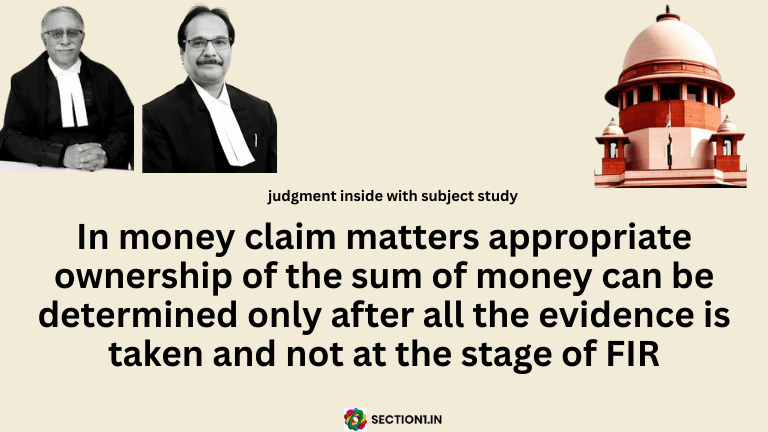
In money claim matters appropriate ownership of the sum of money can be determined only after all the evidence is taken and not at the stage of FIR

Ramprakash Rajagopal September 20, 2025
Unless there is irregularity in funding from international sources either U.P Act or IPC do not prohibit gatherings or doing charity work in the name of religion
Informer (unidentified informant) not examined before the court nor his statement was reduced hence accused aquitted
High court could have saved 6 years worth of time to decide the Criminal Revision in cruelty case
Timely Quash order

Related Study

Section 306 IPC: The act of instigation must be of such intensity to drive deceased to commit suicide
December 3, 2023
Running an impugned Finance company is not a ground to label the owner as a Notorious Goonda
June 7, 2025
Evidentiary value of extrajudicial confession: explained
March 15, 2023
Section 154 Cr.P.C: Police has no other option except to register fir if cognizable offence found and magistrate must direct investigation if cognizable offence found in the complaint
February 22, 2025
Affidavit – Magistrate cannot take proof affidavit except N.I Act
March 28, 2023
Procedure: Magistrates shall not return the final reports
January 5, 2024
Neither the State nor the Victim nor the Complainant had sought enhancement in appeal but the High Court converted the sentence into a conviction of the accused in a suo-motu revision is illegal
December 25, 2025
NDPS Act: Mere owner of the vehicle carrying contraband shall not be an accused
April 26, 2023
Hit & run cases: Closing of final reports: Mere non filing and closing of final reports under section 468 Cr.P.C is an acquittal of an offender by the police themselves without reference to the court
November 9, 2024
N.I Act: Knowledge of Power of Attorney of an individual payee must be specifically stated and in the case of company being a payee the authorised person who has knowledge would be sufficient
June 5, 2025

About

Section1.in is all about the legal updates in Criminal and Corporate Laws. This website also gives opportunity to publish your (readers/users) articles subject to the condition of being edited (only if necessary) by the team of Advocates. Kindly send your articles to paperpageindia@gmail.com or WhatsApp to +919361570190.
  • Quick Links
  • Team
  • Terms
  • Cancellation Policy
  • Privacy Policy
  • My Bookmarks
  • Founder

section1.in is powered by Paperpage.             A product of © Paperpage Internet Services. All Rights Reserved. 

Subscribe Newsletter for free

Subscribe to our newsletter to get judgments instantly!

Check your inbox or spam folder to confirm your subscription.

About

Section1.in is all about the legal updates in Criminal and Corporate Laws. This website also gives opportunity to publish your (readers/users) articles subject to the condition of being edited (only if necessary) by the team of Advocates. Kindly send your articles to paperpageindia@gmail.com or WhatsApp to +919361570190.
  • Quick Links
  • Team
  • Terms
  • Cancellation Policy
  • Privacy Policy
  • My Bookmarks
  • Founder

section1.in is powered by Paperpage.             A product of © Paperpage Internet Services. All Rights Reserved. 

Subscribe Newsletter for free

Subscribe to our newsletter to get judgments instantly!

Check your inbox or spam folder to confirm your subscription.

ஓர்ந்துகண் ணோடாது இறைபுரிந்து யார்மாட்டும் தேர்ந்துசெய் வஃதே முறை [541].

_திருவள்ளுவர்
Welcome Back!

Sign in to your account

Username or Email Address
Password

Lost your password?