
Sign In
Notification
Font ResizerAa
  • Latest
    • Supreme Court
    • Madras High Court
    • Madurai Bench
  • Quick Recall
    • Arms Act
    • BNSS
    • BNS
    • BSA
    • Evidence
    • Drugs Act
    • Cr.P.C
    • IPC
    • N.I.Act
    • PMLA
    • NDPS
    • Corruption Laws
    • General
    • Passports Act
    • Pocso
    • MCOP
    • Writ
  • Acquittal
    • S.C
    • Madras High Court
  • 3 judge bench
  • Resources
    • Notes
      • Cr.P.C 1973
      • Crimes
    • Articles
      • P.G.Rajagopal (Judge Rtd)
      • Ad. Ramprakash Rajagopal
      • Ad. Karunanithi
      • Ad. Ravindran Raghunathan
      • Ad. James Raja
      • Ad. M.S.Parthiban
      • Ad. Rajavel
      • Ad. Azhar Basha
      • Mr. Lokkeshvaran
      • Prasath
    • Digest
      • Monthly Digest
      • Weekly digest
      • Subject wise
    • Bare Acts
      • BSA 2023
      • BNS 2023
      • BNSS 2023
    • Legal Drafting
  • Must Read
  • Author’s note
  • E-Booklet
    • Legal words
  • About
    • Terms
    • Privacy policy
    • Cancellation & Refund Policy
    • Team
  • Civil
    • s. 91 cpc
  • My Bookmarks
Reading: Section 498A IPC: Cruelty case: Court must be careful and curtail the tendency of implicating husband and his immediate relations in complaint which is not uncommon also high court has power to quash the fir even after filing of charge sheet
Share
Font ResizerAa
  • Latest
  • Acquittal
  • Digest
  • Resources
Search
  • Latest
    • Madras High Court
    • Madurai Bench
    • Supreme Court
  • Quick Recall
    • Evidence
    • Cr.P.C
    • IPC
    • N.I.Act
    • Pocso
    • PMLA
    • NDPS
    • Corruption Laws
    • General
    • Passports Act
  • Acquittal
    • S.C
    • Madras High Court
  • Digest
    • Monthly Digest
    • Weekly digest
  • Resources
    • Notes
    • Articles
  • 3 judge bench
  • Must have
  • Author’S Note
  • E-Booklet
  • Legal words
  • About
    • Terms
    • Privacy policy
    • Cancellation & Refund Policy
    • Team
  • Mobile APP
  • My Bookmarks

Get Notifications

Notification
Follow US
> Quick Recall> Cr.P.C> Section 498A IPC: Cruelty case: Court must be careful and curtail the tendency of implicating husband and his immediate relations in complaint which is not uncommon also high court has power to quash the fir even after filing of charge sheet

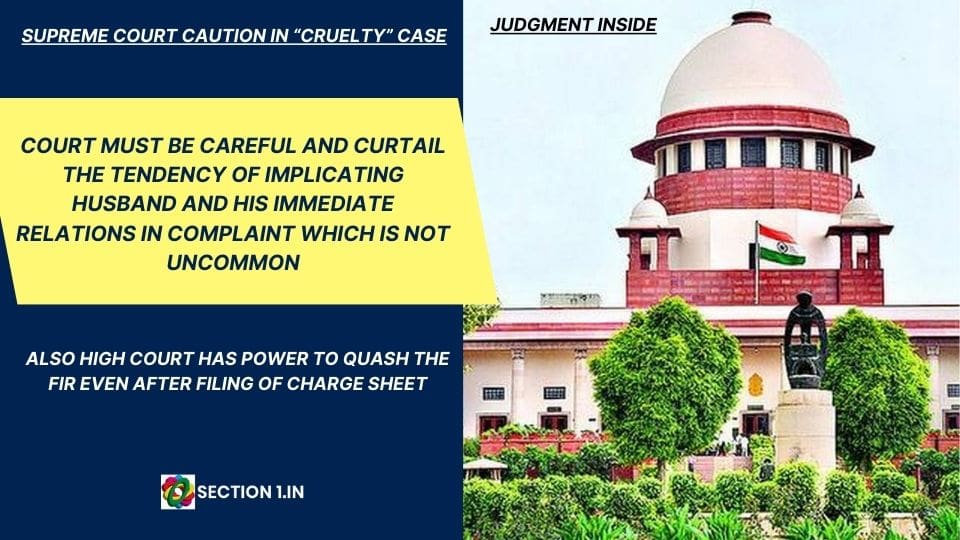
Section 498A IPC: Cruelty case: Court must be careful and curtail the tendency of implicating husband and his immediate relations in complaint which is not uncommon also high court has power to quash the fir even after filing of charge sheet

Section 498A IPC: CRUELTY CASE: Court must be careful and curtail the tendency of implicating husband and his immediate relations in complaint which is not uncommon also high court has power to quash the fir even after filing of charge sheet.
Ramprakash Rajagopal September 2, 2023 6 Min Read
Share
High court has power to quash the fir even after filing of charge sheet

11. This being the factual backdrop, we may note at the very outset that the contention that the appellants’ quash petition against the FIR was liable to be dismissed, in any event, as the chargesheet in relation thereto was submitted before the Court and taken on file, needs mention only to be rejected. It is well settled that the High Court would continue to have the power to entertain and act upon a petition filed under Section 482 Cr.P.C. to quash the FIR even when a chargesheet is filed by the police during the pendency of such petition [See Joseph Salvaraj A. vs. State of Gujarat and others {(2011) 7 SCC 59}]. This principle was reiterated in Anand Kumar Mohatta and another vs. State (NCT of Delhi), Department of Home and another [(2019) 11 SCC 706]. This issue, therefore, needs no further elucidation on our part.

Contents
High court has power to quash the fir even after filing of charge sheetIt is impermissible for the high court to appreciate facts in the allegation sin the complaintCourt must be careful to curtail the tendency to implicate the husband and his immediate relations in compliant which is not uncommonWhat to be mentioned in the complaint?15. Earlier, in Neelu Chopra and another vs. Bharti , this Court observed that the mere mention of statutory provisions and the language thereof, for lodging a complaint, is not the ‘be all and end all’ of the matter, as what is required to be brought to the notice of the Court is the particulars of the offence committed by each and every accused and the role played by each and every accused in the commission of that offence. These observations were made in the context of a matrimonial dispute involving Section 498A IPC.Party
It is impermissible for the high court to appreciate facts in the allegation sin the complaint

12. The contours of the power to quash criminal proceedings under Section 482 Cr.P.C. are well defined. In V. Ravi Kumar vs. State represented by Inspector of Police, District Crime Branch, Salem, Tamil Nadu and others [(2019) 14 SCC 568], this Court affirmed that where an accused seeks quashing of the FIR, invoking the inherent jurisdiction of the High Court, it is wholly impermissible for the High Court to enter into the factual arena to adjudge the correctness of the allegations in the complaint. In M/s. Neeharika Infrastructure (P). Ltd. vs. State of Maharashtra and others [Criminal Appeal No.330 of 2021, decided on 13.04.2021], a 3-Judge Bench of this Court elaborately considered the scope and extent of the power under Section 482 Cr.P.C. It was observed that the power of quashing should be exercised sparingly, with circumspection and in the rarest of rare cases, such standard not being confused with the norm formulated in the context of the death penalty. It was further observed that while examining the FIR/complaint, quashing of which is sought, the Court cannot embark upon an enquiry as to the reliability or genuineness or otherwise of the allegations made therein, but if the Court thinks fit, regard being had to the parameters of quashing and the self-restraint imposed by law, and more particularly, the parameters laid down by this Court in R.P. Kapur vs. State of Punjab (AIR 1960 SC 866) and State of Haryana and others vs. Bhajan Lal and others [(1992) Supp (1) SCC 335], the Court would have jurisdiction to quash the FIR/complaint.

Court must be careful to curtail the tendency to implicate the husband and his immediate relations in compliant which is not uncommon

In Preeti Gupta and another vs. State of Jharkhand and another [(2010) 7 SCC 667], this Court noted that the tendency to implicate the husband and all his immediate relations is also not uncommon in complaints filed under Section 498A IPC. It was observed that the Courts have to be extremely careful and cautious in dealing with these complaints and must take pragmatic realities into consideration while dealing with matrimonial cases, as allegations of harassment by husband’s close relations, who were living in different cities and never visited or rarely visited the place where the complainant resided, would add an entirely different complexion and such allegations would have to be scrutinised with great care and circumspection.

What to be mentioned in the complaint?
15. Earlier, in Neelu Chopra and another vs. Bharti [(2009) 10 SCC 184], this Court observed that the mere mention of statutory provisions and the language thereof, for lodging a complaint, is not the ‘be all and end all’ of the matter, as what is required to be brought to the notice of the Court is the particulars of the offence committed by each and every accused and the role played by each and every accused in the commission of that offence. These observations were made in the context of a matrimonial dispute involving Section 498A IPC.

xxx

22. Given the totality of the facts and circumstances, we are of the considered opinion that Bhawna’s allegations against the appellants, such as they are, are wholly insufficient and, prima facie, do not make out a case against them. Further, they are so farfetched and improbable that no prudent person can conclude that there are sufficient grounds to proceed against them. In effect, the case on hand falls squarely in categories (1) and (5) set out in Bhajan Lal (supra). Permitting the criminal process to go on against the appellants in such a situation would, therefore, result in clear and patent injustice. This was a fit case for the High Court to exercise its inherent power under Section 482 Cr.P.C. to quash the FIR and the consequential proceedings.

Party

Abhishek vs. State of Madhya Pradesh – Criminal Appeal No. 1457 of 2015 – August 31, 2023 – 3 Judge Bench.

https://main.sci.gov.in/supremecourt/2015/23238/23238_2015_3_1501_46679_Judgement_31-Aug-2023.pdf

Abhishek vs. State of M.P 23238_2015_3_1501_46679_Judgement_31-Aug-2023

Further Study

High court could have saved 6 years worth of time to decide the Criminal Revision in cruelty case

Cruelty or harassment not proved by the prosecution

Quash: Cheating: Since the complainant’s filing of the FIR appears to be an attempt to misuse criminal law accused acquitted

Second marriage by a Muslim man during the subsistence of the first marriage is an act of domestic violence and the Wife is entitled to compensation under DV Act

Dowry death: Demand is for celebrating birth of male child and not for marriage further difference between admissibility and acceptability/reliability is explained

TAGGED:allegations in complaintcomplaint and allegationcrueltycruelty false casefalse casefalse case crueltyfir quashfir quash even after charge sheet filedquashing fir
Previous Article Section 323 Cr.P.C/ 362 BNSS: Trial court can commit the case once the chief-examination itself is over and not to wait till cross-examination Section 323 Cr.P.C/ 362 BNSS: Trial court can commit the case once the chief-examination itself is over and not to wait till cross-examination
Next Article Duty of the court to give a reasonable time to the advocate appointed to go through the file and get ready to assist the court
Leave a Comment

Leave a Reply Cancel reply

Your email address will not be published. Required fields are marked *

Popular Study

defamation

The Chilling Effect: How India’s Criminal Defamation Laws and Legal Roadblocks Hinder People’s Access to Justice, Compared to the U.S. ‘Actual Malice’ Standard That Protects Free Speech in Today’s Digital World

Reshma Azath December 4, 2025
Types of conduct of witnesses is explained in detail
Abatement: If a particular proceeding shall be instituted and prosecuted by a particular person only then on his death the proceeding would abate
Criminal court has no power to recall or review its own judgment except to correct or rectify clerical errors by virtue of Section 403 BNSS (section 362 Cr.P.C)
Legal Drafting -2: Defining Legal Drafting (A short overview)

Related Study

Magistrate ordinarily would not entertain application u/s 156(3) Cr.P.C without first approached the police authorities but he can direct investigation u/s 156(3) Cr.P.C if the complaint discloses cognizable offence
July 29, 2025
Dismissal of petition under section 319 Cr.P.C
March 3, 2023
Police summons under section 160 Cr.P.C cannot be sent against the accused
July 3, 2023
Objection shall be decided then and there
February 7, 2023
Quash: Cheating: In order to constitute an offence of cheating, the intention to cheat must be available from the inception
January 24, 2024
Section 313 Cr.P.C: Rape case: The stand taken by the accused that they have paid money for sexual intercourse was not put in the cross-examination of victim
May 16, 2024
Section 299 IPC: Culpable homicide explained
July 23, 2023
In economic offences affecting large number of people court may impose strict and additional conditions for bail and Anticipatory bail
November 5, 2025
Culpable homicide not amounting to murder: Accused was a young man and was overcome by emotion which led him to physical attack of the deceased further there was only a stab wound on the stomach
September 21, 2024
Magistrate can allow power of attorney to maintain complaint
May 18, 2023

About

Section1.in is all about the legal updates in Criminal and Corporate Laws. This website also gives opportunity to publish your (readers/users) articles subject to the condition of being edited (only if necessary) by the team of Advocates. Kindly send your articles to paperpageindia@gmail.com or WhatsApp to +919361570190.
  • Quick Links
  • Team
  • Terms
  • Cancellation Policy
  • Privacy Policy
  • My Bookmarks
  • Founder

section1.in is powered by Paperpage.             A product of © Paperpage Internet Services. All Rights Reserved. 

Subscribe Newsletter for free

Subscribe to our newsletter to get judgments instantly!

Check your inbox or spam folder to confirm your subscription.

About

Section1.in is all about the legal updates in Criminal and Corporate Laws. This website also gives opportunity to publish your (readers/users) articles subject to the condition of being edited (only if necessary) by the team of Advocates. Kindly send your articles to paperpageindia@gmail.com or WhatsApp to +919361570190.
  • Quick Links
  • Team
  • Terms
  • Cancellation Policy
  • Privacy Policy
  • My Bookmarks
  • Founder

section1.in is powered by Paperpage.             A product of © Paperpage Internet Services. All Rights Reserved. 

Subscribe Newsletter for free

Subscribe to our newsletter to get judgments instantly!

Check your inbox or spam folder to confirm your subscription.

ஓர்ந்துகண் ணோடாது இறைபுரிந்து யார்மாட்டும் தேர்ந்துசெய் வஃதே முறை [541].

_திருவள்ளுவர்
Welcome Back!

Sign in to your account

Username or Email Address
Password

Lost your password?