
Appeal and Impugned Order
The present criminal appeal is filed by V. Balakrishnan (Accused No. 1), the sole appellant, against the respondent, the State represented by the Deputy Superintendent of Police, challenging the concurrent impugned judgments of the Trial Court and the High Court that had previously convicted him and affirmed the sentence imposed for alleged corruption and cheating. [Paragraph 1].
Factual Matrix
The genesis of the criminal case traces back to 1991 when the appellant was serving as the Branch Manager of the Indian Bank’s Anna Nagar Branch, where the prosecution alleged he entered into a criminal conspiracy with a retired bank officer (A2) to fraudulently sanction loans to the latter’s domestic workers (A4 and A5). The prosecution asserted that the appellant grossly inflated property valuations through a bank appraiser (A3) and improperly disbursed the loan amounts by way of cheques that were allegedly accepted and endorsed by A2, leading to the framing of charges under Section 420 read with Section 120B of the Indian Penal Code, 1860, and Section 13(2) read with Section 13(1)(d) of the Prevention of Corruption Act, 1988. [Paragraphs 3, 4, 11].
Trial Court and Appellate Courts Verdicts
The Trial Court recorded a verdict of conviction against the appellant, accepting the prosecution’s narrative that he abused his official position to facilitate the fraudulent loan transactions and cause wrongful loss to the bank; this conviction, along with the corresponding sentence, was subsequently upheld in its entirety by the High Court in the impugned appellate order. [Paragraph 1].
Core Legal Arguments and Ratio Decidendi
The appellant’s counsel contended that the loans were duly authorized by higher regional authorities and that the bank suffered no wrongful loss since all dues were fully satisfied through subsequent property auctions with a massive surplus, whereas the prosecution maintained that the transactions were inherently fraudulent and based on inflated valuations. The Supreme Court established its Ratio Decidendi by ruling that a conviction for criminal misconduct and conspiracy cannot be sustained on fabricated or materially deficient evidence, holding specifically that the prosecution’s failure to produce contemporaneous valuation deeds to prove overvaluation at the time of sanction and its inability to authenticate the signatures of the co-accused on the disbursed cheques completely vitiated the evidentiary basis of the charges, thereby entitling the appellant to a clean acquittal. [Paragraphs 2, 6, 12].
Important Judgments
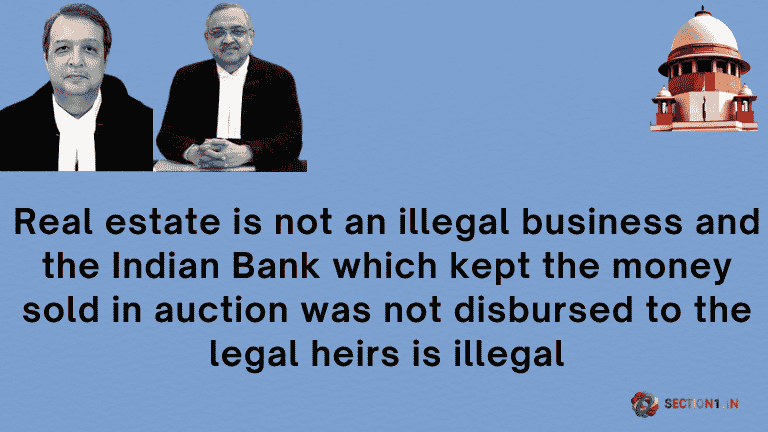
19. We are clear in our minds that the prosecution case set up is fabricated and has no legs to stand. That A1 had sanctioned loans to A4 and A5, has been proved. It is also coming out from the testimonies of the official witnesses, PW1 and PW2 that the loans were sanctioned by the Regional Office itself. Properties mortgaged were proceeded against and sold in auction, the proceeds of which satisfied the loan availed and left much more with the bank. A2 is said to have purchased a number of properties or acted as a middleman, in the name of A4 and A5 or by himself, but that does not prove the prosecution case as against A1, nor can any case lie against A2, A4 and A5. There is also no incriminating circumstance brought out as against A3 too. Real estate business is not an illegal activity and there can be no charge even against A2 on such specious evidence led at the trial. The mere statements made by the witnesses as to A2 having purchased the properties, if contrary to the name of the purchasers revealed from the deeds, makes such testimony inconsequential and irrelevant. That, A4 & A5 were domestic helps of A2, that the loans sanctioned were in fact appropriated by A2, that the mortgaged properties were overvalued, that A1 sanctioned the loans illegally are all just figments of imagination. The CBI has failed miserably in not only proving its case but also in framing the case.
20. We find absolutely no reason to sustain the conviction of the accused and set aside both the orders of the Trial Court and the High Court. The accused, if in custody, shall be released forthwith, if not required in any other case and if the accused is already released on bail, the bail bonds shall stand cancelled.
21. We make it clear that we have granted a clean acquittal to A1 from the allegations set up by the prosecution.
22. Before we leave the matter, we are concerned as to how the Indian Bank kept the excess money in auction received by them, without disbursal to the legal heirs, even if the predecessors-in-interest were arrayed as accused in this case.
23. Having found the case to be fully fabricated, we call for a report from the Branch Manager, Indian Bank, Anna Nagar Branch, who is impleaded herein as a respondent with regard to the loan accounts which are the subject matter of this case booked by the CBI and the satisfaction of the same as also utilisation of the money received on auction sale of the mortgaged properties. The title deeds of the properties mortgaged shall also be produced before us. The Branch Manager, Indian Bank, Annanagar Branch shall be issued a copy of this judgment by the Registry of this Court and directed to comply with the directions herein.
24. The case, though, disposed of, shall be posted only for the purpose of ascertaining the status of the excess money received on auction and to ensure the due disbursal of the same. We direct the Registry of this Court not to return the records of the case until further orders.
Acts and Sections Mentioned
- Indian Penal Code, 1860: Section 420 (Cheating) and Section 120B (Criminal Conspiracy) [cite: 1.1.1].
- Prevention of Corruption Act, 1988: Section 13(2) read with Section 13(1)(d) (Criminal misconduct by a public servant) [cite: 1.1.1].
Party
V. Balakrishnan vs. The State Represented by the Deputy Superintendent of Police - Criminal Appeal No. 2460 of 2026 - 2026 INSC 936 - September 1, 2026 – Hon’ble Mr. Justice J.B. Pardiwala and Hon’ble Mr. Justice K. Vinod Chandran.