
Appeal
Allegations pertaining to bomb blast occurred inside a Rajasthan Roadways
3.5. The factual matrix of the present case, challenges the above principles to the hilt. The allegations pertain to a devastating bomb blast that occurred inside a Rajasthan Roadways bus near Samleti village while it was travelling from Agra towards Bikaner. The explosion claimed the lives of fourteen innocent persons and left numerous others seriously injured, causing immeasurable human suffering and widespread public anguish. The incident was not merely a crime against individual victims but an assault upon public peace and security itself, thereby warranting the most careful and rigorous judicial scrutiny.
3.6. The appeals before us arise from a complex and protracted prosecution spanning nearly three decades in which the Courts below returned differing conclusions regarding the culpability of the accused persons. While two accused persons came to be convicted and were awarded the sentence of death and imprisonment for life respectively, as many as seven other accused persons were ultimately acquitted for want of sufficient evidence connecting them with the crime. It is pertinent to note that Accused No. 9-Dr. Abdul Hameed has remained incarcerated for almost twenty-nine years, whereas, Accused No. 12-Pappu @ Salim stands released on parole after having served more than twenty-three years of imprisonment. In these circumstances, the task before this Court is not merely to examine the gravity of the occurrence, which is undeniable, but to determine, upon a meticulous appraisal of the voluminous record, whether the findings of guilt recorded against the convicted accused withstand the rigorous standards of proof mandated by criminal law and whether the acquittals recorded in favour of the remaining accused call for any interference.
Brief
A. Facts leading to the registration of FIR
4.1. On 22nd May, 1996, at about 4:00 PM, the complainant, i.e., Ashok Kumar (PW-46)1 the conductor on duty in the public transport bus, bearing registration number RJ-07-P-1038, en-route from Agra to Bikaner gave a parcha statement2 to Sub-Inspector Bhawar Singh, Station House Officer, Police Station Mahwa alleging, inter alia, that the bus which was being driven by Ramji Lal left Agra at 11:00 AM with about 49-50 passengers. Two passengers had boarded the bus from Agra and purchased tickets up to Jaipur. However, they got down at Mahwa and returned the tickets to the conductor (PW-46) asking him to use the said tickets by issuing them to help some other needy passengers. The conductor (PW-46) further stated that both the aforesaid passengers appeared to be approximately 27-28 years of age and were conversing in Hindi.
4.2. As the bus continued its journey from Mahwa, the conductor (PW-46) in order to issue tickets to the three police constables including a lady constable went towards the rear end of the bus to the seats which these persons had occupied. After the bus had travelled about 3-4 kilometers from Mahwa towards Dausa, and had reached near village Samleti, a powerful explosion went off inside the bus. The impact of the explosion was devastating. The roof, windows and gate of the bus were blown apart; passengers were hurled from their seats and luggage was scattered over a considerable distance. The conductor (PW-46) himself sustained injuries and reported impairment of hearing owing to the intensity of the blast. Several passengers died on the spot, while many others suffered grievous injuries.
4.3. It was further alleged in the complaint that the explosion had been caused by a powerful bomb or other explosive substance and appeared to be the outcome of a pre-planned conspiracy intended to cause large-scale loss of life and destruction of property. On the basis of the said complaint, FIR bearing Crime No. 148 of 1996 came to be registered on 22nd May, 1996 at Police Station Mahwa, District Dausa against unknown persons for the offences punishable under Sections 302, 307 and 120-B of 12 Indian Penal Code, 1860; Sections 4 and 5 of Explosive Substances Act, 1908; and Section 3 of Prevention of Damage to Public Property Act, 1984.
4.4. Pursuant to the registration of the aforesaid FIR, the high-ranking police officials of District Dausa; CID (Crime Branch); and a team of experts from the Forensic Science Laboratory rushed to the place of occurrence and commenced the proceedings. The investigation of the case was entrusted to Liyakat Ali Khan, Additional Police Commissioner, Dausa (PW-75).
B. Investigation conducted by the State Police
According to the file “Dr.Abdul Hameed vs. State of Rajasthan 381252019_2026-07-21.pdf”, the State Police’s investigation commenced with immediately securing the crime scene and deploying a specialized forensic team, whose preliminary analysis suggested that a high-grade explosive, likely RDX or dynamite, was used in the blast that killed fourteen and injured thirty-seven passengers. A critical breakthrough emerged when the bus conductor provided two returned tickets from suspected passengers who had prematurely disembarked at Mahwa just before the explosion, allowing police to develop and widely circulate suspect sketches across multiple states. The scope of the inquiry expanded significantly after the Jammu and Kashmir Islamic Front (JKIF) claimed responsibility, prompting the transfer of the case to the Crime Branch and the formation of specialized investigative teams. These teams coordinated with intelligence and law enforcement agencies across various states and international borders, ultimately uncovering a broader terrorist conspiracy and facilitating the arrest of multiple operatives linked to the orchestrated attack.
B.1. Expansion of Investigation and Alleged Conspiracy
The investigation expanded significantly after Farooq Ahmed Engineer, Vice Chairman of the Jammu and Kashmir Islamic Front (JKIF), claimed responsibility for the Dausa explosion to various news agencies. During interrogation, he revealed that the attack, along with the Lajpat Nagar blast, was orchestrated by JKIF Chairman Bilal Ahmed Baeg to create terror and disrupt the upcoming Kashmir elections. Consequently, the case was transferred to the Crime Branch on May 24, 1996, prompting the formation of specialized teams to track suspects and coordinate with law enforcement across multiple Indian states and Nepal. As the probe widened, the investigative team reconstructed the bus’s seating plan with the help of survivors, and initial arrests, including that of Farukh Ahmad Khan, were made in Srinagar. Scientific evidence further solidified the investigation when the State Forensic Science Laboratory confirmed that a powerful, timer-operated device containing approximately 2.5 kilograms of RDX had been planted beneath seat numbers 17 and 18.
B.2. Investigation Concerning the Alleged Operational Network
According to the provided document, the investigation into the alleged operational network gained critical momentum following the arrest of Farooq Ahmed Engineer, whose interrogation revealed that the Dausa and Delhi bomb blasts were orchestrated by JKIF Chairman Bilal Ahmed Baeg to disrupt the upcoming Kashmir elections. This breakthrough led to the apprehension of key operatives, including Javed Khan and Abdul Goni from Ahmedabad, as well as several others from Delhi, uncovering a complex conspiracy conceived outside India and executed through a widespread network. The probe further exposed the involvement of Punjab-based extremists, such as Kulwinderjit Singh of the Khalistan Liberation Tiger Force, and culminated in the March 1997 arrest of the suspected bomb-maker, Riaz Ahmad Sheikh. Interrogations, corroborated by travel logs, telephone records, and diaries, ultimately established that the Samleti bus explosion was part of a broader, coordinated terror campaign jointly masterminded by the JKIF and Harkat-ul-Ansar to procure explosives, facilitate the movement of operatives, and spread widespread fear and instability throughout the country.
B.3. Investigation Relating to Dr. Abdul Hameed and Other Accused
According to the provided document, the investigation into Dr. Abdul Hameed and other co-accused gained momentum after they were implicated in the earlier Jaipur Stadium bomb blast case and linked to the extremist group Harkat-ul-Ansar. Following his arrest, Dr. Hameed’s facial features were found to match the description of the suspect seated on seat number 23, an identification supported by test identification proceedings and his own disclosure statements regarding his movements prior to the blast. The prosecution’s case was further solidified by the arrest and detailed confessional statement of Pappu @ Salim, which outlined how a key operative named Salaar used a seminary in Village Fareh to host conspiratorial meetings attended by Dr. Hameed, Riaz Ahmad Sheikh, and others. This confession mapped the procurement of explosives from co-accused Chandra Prakash Agarwal, its logistical movement, and specifically revealed that Dr. Hameed and an associate planted the timer-operated explosive device in the bus before disembarking at Mahwa. Ultimately, the cumulative arrests and recoveries unearthed a massive joint conspiracy between the JKIF and Harkat-ul-Ansar, allegedly masterminded by Pakistan’s ISI and Tiger Memon, designed to trigger widespread violence ahead of the May 1996 Kashmir elections.
C. Details of the Chargesheet
According to the provided document, based on the extensive investigation—including statements, recoveries, and evidence of links among the accused—the police submitted Chargesheet No. 133 of 1996 on September 12, 1996, in relation to the Samleti Bus bomb blast against several individuals including Javed Khan and Abdul Goni for multiple serious offenses, including murder and criminal conspiracy. As the probe continued and additional evidence was gathered, four supplementary chargesheets (133A, 133B, 133C, and 133D of 1996) were filed over subsequent years—up to September 2014—formally charging remaining suspects such as Dr. Abdul Hameed, Riaz Ahmad Sheikh, and Pappu @ Salim under the IPC, Explosive Substances Act, and Prevention of Damage to Public Property Act.
III. PROCEEDINGS BEFORE THE TRIAL COURT
Following the committal of the case to the Sessions Court, proceedings against several accused were dropped or quashed due to death, discharge, or judicial orders, leaving eight accused to face trial where the prosecution examined 99 witnesses and introduced extensive documentary and forensic evidence. On September 29, 2014, the trial court convicted Dr. Abdul Hameed and sentenced him to death, relying heavily on eyewitness identifications regarding his suspicious conduct and the return of bus tickets, alongside forensic reports detailing the use of 2.5 kg of RDX. In the same judgment, six co-accused received life imprisonment, while Accused No. 3 (Farukh Ahmed Khan) was acquitted due to a lack of evidence. Concurrently, Accused No. 12-Pappu @ Salim, who had retracted his earlier confessional statements and denied acting as an approver, was subjected to a separate trial after failing to satisfy the conditions of his pardon under Section 306 of the CrPC. In this separate proceeding, where 25 witnesses were examined, the trial court found Pappu @ Salim guilty on March 7, 2017, sentencing him to life imprisonment for multiple offenses under the IPC, the Explosive Substances Act, and the PDPP Act. Subsequently, the trial court forwarded the death reference for Dr. Abdul Hameed to the High Court for confirmation, which was accompanied by multiple criminal appeals filed by the convicted individuals and the State of Rajasthan.
IV. PROCEEDINGS BEFORE THE HIGH COURT
According to the provided document, the High Court initially remanded Dr. Abdul Hameed’s case to the trial court to ensure a proper sentencing hearing, which subsequently reinstated his death penalty in December 2015. On July 22, 2019, the High Court delivered a common judgment affirming Dr. Hameed’s conviction and death sentence, relying on eyewitness identification, forensic evidence confirming RDX usage, and corroborative confessional material. Conversely, the High Court acquitted six co-accused—including Javed Khan and Raees Baeg—citing insufficient, uncorroborated, and derivative evidence, while also upholding the trial court’s acquittal of Farukh Ahmed Khan and dismissing the State’s appeals for sentence enhancement. In a separate judgment on the same day, the High Court affirmed the conviction and life sentence of Pappu @ Salim. However, in September 2020, the High Court granted Pappu @ Salim permanent parole subject to strict bond and behavioral conditions, a decision that, along with the other rulings, led to the current batch of appeals filed in the Supreme Court by both the accused and the State of Rajasthan.
VII. DISCUSSION AND ANALYSIS OF THE ISSUES ARISING FOR DETERMINATION
13. We have given our anxious and thoughtful consideration to the submissions advanced at the Bar and have undertaken a meticulous examination of the impugned judgments together with the entirety of the material placed on record. Upon a comprehensive appraisal of the rival contentions and the evidence available on record, we proceed to analyse the issues arising for determination in the present matter.
14. At the outset, it may be noted that the present batch of appeals gives rise to distinct issues concerning different sets of accused persons, each resting on separate evidentiary tranches requiring independent consideration. In order to ensure a structured and coherent analysis of the voluminous record and the rival submissions advanced before us, we deem it appropriate to divide our discussion into three broad parts. The first part concerns the challenge to the conviction and sentence awarded to Accused No. 9-Dr. Abdul Hameed. The second part relates to the conviction and sentence awarded to Accused No. 12-Pappu @ Salim, as well as the ancillary issues arising therefrom. The third part pertains to the challenge mounted by the State of Rajasthan against the acquittal of Accused No. 1- Javed Khan, Accused No. 2-Abdul Goni, Accused No. 4-Lateef Ahmad Baja, Accused No. 5-Mohammad Ali Bhatt, Accused No. 6-Mirza Nisar Hussain and Accused No. 10-Raees Baeg. We shall accordingly examine the evidence, the findings recorded by the Courts below and the submissions advanced on behalf of the respective parties under each of the aforesaid heads in seriatim.
Free legal aid representation to accused
Whether the trial culminating in the conviction of Accused No. 9-Dr. Abdul Hameed was conducted in a manner consistent with the constitutional guarantee of a fair trial and the requirements of due process of law?
19. The denial of a fair and constitutionally compliant procedure to Accused No. 9-Dr. Abdul Hameed, is clearly manifest from the proceedings before the High Court. It needs to be noted that the High Court, vide order dated 30th April, 2015, declined the initial D.B. Criminal Death Reference No. 1 of 2014 on the ground that the sentence of death had been imposed on the very same day on which the conviction was recorded and that, at the stage of hearing on sentence, no counsel representing Accused No. 9-Dr. Abdul Hameed was present before the trial Court. The High Court further found that no meaningful opportunity had been afforded to Accused No. 9-Dr. Abdul Hameed to place on record mitigating circumstances relevant to the question of sentence. Recognising that such omissions struck at the heart of the sentencing process in a capital sentence case, the High Court remanded the matter to the trial Court for passing a fresh order on sentence after ensuring compliance with the requirements of a fair hearing.
21. Although the issue concerning the absence of legal representation was noticed by the High Court limited to the sentencing aspect, the broader contention now urged is that Accused No. 9-Dr. Abdul Hameed remained effectively unrepresented throughout the trial and that no assistance by way of legal aid was extended to him during the conduct of the trial proceedings. This contention came to be specifically raised before us during the course of hearing of the instant appeals. Learned counsel, Ms. Jaiswal fervently submitted that Accused No. 9-Dr. Abdul Hameed had faced the trial without the assistance of counsel and that the constitutional mandate of providing legal aid had not been complied with. Having regard to the gravamen of the plea and its direct implication on the fairness and validity of the trial, this Court deemed it appropriate to verify the factual position from Accused No. 9-Dr. Abdul Hameed himself and so also from the record.
22. Consequently, by order dated 20th February, 2025, this Court directed that Accused No. 9-Dr. Abdul Hameed, who was lodged in Central Jail, Jaipur, be connected through video conferencing. Pursuant thereto, Accused No. 9-Dr. Abdul Hameed appeared before us through video conferencing on 6th March, 2025. This Court considered it appropriate to interact with him in order to ascertain whether the grievance now sought to be raised had any factual basis and whether he had, at any stage, been represented by a counsel of his choice or through legal aid.
23. During the course of the interaction, Accused No. 9-Dr. Abdul Hameed unequivocally stated that no advocate had represented him during the trial proceedings. He further informed the Court that he had not engaged any private counsel and that no legal aid counsel was ever provided to him by the trial Court. His response was categorical and left little scope for ambiguity. The statement made by the accused assumes considerable significance, particularly in the context of the constitutional guarantee of a fair trial and the obligation of the Court to ensure effective legal representation to an accused facing criminal prosecution. The State counsel did not dispute that any counsel was ever appointed to represent Accused No. 9-Dr. Abdul Hameed through the legal services authority, nor has any material been brought to our notice indicating that the trial Court undertook any exercise to ensure that the said accused was represented by an amicus curiae before proceeding with the trial.
Court must suggest the consequences of facing criminal trial without legal assistance
24. Likewise, there is nothing on record to suggest that the consequences of facing a criminal trial without legal assistance were explained to Accused No. 9-Dr. Abdul Hameed or that he had consciously and voluntarily waived his right to be represented by counsel. In the absence of any such material, the assertion made by Accused No. 9-Dr. Abdul Hameed assumes greater importance and raises a serious concern as to whether the minimum safeguards of a fair criminal process were duly observed.
Complex criminal case demanded competent and effective legal assistance
25. A careful examination of the record reveals that the proceedings against Accused No. 9-Dr. Abdul Hameed continued over an extended period and involved the examination of a large number of witnesses as well as the consideration of voluminous documentary and forensic evidence. The prosecution case was founded upon multiple complex circumstances, including identification evidence, alleged confessional statements, recoveries, and scientific material. These were not matters of a simple or straightforward nature. The complexity of the issues involved, coupled with the grave consequences flowing from the prosecution case, demanded competent and effective legal assistance to ensure that the accused was in a position to adequately understand, challenge, and respond to the evidence led against him. Yet, the record does not disclose that any meaningful legal assistance was ever made available to Accused No. 9-Dr. Abdul Hameed to enable him to effectively defend himself throughout the course of the trial.
Accused himself conducted the trial without any assistance goes against the fundamental right
26. A closer scrutiny of the trial record unequivocally fortifies this conclusion. The proceeding sheets of the trial Court do not reflect that Accused No. 9-Dr. Abdul Hameed was represented by a legal counsel at any stage of the proceedings. Equally, the depositions of the prosecution witnesses demonstrate that the cross-examination of witnesses was undertaken by the accused himself. The record is bereft of any indication that Accused No. 9-Dr. Abdul Hameed was either represented by a counsel of his choice or was ever provided the benefit of free legal aid, legal assistance, or the services of an amicus curiae. In a prosecution for offences carrying capital punishment and resting upon complex questions of fact and law, involving extensive oral, documentary, and scientific evidence, the absence of representation by an efficient and experienced legal practitioner assumes critical significance. The material on record thus affirms and fortify the defense argument that Accused No. 9-Dr. Abdul Hameed was left to fend for himself and conduct the trial on his own in a case of exceptional seriousness and complexity, a circumstance that raises substantial concerns regarding the fairness of the trial and the effective protection of his fundamental right to a fair and meaningful defence.
27. The right of an accused to be defended by a legal practitioner is not an empty ritual or a mere procedural embellishment, rather, it is a substantive safeguard that lies at the heart of a fair criminal justice system and serves as an essential guarantee against the risk of prejudice, arbitrariness, and miscarriage of justice. Equally, the constitutional obligation of the Court does not stand discharged merely because an accused is physically present before it. The requirement is one of real and meaningful representation, ensuring that the accused is able to understand the proceedings, exercise available legal rights, and adequately present a defence. This obligation becomes particularly onerous where the accused is facing charges carrying severe punishments, including capital punishment. In such cases, the Court is expected to remain vigilant and proactive in safeguarding the rights of the accused, ensuring that the accused is not left to navigate the complexities of a criminal trial completely unaided.
Importance of legal assistance to an accused person is explained
28. This Court has, time and again, underscored the fundamental importance of providing effective legal assistance to an accused person and has consistently held that the denial thereof strikes at the very heart of a fair trial. In several cases, such denial has resulted in the proceedings being declared vitiated, leading either to the acquittal of the accused or, where the interest of justice so required, to a remand for a de-novo trial. In the present case, the statement made by Accused No. 9-Dr. Abdul Hameed, before this Court, read in conjunction with the total absence of any material demonstrating either the appointment of legal aid counsel or the provision of meaningful legal assistance during the trial, raises a grave and unsettling concern regarding the fairness of the proceedings conducted against him. The issue is not one of mere procedural irregularity; it goes to the very legitimacy of the trial and the resultant conviction and sentence recorded by the Courts below, thereby casting a serious doubt on their constitutional validity and necessitating a close scrutiny by this Court of whether the trial satisfied the minimum requirements of fairness guaranteed under Articles 21 and 22 of the Constitution of India.
30. The aforesaid decision unequivocally lays down that the denial of legal representation does not invariably result in the acquittal of the accused. The appellate Court is required to balance the accused’s constitutional entitlement to a fair trial with the nature and gravity of the offence, its impact on society and the larger interests of justice. It was accordingly held that, although a de-novo trial is an exceptional course to be adopted only where the interests of justice so demand, it becomes indispensable where the constitutional infirmity is so fundamental that the conviction cannot be sustained, while, at the same time, the interests of justice require that the prosecution be carried to its logical conclusion through a trial conducted strictly in accordance with law.
Examining the present case on hand in the light of aforesaid principles by way of three alternatives
33. Applying the aforesaid principles to the facts of the present case, we find that broadly, three alternatives present themselves. The first would be to set aside the conviction and sentence and acquit the accused outright, having regard to the serious prejudice occasioned by the denial of legal representation and the fact that Accused No. 9-Dr. Abdul Hameed has remained incarcerated for nearly twenty-nine years with the sword of death penalty hanging over his head for nearly twelve years. The second would be to set aside the impugned judgment and remit the matter to the trial Court for a de-novo trial after ensuring effective legal representation, thereby affording the accused a real and meaningful opportunity to defend himself by testing the prosecution evidence on the anvil of effective crossexamination and presenting his defence in accordance with law. The third would be to undertake an independent reappreciation of the evidence already on record to determine whether, notwithstanding the absence of legal representation and the lack of effective cross-examination of the witnesses, the conviction can still be sustained on the basis of the evidence on record, including the limited cross-examination conducted by the accused himself.
36. The only course, therefore, which adequately balances the fundamental rights of Accused No. 9- Dr. Abdul Hameed with the legitimate societal interest in ensuring that serious criminal allegations are adjudicated in accordance with law, would be to set aside the impugned judgment and remit the matter to the trial Court for a de-novo trial. Such a course alone remedies the constitutional defect, restores procedural fairness, and at the same time preserves the opportunity to the prosecution to establish its case through a trial conducted in conformity with the constitutional and statutory safeguards governing criminal proceedings.
37. We are not oblivious to the practical difficulties that such a course may entail. Nearly three decades have elapsed since the occurrence in question, and the possibility that some witnesses may have passed away; suffered fading memories; or may no longer be available to depose cannot be ruled out. These are, however, consequences that inevitably accompany the delay in the criminal process and cannot, by themselves, justify the affirmation of a conviction recorded in proceedings found to be constitutionally non-compliant, more so when the fundamental procedural defect was writ large on the face of the record and was raised by Accused No. 9-Dr. Abdul Hameed before the High Court. Otherwise also, the obligation to ensure that the accused is provided appropriate legal aid is upon the Court and the accused cannot be faulted for the Court’s failure to discharge its constitutional obligation of ensuring a fair trial. The constitutional guarantee of a fair trial is absolutely non-negotiable and cannot be sacrificed at the altar of practical convenience. The administration of criminal justice is founded not merely upon the objective of securing convictions but equally upon the assurance that every conviction is preceded by a procedure which is fair, just and reasonable. Consequently, notwithstanding the practical impediments that may confront the prosecution or the defence, the constitutional imperative of ensuring a fair trial must prevail
Examining section 164(2) Cr.P.C confessional statements
41. The first confessional statement attributed to Accused No. 12-Pappu @ Salim was recorded under Section 164 of CrPC on 9th September, 1997 in connection with the Jaipur Stadium bomb blast case. Subsequently, more than five years later, another confessional statement came to be recorded on 21st October, 2002 in the present case arising out of the Samleti Bus bomb blast. The prosecution sought to place considerable reliance upon these statements as a crucial part of its evidentiary framework, to establish not only the involvement of Accused No. 12- Pappu @ Salim, in the commission of the alleged offences, but also the participation of several coaccused persons in the alleged conspiracy. According to the prosecution, these confessional statements furnished important details regarding the planning, execution, and inter se roles of the accused persons, and were therefore relied upon to connect the various accused persons with the larger conspiracy alleged in the case.
Identifying the significant dispute in the legality of recording the confession statements the subsequent confession statement recorded and accused disown his earlier statements
42. However, the record discloses that the legality and evidentiary value of these statements became the subject matter of serious dispute. Upon an objection raised by Accused No. 9-Dr. Abdul Hameed regarding the manner in which the statement had been recorded, the trial Court, by order dated 30th November, 2010, directed that the statement be recorded afresh. The said direction itself reflected the Court’s concern that the earlier recording may not have satisfactorily met the procedural requirements necessary to ensure the reliability and admissibility of the statement. Pursuant thereto, a fresh statement was recorded on 4th January, 2011. Even thereafter, doubts persisted regarding compliance with the directions issued by the trial Court. Consequently, the statement of Accused No. 12-Pappu @ Salim was again recorded before the learned Additional Chief Judicial Magistrate, Dausa on 19th February, 2011. Significantly, on that occasion, Accused No. 12- Pappu @ Salim categorically disowned the earlier confessional statements attributed to him. He expressly repudiated the prosecution’s version regarding the circumstances in which those statements were allegedly made and questioned their authenticity. He denied having acted as an approver in any case and asserted that no statement had ever been voluntarily made by him before a Magistrate in the manner alleged by the prosecution.
43. The trial Court, while deciding the main case on 29th September, 2014, recorded a finding that Accused No. 12-Pappu @ Salim had failed to satisfy the conditions governing tender of pardon under Section 306 of CrPC. Consequently, a separate trial was directed and a supplementary chargesheet came to be filed against him. The trial Court thereafter framed charges against him for the offences punishable under Section 302 read with Section 120- B, Section 307 read with Section 120-B and Section 193 of IPC, Sections 4 and 5 of the Explosive Substances Act, and Sections 3 and 4 of the Prevention of Damage to Public Property Act. Ultimately, vide judgment dated 7th March, 2017, he was convicted for various offences under the IPC, the Explosive Substances Act and the Prevention of Damage to Public Property Act and was sentenced, inter alia, to imprisonment for life for the offences punishable under Sections 302, 307 and 120-B of IPC, along with the other substantive sentences awarded thereunder. The High Court vide judgment dated 22nd July, 2019 affirmed the said judgment of conviction and order of sentence and dismissed the appeal preferred by him.
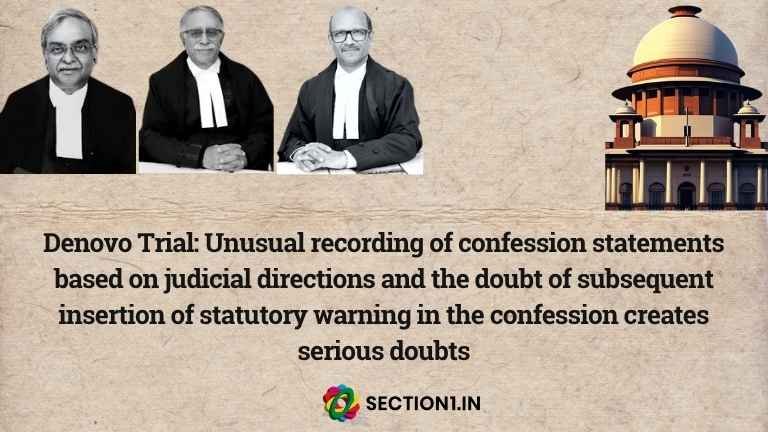
Unusual recording of confession statements basis of judicial directions are wholly inconsistent and thereby raises serious doubts regarding their voluntariness
44. Having carefully examined the entire material on record, we are unable to persuade ourselves to concur with the approach adopted by the Courts below. In our considered opinion, the confessional statements attributed to Accused No. 12-Pappu @ Salim are attended by serious legal as well as factual infirmities/lacuna which substantially erode their evidentiary value and render it unsafe to place reliance upon them. The record discloses that the said accused was subjected to repeated exercises for recording his confessional statements over a protracted period, commencing with the first statement recorded under Section 164 of CrPC in connection with the Jaipur Stadium Bomb Blast case, followed by the confessional statement recorded in the present case on 21st October, 2002, and thereafter by successive attempts to re-record the confession pursuant to judicial directions. Such an unusual and protracted course of recording confessional statements is wholly inconsistent with the safeguards ordinarily governing the recording of voluntary confessions and, by itself, raises serious doubts regarding their voluntariness, authenticity and evidentiary reliability.
Accused no.12 disowned his confession statements and denied having acted as an approver
45. More importantly, the voluntariness of the said statements stands seriously disputed. The maker of the confession, namely, Accused No. 12-Pappu @ Salim, when produced before the trial Court for recording of evidence as PW-95, i.e., as an approver in the main case, categorically disowned the statements attributed to him. He expressly denied having acted as an approver and asserted that no statement had been voluntarily made by him in the manner projected by the prosecution. The significance of this circumstance cannot be understated. A confession derives its evidentiary value primarily from its voluntary character. Once the maker himself challenges the circumstances under which the statement came to be recorded and repudiates its contents, the Court is duty-bound to approach such material with the utmost caution and circumspection.
46. Despite these glaring infirmities, both the trial Court and the High Court proceeded to place substantial reliance and implicit faith upon the alleged confessional statements for recording a finding of guilt. In our view, considered in light of the attending circumstances, such an approach was legally and factually impermissible. A retracted confession, particularly one whose voluntariness is seriously questioned and whose authenticity is rendered doubtful by repeated recording and subsequent repudiation, cannot constitute the foundation of a conviction unless it receives strong and independent corroboration from reliable evidence. The law is equally well-settled that such corroboration must be of a substantive character and must connect the accused with the commission of the offence in material particulars.
Hon’ble S.C doubts that the statutory warning in the s.164(2) crpc confession statement recorded could have been inserted subsequently
47. The doubts surrounding the voluntariness and reliability of the alleged confessional statements become even more pronounced upon an examination of the original confessional statement dated 9th September, 1997, recorded in connection with the Jaipur Stadium bomb blast case. A careful perusal of the original confessional statement dated 9th September, 1997, recorded in connection with the Jaipur Stadium bomb blast case, reveals certain features which cast serious doubt on the manner in which the mandatory safeguards prescribed under Section 164 of CrPC were observed. In particular, we find that the manner in which the statutory warning contemplated under Section 164(2) of CrPC has been recorded is not entirely free from doubt. A close scrutiny of the original document reveals that the endorsement containing the statutory warning clearly appears to have been inserted subsequently in the limited space available at the commencement of the document and, prima facie, appears to be in handwriting different from that employed in the main body of the confession. The placement and appearance of the endorsement are such that they give rise to a legitimate doubt whether the statutory warning was, in fact, administered in the manner and at the stage contemplated by Section 164(2) of CrPC, namely, before the recording of the confession commenced. This circumstance assumes considerable significance, for the statutory warning constitutes an essential safeguard intended to ensure that the confession is made voluntarily and with full awareness of its legal consequences.
48. We hasten to add that we do not propose to record any finding on this aspect, effecting the legality and validity of the said confession recorded in the Jaipur Stadium bomb blast case, since the said issue does not directly fall for determination before us. Nonetheless, the aforesaid circumstances cannot be regarded as wholly insignificant. They do give rise to a legitimate doubt as to whether the procedural safeguards intended to secure the voluntariness and authenticity of the confession were observed in their true letter and spirit. It is trite that where a confession is relied upon as a substantive incriminating circumstance, the Court must be satisfied that every statutory safeguard has been scrupulously observed. Any circumstance casting doubt upon such compliance necessarily diminishes the degree of assurance that may otherwise be derived from the statement and warrants a correspondingly cautious approach while assessing its evidentiary worth.
49. Tested on the aforesaid principles, the prosecution case against Accused No. 12-Pappu @ Salim is found to be woefully wanting and lacking in merit. Apart from the confessional statements, which themselves suffer from serious infirmities highlighted supra, the prosecution has failed to place any independent and reliable material on record capable of lending substantive corroboration thereto. As a matter of fact, once the confessional statements are eschewed from consideration, there is no independent evidence establishing the participation of Accused No. 12-Pappu @ Salim in the alleged conspiracy, his involvement in the preparation or execution of the offence, or his connection with the explosive device allegedly used in the occurrence. No witness has deposed to having seen him participate in any conspiratorial meeting, procure or transport any explosive substance, provide logistical support for the commission of the offence, or otherwise perform any overt act indicative of his involvement in the alleged criminal design. Equally, there is no documentary, scientific or forensic material on record which could lend assurance to the prosecution’s theory regarding his role in the occurrence. The investigating officials have not stated about the collection of any incriminating evidence against Accused No. 12-Pappu @ Salim during investigation except of course for the confessional statements.
51. The weakness of the prosecution case is further compounded by the complete absence of any incriminating recovery or discovery attributable to Accused No. 12-Pappu @ Salim. We may note that the entire record and evidence led by the prosecution do not refer to any recovery or discovery of an incriminating fact having been effected at his instance during the course of the investigation. Neither any explosive substance, weapon, incriminating document nor any other material object was recovered from his possession or pursuant to any disclosure statement attributed to him. The prosecution has also been unable to point out any physical, forensic or documentary evidence connecting him with the procurement, storage, transportation or deployment of the explosive substance allegedly used in the commission of the offence. Indeed, the evidence of the investigating officers themselves indicates that no material recovery linking the Accused No. 12-Pappu @ Salim to the alleged conspiracy was ever effected.
Serious lacuna in the prosecution case
53. The aforesaid circumstances assume considerable significance in the facts of the present case. The allegation against Accused No. 12-Pappu @ Salim is that he was an active participant in a largescale terrorist conspiracy involving the movement and use of explosive substances. In such a case, the recovery of incriminating articles or the discovery of material objects pursuant to information supplied by the said accused would ordinarily furnish important corroborative support to the prosecution version. The evidence of the prosecution witnesses, including the investigating officers themselves, does not establish any recovery or discovery linking Accused No. 12- Pappu @ Salim to the alleged conspiracy. The complete absence of any such circumstance, when viewed alongside the doubtful and unreliable confessional statements discussed hereinabove, leaves the prosecution case devoid of any dependable evidentiary foundation. This constitutes a serious lacuna which substantially undermines the allegation of his involvement in the offence.
Prosecution failed to establish guilt of accused no.12
55. Thus, when the evidence on record is evaluated in its entirety, what emerges is a case devoid of any reliable recovery or discovery, bereft of direct evidence, unsupported by a complete chain of circumstances, and founded principally upon confessional statements whose voluntariness and reliability stand seriously impeached. The prosecution has therefore failed to establish the guilt of Accused No. 12-Pappu @ Salim beyond reasonable doubt. In our considered view, the findings recorded by the trial Court and affirmed by the High Court are unsustainable in facts as well as in law, being founded substantially upon conjectures and inferences rather than legally admissible and reliable evidence. Consequently, the benefit of doubt must necessarily enure to the accused and hence, the conviction and sentence recorded against Accused No. 12-Pappu @ Salim cannot be sustained and deserve to be set aside.
Appellant/accused no.12 is acquitted and his appeal is allowed
56. Resultantly, Criminal Appeal No. 1830 of 2019 preferred by Accused No. 12-Pappu @ Salim is allowed. The impugned judgment of conviction and order of sentence dated 7th March, 2017 passed by the trial Court as well as the judgment and order dated 22nd July, 2019 passed by the High Court affirming the conviction and sentence awarded to Accused No. 12-Pappu @ Salim are hereby set aside. The conviction of Accused No. 12-Pappu @ Salim and the sentences awarded to him by the trial Court and affirmed by the High Court are also set aside.
Identification of place is itself does not constitute incriminating evidence against the accused unless it leads to discovery of a relevant fact
63. We also find that nothing material emanates from the alleged disclosure statements attributed to Accused No. 1-Javed Khan and Accused No. 10- Raees Baeg. Though the prosecution has contended that certain places, including a Masjid and premises allegedly used by one Salaar, were identified pursuant to disclosures made by the aforesaid accused persons, such circumstances do not materially advance the prosecution case. The identification of a place, by itself, does not constitute incriminating evidence unless it leads to the discovery of a relevant fact previously unknown to the investigating agency and having a direct nexus with the crime under investigation. In the present case, the prosecution has failed to demonstrate that any recovery of incriminating fact or material, explosive substance, document, weapon, or other article connected with the Samleti Bus bomb blast was effected as a consequence of such disclosures.
Contents of panchnama or memorandum do not constitute substantive evidence
What constitutes substantive evidence?
64. At this stage, it would be apposite to notice the settled principles governing the evidentiary value of disclosure statements and the memoranda prepared pursuant thereto. The contents of a panchnama or memorandum do not constitute substantive evidence. As held by this Court in Murli & Anr. v. State of Rajasthan, it is the testimony of the witness in the witness box, and not the recitals contained in such documents, that constitutes substantive evidence. The memorandum merely records what the investigating officer claims to have observed and cannot, by itself, prove either the disclosure allegedly made by the accused or the discovery said to have followed. The evidentiary value of such memoranda, therefore, is necessarily circumscribed and depends upon satisfactory oral evidence proving the precise information allegedly furnished by the accused and the discovery said to have ensued therefrom.
65. The principles governing the admissibility of information under Section 27 of IEA are equally well settled. In Pulukuri Kottaya v. Emperor, it was authoritatively held that only that portion of the information furnished by an accused which distinctly relates to the fact thereby discovered is admissible in evidence. The discovery contemplated by Section 27 of IEA is not the mere pointing out of a place already within the knowledge of the investigating agency or the production of an object without any incriminating nexus, but the discovery of a relevant fact previously unknown, brought to light as a direct consequence of the information supplied by the accused. Unless the information furnished by the accused results in the discovery of a relevant fact previously not known and connected with the offence under investigation, the statutory exception carved out under Section 27 of IEA would not be attracted. Mere statements expressing willingness to identify places or locations, without resulting in the discovery of a relevant fact, do not satisfy the statutory requirements.
66. Examined in the light of the aforesaid settled principles, the disclosure statements attributed to Accused No. 1-Javed Khan and Accused No. 10- Raees Baeg do not advance the prosecution case. The prosecution has primarily relied upon the memoranda and the consequential site verification proceedings, but has failed to establish, through cogent oral evidence, the precise information allegedly furnished by the accused which led to the discovery of any relevant fact. Nor has it been shown that the alleged disclosures resulted in the recovery of any incriminating article, document, explosive substance or other fact having a direct nexus with the Samleti Bus bomb blast. The alleged pointing out of certain places, by itself, does not constitute a discovery of an incriminating fact within the meaning of Section 27 of IEA. The memoranda and the consequential site verification proceedings do not satisfy the statutory requirements of Section 27 of IEA and are incapable of constituting an incriminating circumstance against the said accused persons.
67. Consequently, the alleged disclosures, the memoranda prepared pursuant thereto, and the site verification proceedings undertaken on their basis do not constitute incriminating circumstances capable of connecting Accused No. 1-Javed Khan, Accused No. 10-Raees Baeg, or any of the co-accused with the commission of the present offence. The evidentiary value sought to be attached to such material is, therefore, extremely limited and incapable of advancing the prosecution case. Viewed in their entirety, these circumstances neither furnish a legally admissible link in the chain of prosecution evidence nor provide any meaningful corroboration to the allegations levelled against the accused persons. The said material, therefore, is of no assistance in dislodging the view taken by the High Court while acquitting the aforesaid accused persons.
69. Even otherwise, a careful examination of the confessional statement attributed to Accused No. 12- Pappu @ Salim does not disclose any specific role played by Accused No. 10-Raees Baeg in the Samleti Bus bomb blast. It is also relevant to note that once the status of Accused No. 12-Pappu @ Salim as an approver stood withdrawn as he resiled from the confession recorded after the grant of pardon, his statement could, at best, assume the character of a confession of a co-accused. Such a confession is not substantive evidence and can only be used to lend assurance to a conclusion otherwise reached on the basis of independent and legally admissible substantive evidence. In the present case, however, the confessional statement is conspicuously silent as regards participation, specific act, or involvement of Accused No. 10-Raees Baeg in the execution of the Samleti Bus bomb blast. In the absence of any other proven circumstance connecting him with the offence, the statement furnishes no material capable of lending assurance to the prosecution case against the said accused.
70. The prosecution has not produced any independent evidence connecting him with the occurrence. His alleged involvement in other terrorist activity related cases cannot constitute proof of participation in the present offence. Criminal liability must be established on the basis of evidence relating to the offence under consideration and cannot be founded upon suspicions arising from other proceedings that are neither directly connected with nor cognate to the offence in question. In the absence of legally admissible direct evidence implicating him in material particulars, coupled with the lack of independent corroborative evidence, no incriminating circumstance can be said to have been established against Accused No. 10-Raees Baeg.
74. The prosecution has failed to point out any material circumstance or credible ground demonstrating that the appreciation of evidence by the High Court is manifestly erroneous, perverse, or otherwise warranting interference with the order of acquittal in exercise of appellate jurisdiction. On the contrary, upon an independent examination of the evidence on record, we find that the view taken by the High Court is reasonable, plausible and rather, the only permissible view based on the material available on record. Accordingly, we find no justification to disturb the acquittal of the aforesaid accused persons.
D. Conclusion
76. Having given our thoughtful consideration to the issues arising in the present batch of appeals and having recorded our conclusions thereon, we deem it appropriate to dispose of the present batch of appeals by issuing the following directions and consequential orders in the succeeding paragraphs.
77. Criminal Appeal Nos. 1827-1829 of 2019 preferred by Accused No. 9-Dr. Abdul Hameed are partly allowed. The impugned judgment of conviction dated 29th September, 2014 and order of sentence dated 17th December, 2015 passed by the trial Court as well as the common judgment dated 22nd July, 2019 passed by the High Court to the extent that it upheld the conviction and sentences awarded to Accused No. 9-Dr. Abdul Hameed are hereby set aside. The conviction of Accused No. 9-Dr. Abdul Hameed and the sentences awarded to him by the trial Court and affirmed by the High Court are also set aside. While setting aside the conviction and sentence awarded to Accused No. 9-Dr. Abdul Hameed, we direct as under: –
A. The matter is remitted to the Court of Sessions for conducting a de-novo trial against Accused No. 9- Dr. Abdul Hameed.
B. Having regard to the fact that the occurrence relates to the year 1996 and the matter has remained pending for nearly three decades, we request the Hon’ble the Acting Chief Justice of the High Court of Judicature for Rajasthan to designate a Special Court at Jaipur for conducting the de-novo trial. The Special Court shall be presided over by an officer of the Rajasthan Higher Judicial Service having not less than seven years’ experience of conducting Sessions trials. The trial shall be conducted at Jaipur, and the Special Court shall make every endeavour to conclude the trial within a period of one year from the date of assignment of the case.
C. The Special Court shall proceed with the case from the stage of recording of prosecution evidence and thereafter conduct the trial afresh in accordance with law, uninfluenced by any observations contained in the judgments of the trial Court, the High Court or in the present judgment on the merits of the prosecution case.
D. Before commencing the trial, the Special Court shall ensure that Accused No. 9-Dr. Abdul Hameed is represented by a counsel of his choice. In the event the said accused is unable to engage a counsel, the Special Court shall secure competent legal representation for him through the Rajasthan State Legal Services Authority by appointing an advocate having not less than ten years’ standing at the Bar as the lead defence counsel, assisted by another advocate having not less than seven years’ standing at the Bar, so as to ensure effective and meaningful legal assistance throughout the proceedings. The fees and other incidental expenses of the said counsel shall be borne by the Rajasthan State Legal Services Authority as per Rules.
E. The Special Court shall ensure that copies of all documents and other materials relied upon by the prosecution are furnished to Accused No. 9-Dr. Abdul Hameed in accordance with law without any avoidable delay so as to facilitate the expeditious commencement and conduct of the trial.
F. Since, we have set aside the impugned judgment passed by the trial Court qua Accused No. 9-Dr. Abdul Hameed on the ground that the said accused was not provided effective legal representation at the time of recording of evidence during the trial, the Special Court shall take immediate steps for summoning all the prosecution witnesses and thereafter, provide Accused No. 9-Dr. Abdul Hameed a full and effective opportunity to cross-examine them. The concerned police authorities shall extend full assistance to the Special Court and make every endeavour to secure the presence of the witnesses on the dates fixed for recording their evidence so as to ensure that the trial proceeds expeditiously and is concluded within the time stipulated by this Court. The defence counsel engaged to represent Accused No. 9-Dr. Abdul Hameed in the de-novo trial shall be provided sufficient time to prepare the case. G.It shall be open to the prosecution to seek the issuance of appropriate coercive process for securing the attendance of witnesses, and the Special Court shall pass appropriate orders in accordance with law to ensure their presence. H.The Special Court shall, upon commencement of the trial, proceed with the recording of evidence on a day-to-day basis, as far as practicable, and shall not grant unnecessary adjournments except for reasons to be recorded in writing.
I. Once the prosecution evidence is concluded, the trial Court may, if it so desires, examine Accused No. 9-Dr. Abdul Hameed under Section 313 of CrPC. Accused No. 9-Dr. Abdul Hameed shall thereafter be given reasonable opportunity to lead defence evidence. Thereafter, the trial Court shall proceed to hear the final arguments and pass a fresh judgment in accordance with law.
J. Accused No. 9-Dr. Abdul Hameed shall remain in judicial custody during the pendency of the denovo trial. However, it shall be open to him to apply for bail before the Special Court. If any such application is preferred, the same shall be considered on its own merits, strictly in accordance with law and uninfluenced by the findings recorded in the judgments which have been set aside by this Court or by any observations contained in the present judgment.
K. The Registry of this Court shall forthwith transmit a copy of this judgment to the Registrar General, High Court of Judicature for Rajasthan, who shall place the same before the Hon’ble the Acting Chief Justice forthwith for appropriate administrative orders in terms of Direction B above and shall thereafter ensure due compliance with all the directions contained in this judgment.
L. The Registry of this Court shall forthwith transmit the original records of the case to the Registrar General, High Court of Judicature for Rajasthan, who shall, immediately upon the designation of the Special Court in terms of Direction B, ensure that the entire original record is transmitted to the said Special Court to facilitate the expeditious commencement of the de-novo trial.
M. The Registry of this Court shall also ensure the translation of the present judgment into Hindi. A copy of the English version of the judgment shall forthwith be transmitted to Accused No. 9-Dr. Abdul Hameed, who is lodged in Central Jail, Jaipur. Upon completion of the Hindi translation, a copy thereof shall also be forwarded to him.
Judgments Cited and Discussed
- Sharad Birdhichand Sarda v. State of Maharashtra, (1984) 4 SCC 116: Relied upon by the defence to emphasize the well-settled principles and the indispensable conditions required for establishing a conviction based solely on circumstantial evidence.
- Pulukuri Kotayya v. King-Emperor, 1946 SCC OnLine PC 47: Cited to support the argument that only the portion of information furnished by an accused that distinctly relates to the actual fact discovered is admissible in evidence.
- Kashmira Singh v. State of Madhya Pradesh, (1952) 1 SCC 275: Relied upon to establish that the confession of a co-accused is not substantive evidence and can only be used to lend assurance to other independent evidence already found reliable.
- Haricharan Kurmi v. State of Bihar, 1964 SCC OnLine SC 28; (1964) 6 SCR 623: Cited alongside Kashmira Singh to assert that a co-accused’s confession cannot form the sole foundation of a conviction.
- Bachan Singh v. State of Punjab, (1980) 2 SCC 684: Cited by the prosecution to argue that the capital punishment awarded was justified because the terrorist act fell under the “rarest of rare” category.
- Suk Das v. UT of Arunachal Pradesh, (1986) 2 SCC 401: Referenced by the Court to underscore that the denial of effective legal assistance strikes at the heart of a fair trial and can vitiate the proceedings.
- Tyron Nazareth v. State of Goa, 1994 Supp (3) SCC 321: Cited by the Court as precedent where a fundamental infraction of the guarantee of a fair trial due to denial of legal assistance led to a remand for a de-novo trial.
- Mohd. Hussain v. State (Govt. of NCT of Delhi), (2012) 9 SCC 408: Extensively quoted by the Court regarding the balance between an accused’s right to a fair trial and the appellate court’s power to order a retrial to avert a failure of justice when legal representation was denied.
- Naveen v. State of M.P., (2023) 17 SCC 381: Quoted by the Court to reiterate the scope of the constitutional guarantee of a fair trial, emphasizing the necessity of a meaningful opportunity to defend and the principle of “judicial calm”.
- Murli & Anr. v. State of Rajasthan, (2009) 9 SCC 417: Cited by the Court to clarify that the contents of a panchnama or memorandum do not constitute substantive evidence, but the actual testimony of the witness in the box does.
- Suresh Budharmal Kalani v. State of Maharashtra, (1998) 7 SCC 337: Cited to reiterate that a confession of one accused which is unreliable cannot be employed directly or indirectly as substantive evidence against a co-accused.
- Sheo Swarup v. King Emperor, 1934 SCC OnLine PC 42: Referenced by the Court to highlight the presumption of innocence and the traditional reluctance of appellate courts to disturb a trial court’s acquittal.
- Ramesh Babulal Doshi v. State of Gujarat, (1996) 9 SCC 225: Cited to establish that an appellate court must conclude a trial court’s findings are palpably wrong or manifestly erroneous before interfering with an acquittal.
- Chandrappa v. State of Karnataka, (2007) 4 SCC 415: Cited by the Court to explain the double presumption of innocence operating in favor of an acquitted accused.
Acts and Sections Involved
- Indian Penal Code, 1860 (IPC): Sections 115, 117, 118, 120-B, 176, 193, 302, 307.
- Explosive Substances Act, 1908: Sections 4, 5.
- Prevention of Damage to Public Property Act, 1984 (PDPP Act): Sections 3, 4.
- Indian Evidence Act, 1872 (IEA): Sections 3, 27.
- Code of Criminal Procedure, 1973 (CrPC): Sections 161, 164, 164(2), 306, 313, 315, 366, 386(b).
- Constitution of India: Articles 21, 22.
- Rajasthan Prisoners Release on Parole Rules, 1958: Mentioned in the context of parole conditions.
Party
Dr. Abdul Hameed versus State of Rajasthan - Criminal Appeal No(s). 1827-1829 of 2019 - 2026 INSC 734 - July 21, 2026 Hon’ble Mr. Justice Vikram Nath, Sanjay Karol, and Hon’ble Mr. Justice Sandeep Mehta, JJ. [3 judge bench]