
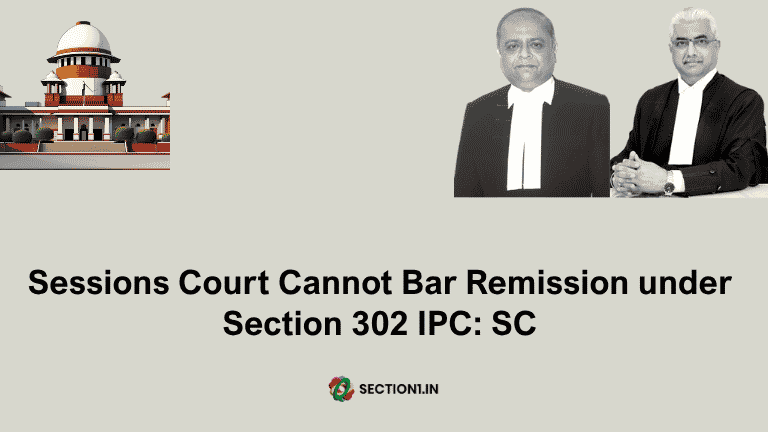
Naval Kishore & Anr. Versus State of Punjab – Criminal Appeal No. 4546 of 2026 (Arising out of SLP (Crl.) No. of 2026, Diary No. 56431 of 2025) – 2026 INSC 1048 – September 24, 2026 – Hon’ble Mr. Justice Aravind Kumar and Hon’ble Mr. Justice Vipul M. Pancholi
Appellate Jurisdiction and Impugned Proceedings
The present criminal appeal was instituted by the appellants (accused Nos. 2 and 3), challenging the final judgment and order dated 12.12.2022 rendered by the High Court of Punjab and Haryana at Chandigarh in Criminal Appeal No. CRA-D-759-DB-2014, whereby the High Court dismissed their appeal and confirmed the judgment of conviction dated 26.04.2014 and order of sentence dated 28.04.2014. The specific grievance in the appeal centered on the direction that the convicts shall “remain in prison till rest of their life”, a condition that excluded statutory remission. [Paras 3, 3.1, 7, 8]
Factual Matrix of the Crime
The prosecution case unfolded from a missing persons report turned triple homicide; the deceased and her two minor daughters went missing on the evening of 27.12.2009 after leaving to purchase eatables, and their bodies with sharp-weapon throat injuries were recovered the next morning near railway tracks in Ludhiana. The primary motive arose from the husband (accused No. 1) suspecting his wife’s fidelity and the paternity of the children, alongside an insurance payout conspiracy involving the appellants. Subsequent investigation and disclosure statements led to the recovery of blood-stained clothes, weapons of offence, gold ornaments belonging to the deceased, alongside corroborative last-seen testimonies, extra-judicial confessions, and matching DNA forensics from hair found in the victim’s hand. [Paras 4.1 to 4.7]
Verdicts of the Trial & Appellate Courts
The Court of Additional Sessions Judge, Ludhiana, convicted the accused persons for offences punishable under Section 302 read with Section 34 of the Indian Penal Code and, alongside fines, sentenced them to rigorous imprisonment for life with an express direction “to remain in prison till rest of their life. On appeal, the High Court of Punjab and Haryana re-examined the circumstantial, ocular, disclosure, and forensic evidence, affirming the conviction and sentence in full. However, the High Court omitted to consider or assess the legal competence and jurisdiction of the Sessions Court in imposing a life sentence stripped of statutory remission. [Paras 3.1, 5, 6, 6.1, 6.2]
Submissions and Legal Contentions
Counsel for the appellants conceded the conviction but vigorously contended that Section 302 IPC only provides for death or imprisonment for life, rendering the Sessions Court’s direction to imprison them for their natural lives ultra vires and legally unsustainable, especially given their prolonged custody and satisfactory prison conduct. Conversely, the respondent-State argued that the barbaric and premeditated nature of the triple homicide involving two minor children fully justified life incarceration without release, warranting no judicial leniency or interference with the concurrent sentencing orders. [Paras 9.1 to 10.2]
Ratio Decidendi
A Court of Session is not competent to impose a special category sentence directing a convict to remain imprisoned for the remainder of their natural life to the exclusion of statutory remission and commutation regimes under Sections 432 to 435 of the Cr.P.C.; the authority to substitute death with a non-remissible fixed term or natural-life incarceration resides solely within the Constitutional Courts (the Supreme Court and the High Courts). [Paras 18, 19, 23, 25, 33]
Important Paragraphs
Remain in prison till rest of their life: Direction issued by the Trial Court whether legal or not
6.1. At this stage, it is relevant to observe that the High Court in paragraph 1 of the impugned judgment noted as under:
“1. The instant appeal is directed against the impugned verdict, as made on 26.4.2014, upon Sessions Case No. 20 of 3.8.2010, by the learned Additional Sessions Judge, Ludhiana. Through the above said verdict, the learned trial Judge concerned, convicted all the accused, for the commission of offences punishable, under Section(s) 302 read with Section 34 of the IPC. Moreover, through a separate sentencing order, drawn on 28.4.2014, the learned trial Judge concerned, sentenced the convicts to undergo rigorous imprisonment for life, for an offence punishable under Section 302 read with Section 34 of the IPC, besides also imposed, upon the convicts sentence of fine, comprised in a sum of Rs. 2500/- each, and, in default of payment of fine amount, he sentenced the convicts to undergo simple imprisonment for a period of one year.”
6.2. Thus, from the aforesaid, it is clear that while affirming the conviction and sentence imposed by the Trial Court, the High Court did not take into consideration the specific direction issued by the Trial Court that the accused shall “remain in prison till rest of their life” and thus, the said direction, which is part of the sentence of rigorous imprisonment for life imposed upon the accused, was not examined by the High Court while passing the impugned judgment dated 12.12.2022.
Issues
12. In view of the order dated 10.11.2025, the conviction of the appellants is not required to be reconsidered and thus, the following questions concerning the sentence of the appellants arise for our consideration :
A. Whether the Trial Court was competent to direct, while imposing the punishment of imprisonment for life under Section 302 IPC, that the appellants shall remain in prison for the remainder of their lives?
B. If the answer to Question (A) is in the negative, what sentence is to be imposed upon the appellants?
Section 302 IPC: Explained
3. Section 302 IPC is reproduced as under, for convenience: “302. Punishment for murder.— Whoever commits murder shall be punished with death, or imprisonment for life, and shall also be liable to fine.”
Explaining the sentence of sections 45, 53, 302 IPC read with Articles 72 and 161 of the Constitution of India and sections 432 to 435 Cr.P.C
14. Section 302 IPC prescribes two punishments for the offence of murder, namely, (i) death or (ii) imprisonment for life, apart from fine. However, significantly Section 302 IPC does not expressly provide that imprisonment for life shall mean imprisonment for the remainder of the natural life of convict, unlike certain other provisions of the IPC which expressly provide for such a consequence.
15. It is well settled that, as per Section 53 read with Section 45 of the IPC, imprisonment for life means imprisonment for the remainder of the natural life of the convict. At the same time, such sentence is subject to the statutory powers of remission and commutation vested in the appropriate Government under Sections 432 to 435 of the Code of Criminal Procedure, 1973 (hereinafter referred to as “the Cr.P.C.”) and the constitutional powers under Articles 72 and 161 of the Constitution of India.
Question of law involved
16. In the present case, the distinction between an ordinary sentence of imprisonment for life and a special category sentence directing that the convict shall not be released for the remainder of his natural life by excluding the statutory remission regime, is to be considered. Therefore, the question that falls for our consideration is whether a Court of Session, while imposing a sentence under Section 302 IPC, is competent to issue a direction that the convict shall remain imprisoned for the remainder of his natural life, thereby excluding or curtailing the statutory powers of remission and commutation vested in the appropriate Government.
19. The important question as to the authority competent to impose such a special category sentence was recently again considered by this Court in Kiran v. State of Karnataka, 2025 SCC OnLine SC 2863. In that case also, the Sessions Court had imposed life imprisonment with a direction that the sentence would operate till the end of the natural life of the accused. After considering Swamy Shraddananda (2) (supra) and V. Sriharan alias Murugan (supra), this Court held that although life imprisonment denotes imprisonment for the remainder of the life of convict, the statutory powers of remission and commutation cannot be curtailed by a Sessions Court and thus, the power to impose a special category sentence of life imprisonment without remission belongs to the Constitutional Courts and not to the Sessions Court. This Court further held that the power to grant remission and commutation under Sections 432 to 435 of the Cr.P.C. cannot be curtailed by the Sessions Court and a direction by the Sessions Court that imprisonment for life shall continue till the end of the natural life of the convict is in conflict with the statutory scheme. Accordingly, in that case, the sentence imposed by the Trial Court was modified to imprisonment for life simpliciter. The relevant paragraph reads as under:
“15. Going by the decisions cited, it has to be held that life imprisonment awarded would be for the rest of the life, the power to grant remission and commutation under Sections 432 to 435 Cr. P.C. cannot be curtailed by the Sessions Court, when the remission as provided under the Constitution was declared to be not permissible of interference by the Constitutional Courts. The power of alternate sentencing to cover the hiatus between 14 years and death, cannot be applied by the Sessions Courts. Hence, the sentence of life imprisonment cannot be directed to be till the end of natural life, by the Sessions Court which direction would be in conflict with the provisions of the Cr. P.C. The power of remission or commutation conferred on the State cannot be taken away and the sentence as awarded by the trial court and confirmed by the High Court for the offence under Section 302 of the Penal Code, 18605 is confirmed as imprisonment for life.”
22. At this stage, we consider it appropriate to examine the legislative developments subsequent to the decision in V. Sriharan alias Murugan (supra). The Criminal Law (Amendment) Act, 2018, was enacted against the backdrop of grave sexual offences against women and children and sought to substantially enhance the punishment prescribed for certain aggravated forms of rape. The Parliament, inter alia, introduced Sections 376AB, 376DA and 376DB into the IPC and in each of these provisions, expressly provided that the punishment of imprisonment for life “shall mean imprisonment for the remainder of that person’s natural life”. During the Parliamentary Debate on the Criminal Law (Amendment) Bill, 2018, it was pointed out that the Bill defined life imprisonment as imprisonment for the natural life of convict and unlike the ordinary remission regime applicable to life imprisonment, such a sentence would not contemplate release merely on account of good behaviour. Therefore, it is evident that when the Parliament intended the expression “imprisonment for life” to mean imprisonment for the remainder of the natural life of convict, it used specific and unambiguous language to that effect.
23. We are of the considered view that this legislative choice is of considerable significance when Section 302 IPC is examined, as Section 302 IPC has not been amended in the similar terms and continues to provide that whoever commits murder shall be punished with death, or imprisonment for life, and shall also be liable to fine. Thus, the legislative intent to use such express language in those provisions, while retaining Section 302 IPC in its existing form, cannot be disregarded while interpreting the scope of the sentencing power under Section 302 IPC. Therefore, it would be impermissible to read into Section 302 IPC, a punishment, which the Parliament has expressly incorporated in other penal provisions and in doing so, the Sessions Court would be supplementing the punishment prescribed by the legislature.
Sentencing: Court must sentence within the punishment prescribed by the legislature and permissible limits
24. This position is fortified by the Constitution Bench decision in V. Sriharan (supra), wherein this Court emphasised that prescribing punishments is essentially a legislative function and that the Courts must operate within the punishment prescribed by the legislature and while the Constitutional Courts may, in appropriate cases, mould a sentence within the permissible limits of the punishment prescribed, the exercise of such power is circumscribed by the constitutional and statutory scheme.
Trial Court was not competent to impose a special category sentence that is to send the accused to remain in prison till the rest of their life
25. In light of the decisions considered hereinabove, we are of the view that there is no doubt that the Trial Court was competent to impose the punishment of imprisonment for life upon the appellants for the offence under Section 302 read with Section 34 IPC, however, at the same time, the Trial Court was not competent to impose a special category sentence that the appellants “to remain in prison till rest of their life”, which in substance and effect, excludes the statutory power of remission or commutation. Therefore, the High Court, while affirming the sentence imposed by the Trial Court, did not examine the competence of the Trial Court to impose such a sentence and thus, to that extent, the impugned judgment requires interference of this Court.
26. Having held that the direction issued by the Trial Court that the appellants shall “remain in prison till rest of their life” cannot be sustained, the next question that arises for our consideration is as to the sentence to be imposed upon the appellants having regard to the facts and circumstances of the present case.
27. As noted hereinabove, the power to impose a special category of sentence, whereby a convict is required to undergo imprisonment for a specified period beyond the ordinary remission or commutation regime, is vested only in the Constitutional Courts. In this regard, paragraph 79 of Navas (supra), reproduced hereinabove, is relevant, wherein this Court provides for the sentencing principles and considerations that guide the exercise of such power and it is held that the power is to be exercised sparingly and upon a holistic consideration of the facts and circumstances of each case, including the nature and gravity of the offence, the circumstances in which the offence was committed, the role attributable to the accused, the period of incarceration already undergone, the conduct of the convict while in custody and the prospects of rehabilitation of the convict.
Conclusion
30. In the present case, the appellants have undergone a substantial period of incarceration. The custody certificates placed on record show that, as on 08.07.2026, Naval Kishore had undergone an actual period of custody of 12 years, 5 months and 20 days, including the period of custody undergone as an undertrial, whereas Jyoti Kumar had undergone an actual period of custody of 11 years, 6 months and 9 days.
33. In view of the above discussion, Question (A) is answered in the negative. The Trial Court was competent to impose the punishment of imprisonment for life upon the appellants under Section 302 read with Section 34 IPC, however, it was not competent to direct that the appellants shall “remain in prison till rest of their life”. Accordingly, Question (B) is answered and while exercising our powers as a Constitutional Court, we alter the sentence of the appellants from rigorous imprisonment for life with the direction that they shall “remain in prison till rest of their life” to the sentence of rigorous imprisonment for a period of 25 years without the benefit of statutory remission. At this stage, it is required to be observed that as on 08.07.2026, appellant No.1 had already undergone a period of custody of 12 years, 5 months and 20 days and appellant No.2 had already undergone a period of custody of 11 years, 6 months and 9 days.
Appeal allowed in part by affirming the conviction of the trial court and modification
34. Accordingly, the conviction of the appellants under Section 302 read with Section 34 of the IPC is affirmed. However, the sentence imposed upon the appellants by the Trial Court, which was affirmed by the High Court, is modified to the extent indicated above. The direction requiring the appellants “to remain in prison till the rest of their life” is hereby set aside and in substitution thereof, both the appellants are sentenced to undergo rigorous imprisonment for a period of 25 years, without the benefit of any statutory remission.
35. For the aforesaid reasons, the present appeal is allowed in part.
Judgments Cited, Involved, Quoted
- Swamy Shraddananda (2) v. State of Karnataka, (2008) 13 SCC 767 : (2009) 3 SCC (Cri) 113. Established the special category of sentence bridging the gap between death and ordinary life imprisonment subject to remission, where the latter would be grossly inadequate. Applied as the foundational sentencing precedent. [Paragraphs 17–18]
- Union of India v. V. Sriharan alias Murugan, (2016) 7 SCC 1 : (2016) 2 SCC (Cri) 695. The Constitution Bench upheld special category sentences excluding statutory remission but confined their imposition to the High Courts and Supreme Court. Relied upon to hold that the Sessions Court exceeded its sentencing competence. [Paragraphs 18, 24–25]
- Sangeet v. State of Haryana, (2013) 2 SCC 452 : (2013) 2 SCC (Cri) 611. Appears within the quotation from V. Sriharan. Its view that courts could not exclude governmental remission powers by imposing specified non-remittable sentences was expressly overruled in the quoted Constitution Bench decision. [Paragraph 18]
- Kiran v. State of Karnataka, 2025 SCC OnLine SC 2863. Reaffirmed that a Sessions Court cannot curtail statutory remission or commutation by directing imprisonment until the end of the convict’s natural life; the sentence there was modified to life imprisonment simpliciter. [Paragraph 19]
- Ravinder Singh v. State (NCT of Delhi), (2024) 2 SCC 323. Relied upon by the appellants. The Court explained that special category sentencing remains available to Constitutional Courts even where the maximum statutory punishment is life imprisonment, but requires grave circumstances and cogent reasons; Sessions Courts lack that power. [Paragraph 20]
- Navas alias Mulanavas v. State of Kerala, (2024) 14 SCC 82. Relied upon for reducing a non-remittable sentence from 30 to 25 years and for proportionality-based sentencing. Its discussion of aggravating and mitigating circumstances informed the assessment of the offence, custody undergone, prison conduct and rehabilitation prospects. [Paragraphs 21, 27–32]
- Ramraj v. State of Chhattisgarh, (2010) 1 SCC 573 : (2010) 1 SCC (Cri) 842. Mentioned within the quotation from Navas as a case imposing 20 years’ imprisonment including remission; it was not independently analysed in this judgment. [Paragraph 21]
Acts and Sections
- Indian Penal Code, 1860 (IPC): Section 34, Section 45, Section 53, Section 302, Section 376AB, Section 376DA, Section 376DB.
- Code of Criminal Procedure, 1973 (Cr.P.C.): Sections 432, 433, 434, 435.
- Constitution of India: Article 72, Article 161.
- Criminal Law (Amendment) Act, 2018.