

Appeal
State preferred the appeal against the acquittal of the accused/respondent in murder case
1. The instant Criminal Appeal has been preferred by the State of Himachal Pradesh assailing the Final Judgment and Order dated 26.08.2014 passed by the High Court of Himachal Pradesh at Shimla in Criminal Appeal No. 295 of 2010, whereby the High Court allowed the appeal preferred by the respondent and set aside the judgment of conviction dated 16.07.2010 and the consequential order of sentence dated 03.08.2010 passed by the Sessions Judge, Chamba Division, Chamba, Himachal Pradesh in Sessions Trial No. 19 of 2010, thereby acquitting the respondent of the charge under Section 302 of the Indian Penal Code, 1860.
Facts
Deceased set her on fire despite respondent’s attempt to save her she died
2. The case of the prosecution is that on 07.12.2009, the respondent-husband Chaman Lal allegedly poured kerosene on his wife Saro Devi (deceased) at their residence situated in Village Rampur, Pargana Dhundi, Tehsil and District Chamba, Himachal Pradesh and set her on fire by lighting a matchstick. On seeing her engulfed in flames, some villagers rushed to her rescue and the respondent also attempted to extinguish the fire. Despite these efforts, the deceased sustained severe burn injuries. The information was conveyed to her brother, Ramesh Kumar, who arrived at the spot and made arrangements to take her to the District Hospital, Chamba where she was provided with medical treatment. After receiving initial treatment at Chamba, her condition did not improve and she was referred to Tanda Medical College and Hospital on 15.12.2009 where she was provided with further treatment. When the doctor opined that there was no chance of improvement, the brother of the deceased took her back to his home on 22.12.2009, after which he continued to look after her. On 15.01.2010, she succumbed to her injuries.
Allegation in the FIR was respondent poured kerosene on the deceased and set her on fire
3. Based on the information given by the brother of the deceased, FIR No. 292 of 2009 was registered under Section 302 IPC against the respondent at Police Station Sadar, Chamba on 08.12.2009. During the investigation, it was revealed that the respondent had contracted a love marriage with the deceased and three children were born out of the said wedlock. However, their relationship had become strained and on the fateful day, i.e. on 07.12.2009, the accused poured kerosene upon the deceased and set her on fire, thereby causing her death. Upon information given by the brother of the deceased, ASI Mukesh Kumar came to the hospital. On his intimation, the Tehsildar of the Chamba region reached the hospital and recorded the statement of the deceased, which was treated as Dying Declaration.
Final report filed under section 302 IPC: 4. After completion of the investigation, a challan under Section 302 IPC was prepared and filed before the Chief Judicial Magistrate, Chamba. The Magistrate upon examining the record and complying with the provisions of Section 207 of the Code of Criminal Procedure, 1973, found that the case was exclusively triable by the Court of Sessions and accordingly, committed it to the Sessions Court.
Trial court framed charges u/s 302 IPC: 5. The trial Court, after hearing the respondent and the prosecution and on the basis of the materials available on record, framed a charge under Section 302 IPC. The respondent pleaded not guilty and claimed to be tried.
Trial court convicted the accused for murder: 6. The prosecution led its evidence. Thereafter, the statement of the respondent was recorded under Section 313 Cr.P.C. He was given an opportunity to lead evidence in defence. After trial and upon perusal of the materials brought on record by the parties, the trial Court found the respondent guilty of the offence under Section 302 IPC and accordingly convicted and sentenced him to imprisonment for life and to pay a fine of Rs. 50,000/- and in default thereof, to undergo simple imprisonment for a further period of three years. The period of detention undergone during investigation and trial was directed to be set off against the sentence imposed.
Hon’ble High Court set aside the conviction: 7. Aggrieved by the judgment of conviction and the order of sentence imposed by the trial Court, the respondent preferred Criminal Appeal No. 295 of 2010 before the High Court. By its judgment dated 26.08.2014, the High Court set aside the judgment of conviction and the order of sentence dated 16.07.2010 and 03.08.2010 respectively and acquitted the respondent of the charge under Section 302 IPC by extending to him the benefit of doubt.
Analysis
11. We have carefully considered the submissions made on both sides and perused the materials available on record.
State preferred the appeal
12. In the present case, the appellant – State has challenged the judgment of the High Court acquitting the respondent of the offence punishable under Section 302 IPC. The trial Court earlier found the respondent guilty of committing the offence under Section 302 IPC, holding that he had caused the death of his wife by setting her on fire. Accordingly, the trial Court convicted the respondent and sentenced him to undergo imprisonment for life and to pay a fine of Rs. 50,000/- and in default thereof, to undergo simple imprisonment for a further period of three years.
Principles for appellate court interference with an order of acquittal
13. Before adverting to the facts of the present case, it would be apposite to refer to certain decisions delineating the contours of appellate interference with an order of acquittal. In Sadhu Saran Singh v. State of Uttar Pradesh and others, this Court, while considering appeals against a judgment of acquittal rendered by the High Court, categorically observed that there is no absolute restriction in law on the appellate court to review and reappreciate the entire evidence upon which the order of acquittal is founded. It was further reiterated that where, upon scrutiny, the appellate court finds that the decision of the court below is based on an erroneous appreciation of evidence or is contrary to settled principles of law, interference with such an order becomes not only permissible but also imperative.
13.1. In Rajesh Prasad v. State of Bihar and another etc. (one of us, B.V. Nagarathna, J., was a member of the Bench) this Court, after undertaking a detailed survey of the case law, summarised the circumstances under which in an appeal against an order of acquittal an order of conviction may be passed. The following paragraphs are relevant:
“…………………..”
13.4. Thus, it is vivid that where a judgment of acquittal is found to be manifestly erroneous, perverse, or founded on a misreading of evidence or incorrect application of law, this Court would be justified to set aside the acquittal and record a conviction, albeit exercising such power with circumspection and in exceptional circumstances
Analysing the facts
14. Guided by the above principles, we now proceed to examine the facts of the present case. In order to substantiate its case, the prosecution examined twelve witnesses (PW-1 to PW-12) and marked the relevant documents and material objects. The defence, in turn, examined two witnesses (DW-1 and DW-2). A brief and structured appreciation of the oral evidence is as under:
- PW-1 deposed that the deceased has stated that her husband had poured kerosene and set her on fire: PW-1 Amar Singh, the Tehsildar-cum-Executive Magistrate, deposed that pursuant to a written direction (Ext. PW-1/A), he proceeded to the Civil Hospital, Chamba on 08.12.2009 at about 11.00-11.15 a.m. for the purpose of recording the statement of Saro Devi. Before recording the statement, he ascertained from the attending doctor that the patient was in a fit condition to make a statement. Thereafter, he recorded her statement, which is on record as Ext. PW-1/B. According to PW1, the deceased stated in clear and unequivocal terms that her husband had sprinkled kerosene oil upon her and set her on fire with a matchstick. She further stated that the respondent used to abuse her by calling her “Kanjri” and had asked her to leave the house. PW-1 deposed that the deceased remained conscious throughout, affixed her thumb impression on the statement and that he appended the requisite certificate regarding her fitness and consciousness. He further stated that PW-10, K.D. Sharma, Deputy Superintendent of Police, was present at that time and signed the statement as a witness. In his cross examination, PW-1 categorically denied the suggestion that the statement was recorded at the instance of the police or that the deceased had not made such a statement.
- PW.2 heard from P.W3 that deceased had informed PW.3 as if deceased was put on fire and sought help: PW-2, Ramesh Kumar, the brother of the deceased, deposed that on 07.12.2009 he was informed by PW-3 Yashpal that his sister had suffered burn injuries. He stated that he contacted his sister telephonically on someone else’s phone and she told him that she had been put on fire and sought help. PW-2 further stated that he immediately went to the house of the respondent and found his sister lying on the bed in a seriously burnt condition without clothes on her body. She was alive at that time and was taken by him to the hospital at Chamba. He reported the matter to the police and his statement Ext. PW-12/A was recorded, on the basis of which the FIR came to be registered. PW-2 further stated that on the next day, i.e. 08.12.2009, the Tehsildar came to the hospital and recorded the statement of his sister in his presence. Although he initially stated that the Tehsildar came in the evening, on a question put by the Court he clarified that the statement was recorded at about 11.30 a.m. He also stated that at the time of recording of the statement, the deceased recognised him, his parents and her mother-in-law. In his cross-examination, he denied the suggestion that the deceased was unconscious or incapable of making a statement.
- PW-3, Yashpal corroborated the version of PW-2. He stated that on 07.12.2009 he received a telephonic call from the respondent informing him that Saro Devi had sustained burn injuries and seeking help to save her. He deposed that he immediately conveyed this information to PW-2, Ramesh Kumar.
- PW.4 deposed that the deceased had informed her that she herself poured kerosene oil on her: PW-4, Om Prakash, a ward member, stated that upon reaching the house of the respondent, he found the deceased crying and shouting “bachao, bachao”. He further stated that upon enquiry, the deceased told him that she had herself poured kerosene oil on her. He also deposed that the police seized a kerosene can and a matchbox from the spot and took photographs. He proved the seizure memos Ext. PW-4/A and Ext. PW-4/B and identified the seized articles including the kerosene can, matchbox and burnt clothes, namely, salwar, shirt, bra, dupatta and scalp hair.
- PW-5, Ravindra, the aunt of the respondent stated that the deceased did not say that the respondent had set her on fire but stated that she had herself caught fire.
Analysing the guilt of the respondent
15. Having noticed the evidence of the witnesses and the rival submissions, it is now necessary to evaluate whether the prosecution has succeeded in establishing the guilt of the respondent beyond reasonable doubt.
Prosecution relied the dying declaration to prove the murder
15.1. As noticed earlier, the prosecution case is that on 07.12.2009, the respondent poured kerosene oil upon his wife, Saro Devi, at their residence and set her ablaze by lighting a matchstick. On hearing her cries, neighbours rushed to the spot and attempted to rescue her; the respondent also participated in extinguishing the fire and sustained minor burn injuries. The deceased suffered extensive burn injuries and was admitted to the hospital at Chamba. On 08.12.2009, her statement was recorded in the hospital by PW-1, the Tehsildarcum-Executive Magistrate, after obtaining medical opinion regarding her fitness, in the presence of PW-10, the Deputy Superintendent of Police. The deceased ultimately succumbed to her injuries on 15.01.2010 due to septic shock. The prosecution relies upon the said statement as a dying declaration under Section 32(1) of the Indian Evidence Act, 1872.
Settled legal principles governing dying declarations
16. Before examining the evidentiary value of the dying declaration, it is apposite to note the settled legal principles governing dying declarations. Section 32(1) of the Indian Evidence Act renders admissible statements made by a deceased person as to the cause of death or the circumstances of the transaction resulting in death. It is well settled that a dying declaration need not be made in expectation of immediate death; that a conviction under Section 302 IPC can rest solely on a dying declaration if it is found to be voluntary, truthful and reliable; and that corroboration is not a rule of law but one of prudence.
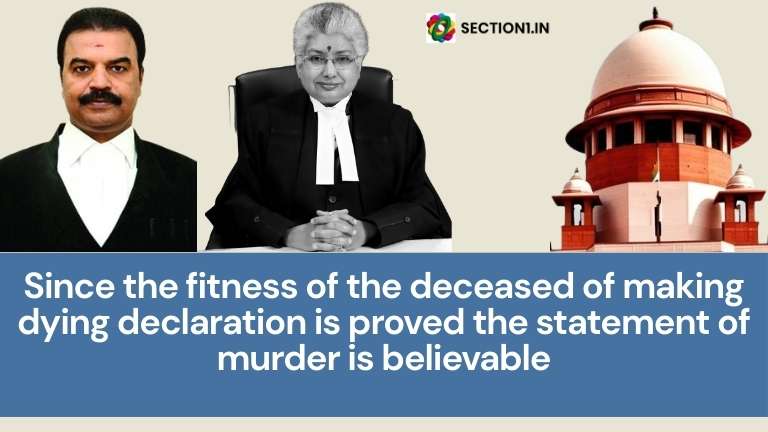
Since the medical officer deposed that the deceased was conscious when making dying declaration of murder and hence believable
17. In light of the aforesaid principles, the dying declaration in the present case inspires full confidence. It was recorded on 08.12.2009 by PW-1, the Tehsildar, a neutral and independent public officer. Prior to recording the statement, medical opinion regarding the fitness of the deceased was duly obtained. PW-1 categorically stated that the deceased was conscious, oriented and capable of making a statement. This version stands corroborated by PW-10, the Deputy Superintendent of Police and PW-2, the brother of the deceased, both of whom deposed that the deceased recognised them and responded appropriately to questions. Although PW-11, the Medical Officer vacillated on certain aspects, the dying declaration cannot be discarded on that ground alone. The declaration clearly and unequivocally attributes the act of pouring kerosene oil and igniting the fire to the respondent. It bears the thumb impression of the deceased and was recorded in the presence of senior officers. There is no material on record suggestive of tutoring, coercion or manipulation.
High Court’s view dissented
18. The High Court disbelieved the dying declaration primarily on two grounds: (i) an alleged inconsistency with respect to the time at which the statement was recorded; and (ii) a doubt as to whether PW-1 himself recorded the statement or merely dictated it. In our considered opinion, neither ground is sustainable.
Time difference is minor discrepancy and satisfactorily explained
18.1. As regards the first aspect, PW-2 initially made a vague reference to the evening; however, upon a clarification sought by the Court, he categorically stated that the statement was recorded at around 11.30 a.m. This clarification aligns with the testimonies of PW-1 and PW-10. Such a minor discrepancy, which stood satisfactorily explained, does not go to the root of the prosecution case, especially when the factum of recording of the dying declaration on 08.12.2009 stands firmly established.
No suggestion that PW.1 did not record the statement
18.2. With regard to the manner of recording, PW-1 clearly deposed that he recorded the statement of the deceased after putting questions to her. PW-10 clarified that the statement was recorded under the supervision and authority of PW-1, who ensured that the answers given by the deceased were correctly reduced into writing. Recording a dying declaration under the supervision of a Magistrate does not render it invalid. No suggestion was put to PW-1 in cross examination that he did not record the statement or that he abdicated his responsibility. The High Court thus discarded the dying declaration on conjectures not borne out by the evidence.
Law does not prescribe any rigid form for recording a dying declaration
18.3. In any event, the law does not prescribe any rigid form for recording a dying declaration. So long as the Court is satisfied that the declaration is voluntary, truthful and reliable, hyper-technical objections cannot form the basis for its rejection.
Omission to inform the accused name in the FIR is not fatal since saving the deceased is importance
19. In the present case, it is true that the Rukka (FIR) records that the deceased did not initially name the assailant. However, it is settled law that an FIR is not expected to be an encyclopaedia of the entire prosecution case. At that stage, the immediate concern of the family members was the survival of the victim who had sustained nearly 70% burn injuries. Such an omission in the earliest version, in these circumstances, cannot ipso facto discredit the subsequent dying declaration recorded in accordance with law.
How to record conviction based on hostile witness? Explained
20. PW-4 and PW-5 were declared hostile and attempted to attribute oral statements to the deceased suggesting self-immolation. The trial Court rightly rejected their testimony. Their version is essentially hearsay and was never disclosed at the earliest available opportunity. In Bhajju v. State of Madhya Pradesh, this Court held that the testimony of a hostile witness can be relied upon only to the extent it is corroborated by other reliable evidence. Recently, in Gurdeep Singh v. State of Punjab, this principle was reiterated. In the present case, no such corroboration exists in respect of the testimony of PW-4 and PW-5, whose statements are unsupported by any independent or reliable evidence on record.
Accused’s attempt to extinguish the fire does not dilute the evidentiary value of dying declaration
21. The defence witnesses, DW-1 and DW-2, stand on no better footing. DW-1 admitted in cross-examination that she had reached the spot only after the deceased had already caught fire and was not present at the time of the incident. Her testimony is thus not based on direct knowledge and lacks corroboration. DW-2, the minor son of the deceased, does not claim to have witnessed the act of pouring kerosene or igniting the fire. At best, his testimony indicates that the respondent attempted to extinguish the fire, a circumstance which does not negate or dilute the evidentiary value of the dying declaration. The High Court without a proper appreciation of the probative value of these testimonies, erred in placing reliance upon them to overturn the conviction recorded by the trial Court.
22. The plea of self-immolation on behalf of the respondent does not inspire the confidence of this Court. The alleged conduct of the respondent in attempting to extinguish the fire and sustaining minor burn injuries does not, by itself, exonerate him from culpability. Such conduct can equally be consistent with an attempt to create an appearance of innocence after the commission of the offence. The defence witnesses are either interested or partisan and fail to rebut the consistent and cogent prosecution evidence.
Motive: Dying Declaration refers the matrimonial ill-treatment
23. Motive assumes significance, primarily in cases based on circumstantial evidence. Where there is direct evidence in the form of a credible and trustworthy dying declaration, the absence of strong proof of motive is not fatal to the prosecution case. This position has been consistently affirmed by this Court in State of Andhra Pradesh v. Bogam Chandraiah and another, Dasin Bai @ Shanti Bai v. State of Chhattisgarh18, and Purshottam Chopra v. State (NCT of Delhi). In the present case, the evidence on record discloses that the respondent subjected the deceased to frequent quarrels, humiliation and verbal abuse, including branding her a “Kanjri” and repeatedly asking her to leave the matrimonial home. The dying declaration itself refers to persistent matrimonial discord and ill-treatment thereby furnishing a plausible background for the commission of the offence. In any event, the prosecution is not required to establish motive with mathematical precision and failure to conclusively prove motive does not weaken an otherwise reliable and cogent case.
Dying Declaration is truthful voluntary and reliable
24. Upon an overall appraisal of the evidence, we are satisfied that the dying declaration of the deceased, Saro Devi, is voluntary, truthful and reliable. It was recorded by a competent authority at a time when the deceased was conscious, oriented and capable of making a statement. The minor discrepancies highlighted by the High Court do not create any dent in the credibility of the dying declaration. Therefore, the prosecution has proved beyond reasonable doubt that the respondent committed the offence punishable under Section 302 IPC.
Conclusion
Set aside the acquittal and convict the respondent for murder
27. Accordingly, the criminal appeal filed by the appellant – State is allowed. The impugned judgement of acquittal passed by the High Court is set aside. Consequently, the judgement of conviction and order of sentence passed by the trial Court are restored. The respondent shall surrender forthwith to undergo the remaining sentence, failing which the trial Court shall take appropriate steps in accordance with law.
Acts and Sections
I. Appellate Interference with Orders of Acquittal
- Sadhu Saran Singh v. State of Uttar Pradesh and others, AIR 2016 SC 1160; (2016) 4 SCC 357.
- Rajesh Prasad v. State of Bihar and another, (2022) 3 SCC 471 (3-Judge Bench).
- State of Madhya Pradesh v. Phoolchand Rathore, 2023 SCC OnLine SC 537.
- State of M.P. v. Paltan Mallah, (2005) 3 SCC 169.
- Basheera Begam v. Mohd. Ibrahim & Others, (2020) 11 SCC 174.
- State of Uttar Pradesh v. Ajmal Beg, 2025 SCC OnLine SC 2801.
- State of U.P. v. Sahai, AIR 1981 SC 1442.
- Arunachalam v. P.S.R. Sadhanantham, AIR 1979 SC 1284.
- Surajdeo Mahto v. State of Bihar, (2022) 11 SCC 800.
II. Evidentiary Value of Dying Declarations
- Khushal Rao v. State of Bombay, 1958 SCR 552.
- Smt. Paniben v. State of Gujarat, 1992 SCC OnLine SC 355; AIR 1992 SC 1817.
- Laxman v. State of Maharashtra, (2002) 6 SCC 710.
- State of U.P. v. Veerpal, (2022) 4 SCC 741.
- Munnu Raja v. State of M.P., (1976) 3 SCC 104.
- K. Ramachandra Reddy v. Public Prosecutor, (1976) 3 SCC 618.
III. Hostile and Defense Witnesses
- Bhajju v. State of Madhya Pradesh, (2012) 4 SCC 327.
- Gurdeep Singh v. State of Punjab, 2025 SCC OnLine SC 1669.
- State of Haryana v. Ram Singh, (2002) 2 SCC 426.
- Sanjiv Kumar v. State of Punjab, (2009) 16 SCC 487.
IV. Motive in Criminal Cases
- State of Andhra Pradesh v. Bogam Chandraiah and another, (1986) 3 SCC 637.
- Dasin Bai @ Shanti Bai v. State of Chhattisgarh, 2015 SCC OnLine SC 107.
- Purshottam Chopra v. State (NCT of Delhi), 2020 SCC OnLine SC 6.
Acts and Sections
Indian Penal Code, 1860 (IPC)
- Section 302: This is the core section under which the respondent was charged, convicted by the trial court, and ultimately had his life sentence restored by the Supreme Court for the murder of his wife.
Code of Criminal Procedure, 1973 (Cr.P.C.)
- Section 161: Relates to the examination of witnesses by the police; the Court discussed discrepancies between the Tehsildar’s court testimony and his Section 161 statement.
- Section 207: Concerns the supply of copies of statements and documents to the accused.
- Section 313: Relates to the power of the Court to examine the accused to explain any circumstances appearing in the evidence against him.
Indian Evidence Act, 1872
- Section 32(1): This is the critical section regarding Dying Declarations. The Court relied heavily on this provision to validate the statement made by the deceased as admissible evidence regarding the cause of her death.
The Constitution of India
- Article 136: Refers to the “Special Leave to Appeal” by the Supreme Court. The judgment discusses the scope of the Court’s extraordinary jurisdiction under this Article to reverse an acquittal if there has been a grave miscarriage of justice.
Party
State of Himachal Pradesh vs. Chaman Lal - Criminal Appeal No. 430 of 2018 -2026 INSC 57 - January 15, 2026 – Hon’ble Mrs. Justice B.V. Nagarathna and Hon’ble Mr. Justice R. Mahadevan.