

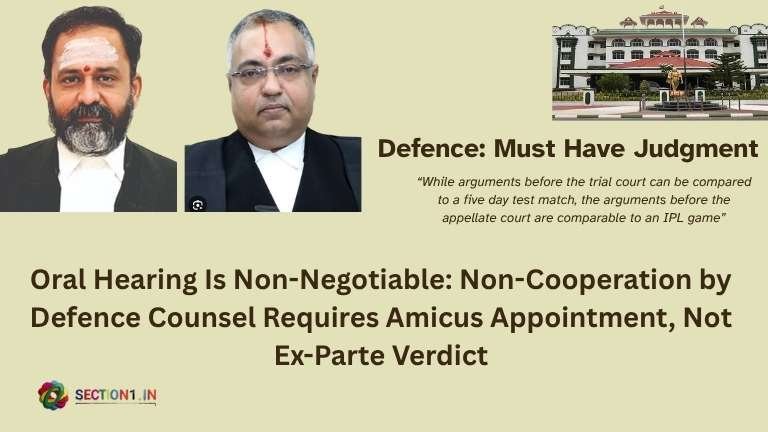
Case Details
Appeal Details and Factual Matrix
While the provided document is a judgment from the Madras High Court rather than the Supreme Court, this appeal was filed by the accused, Chinnavan @ Govindaraj (A1) and Thangabalu (A2), challenging the impugned judgment of conviction and sentence passed in S.C.No.72 of 2017 by the III Additional District and Sessions Judge, Salem. The factual matrix centers on a procedural violation during the trial concerning charges under Sections 294(b), 323, 324, 326, and 302 read with Section 34 of the IPC. After the closure of prosecution evidence and questioning under Section 313 of the Cr.P.C., the defence counsel repeatedly failed to advance oral arguments or cooperate with the proceedings. Under pressure to comply with a High Court directive to dispose of the matter within four months, the trial judge dispensed with the defence arguments entirely and proceeded to pronounce the verdict based solely on the available records. [Paras 2, 3, 5, 10]
Trial Court Verdict
The III Additional District and Sessions Judge, Salem, convicted both appellants relying exclusively on the prosecution’s evidence without granting an oral hearing to the defence. A1 was found guilty and convicted under Sections 294(b) (two counts), 324, 326, and 302 read with Section 34 of the IPC, resulting in a sentence of life imprisonment alongside rigorous imprisonment for seven years and associated fines. A2 was convicted under Sections 294(b) (two counts), 323, and 302 read with Section 34 of the IPC, similarly receiving a sentence of life imprisonment and corresponding fines. The trial court justified this conviction by citing the severe non-cooperation of the defence counsel and the strict mandate to conclude the day-to-day proceedings within the judicially stipulated four-month timeframe. [Paras 3, 4, 11]
Core Legal Arguments
The primary legal controversy revolved around whether a trial court could legally pronounce a judgment without hearing oral arguments from the defence. The appellate court suo motu took up the issue of the vitiated trial after noting the absence of defence arguments in the impugned judgment, inherently representing the appellants’ stance that the denial of an oral hearing breached the fundamental right to a fair trial. Conversely, the State, represented by the Government Counsel, argued that the trial court’s omission to hear the defence arguments was a curable defect. Relying on the precedent in K.S. Panduranga v. State of Karnataka, the State contended that the appellate court could rectify the procedural flaw by hearing the defence arguments comprehensively during the appeal itself rather than remanding the matter. [Paras 2, 6, 16]
Ratio Decidendi
The Court established that the right to advance oral arguments is not solely a statutory mandate under Sections 234 and 235 of the Cr.P.C., but a non-waivable fundamental right constituting a material facet of a fair trial under Article 21 of the Constitution. The statutory phrase “if any” in Section 235(1) Cr.P.C. applies exclusively to “points of law” and does not permit a trial judge to dispense with oral arguments. Consequently, a trial court cannot pronounce a conviction based solely on records due to the non-cooperation of defence counsel; instead, it is legally obligated to appoint a legal aid counsel or an amicus curiae to argue on the accused’s behalf. This fundamental deprivation of a full oral hearing at the trial stage permanently vitiates the proceedings and cannot be cured subsequently at the appellate level. [Paras 8, 11, 12, 14, 17]
Important Paragraphs
Dissenting Judgment
9. There are various stages in a criminal trial. The Hon’ble Supreme Court in Ashok v State of UP reported in (2025) 2 SCC 381 held as follows:
“38.5. An accused who is not represented by an advocate is entitled to free legal aid at all material stages starting from remand. Every accused has the right to get legal aid, even to file bail petitions;”
If the counsel who appears for the accused fails to discharge his professional obligation and his duty to the court, it must be deemed that the accused is not represented and alternative steps will have to be taken by the court itself. Oral arguments do constitute a material stage in a criminal trial. The Hon’ble Delhi High Court in Sushil Ansal v State through CBI reported in 2007 SCC OnLine Del 1306 recognised the importance of an opportunity to address final arguments in the following terms:
“10 …A fair trial means that a proper opportunity has to be given to the accused to address arguments on charge, to cross-examine the witnesses, to answer the questions under Section 313 Cr.P.C, to lead defence and to address final arguments…”
10. The issue that is now being considered came up for consideration before the Division Bench of the Allahabad High Court. On account of split verdict, the matter was referred to the third Judge. The third Judge (His Lordship Mr. Justice Vikram Nath as His Lordship then was) formulated the issues as follows:
“1. The extent of right of the accused to be heard through his counsel and for submission of written brief in view of section 314 Cr.P.C.
2. Whether even where accused have appointed their counsel, the Trial Court is still obliged under law to appoint Amicus Curiae where counsel for the defence is not cooperating and advancing his arguments.
3. Whether any prejudice is caused to the accused on account of the failure of his counsel to argue on his behalf and submit written brief even though the Trial Court has considered and discussed the evidence available on record.
4. Whether the appeal being continuation of proceedings and being a statutory right of the accused, the Appellate Court by providing hearing to the counsel for the accused in appeal can ratify the defect which has occasioned before the Trial Judge where opportunity of oral hearing was denied.”
His Lordship held that the right of the accused under Section 314 of Cr.Pc is for availing the opportunity provided and not to misuse or abuse such right. The accused can complain only if no right was extended. The question of appointing legal aid counsel would arise only when the accused lacks sufficient means to engage a pleader. When the trial court had dealt with the evidence and was constrained to give judgment without the benefit of defence arguments, the prejudice, if at all can be set right by granting opportunity at the appellate stage.
11.With the greatest respect and with utmost humility, we dissent from the said view. This is for more than one reason. Sections 234 and 235 of Cr.Pc were not brought to the notice of the Hon’ble Judge. Likewise, the defence does not appear to have invoked Article 21 of the Constitution of India. Section 234 of Cr.Pc has already been extracted. Section 235 of Cr.Pc reads as follows:
“235.Judgment of acquittal or conviction.— (1) After hearing arguments and points of law (if any), the Judge shall give a judgment in the case...
The language of Section 235 Cr.PC clinches the issue. It clearly states that the Judge shall pronounce the judgment after hearing the arguments. It means that the arguments should precede the pronouncement of judgment. Unless the trial Judge had heard the arguments on either side, he cannot proceed to the next stage (ie.,) pronouncement of judgment.
Conclusion
Matter remitted back to the file of the trial court
17. Since the trial Court had pronounced the judgment convicting the accused without hearing the oral arguments of the defence, we hold that their right to fair trial has been breached. It is for this reason, we set aside the impugned judgment. The matter is remitted to the file of the trial Court. The learned trial Judge will call upon both sides to advance their arguments. If the accused do not extend their cooperation, an amicus shall be appointed to argue the case and thereafter, the trial Court will pronounce the judgment. We make it clear that we have not gone into the merits of the matter and the case is remanded only for the purpose of hearing the arguments on either side.
18. The accused do not appear to be lacking means. They had already engaged a counsel before the trial court. They had also engaged a counsel before this Court. The fee payable to the amicus, if appointed, shall be recovered from the accused as if it is an arrear of fine. We also take this opportunity to remind the defence counsel of their duty to court. If the counsel’s authority has not been withdrawn by the accused, they are obliged to get along with the matter and not decline to argue the case. Deliberate avoidance in this regard may even amount to professional misconduct.
19. Accordingly, the criminal appeal stands allowed. Since the judgment of conviction and sentence has been set aside by us, the appellants will continue to be on bail. Consequently, connected miscellaneous petition is closed.
Judgments Cited
- PN Eswara Iyer v. Supreme Court of India (1980) 4 SCC 680: Quoted to emphasize the “non-fungible importance” and precious nature of oral advocacy, the Socratic process, and the Bar-Bench dialogue.
- Lombardi Engineering v. Uttarakhand Jal Vidyut Nigam Ltd. ((2024) 4 SCC 341) & Basheshar Nath v. CIT (1959) 35 ITR 190: Relied upon to support the constitutional proposition that certain fundamental rights, such as those founded on Article 14, cannot be waived by an individual.
- Sarla Gupta v. Directorate of Enforcement (2025 INSC 645): Cited to establish that the right to a fair trial is a recognized fundamental right flowing from Article 21 of the Constitution, meaning an accused cannot waive their right to oral arguments.
- Ashok v. State of UP ((2025) 2 SCC 381): Quoted to highlight that an unrepresented accused is entitled to free legal aid at all material stages, establishing that if a counsel fails their duty, the court must make alternative arrangements.
- Sushil Ansal v. State through CBI (2007 SCC OnLine Del 1306): Referenced to define a fair trial, which strictly requires providing the accused with a proper opportunity to address final arguments.
- Dr. Narayan Waman Nerukar v. State (2009 SCC OnLine Del 3613): Used for statutory interpretation regarding the grammatical use of parentheses—specifically the phrase “if any” in Section 235(1) Cr.P.C.—to show it applies only to “points of law” and not “arguments”.
- K. Muruganadam v. State ((2021) 20 SCC 642): Cited to demonstrate that an appellate court cannot dismiss an appeal for default without an oral hearing and is obligated to appoint an amicus curiae if the defense counsel fails to appear, a standard that applies with even greater force to trial courts.
- Sunil Garg v. Munnalal Halwai (2020 SCC OnLine Bom 11795): Quoted for observations on the unmatched and critical importance of oral advocacy in the forensic process.
- K.S. Panduranga v. State of Karnataka ((2013) 3 SCC 721): Relied upon by the State to argue that the lack of defense arguments could be cured at the appellate stage; however, the Court distinguished this precedent as it applied to appellate courts disposing of appeals, not trial courts rendering initial convictions without a hearing.
Acts and Sections
- Code of Criminal Procedure, 1973 (Cr.P.C.): Sections 234, 235, 235(1), 235(2), 313, 314, 314(1), 314(3), 314(4), and 372.
- Bharatiya Nagarik Suraksha Sanhita, 2023 (BNSS): Sections 257 and 349(1).
- Indian Penal Code, 1860 (IPC): Sections 294(b), 302, 323, 324, 326, read with Section 34.
- Constitution of India: Articles 14 and 21.
Party
Chinnavan @ Govindaraj and Thangabalu v. The State and Anr - Criminal Appeal No. 1185 of 2022 - 29-05-2026 - Hon'ble Mr. Justice G.R. Swaminathan and the Hon'ble Mr. Justice V. Lakshminarayanan.