
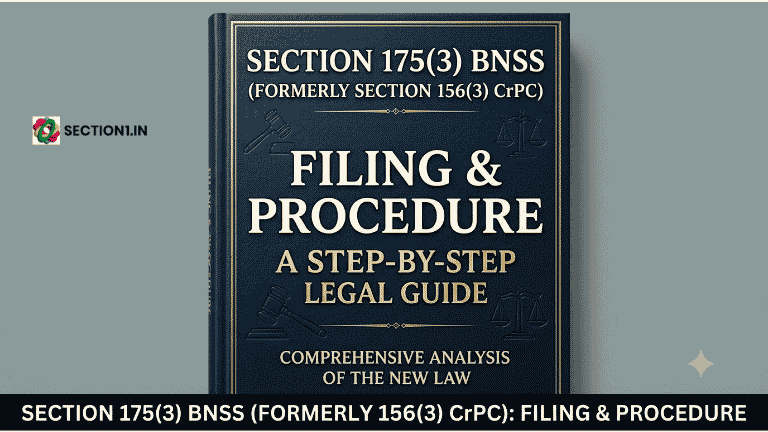
- 1. Section 156(3) Cr.P.C/Section 175(3) BNSS: Purpose and Scope of the Provision
- 2. CrPC 1973 vs BNSS 2023 — What Changed and Why It Matters
- 2.1. Statutory extracts (verbatim quotations)
- 2.2. Explanation — Section 175(3) BNSS
- 2.3. The three BNSS safeguards (new over CrPC)
- 2.4. Section-by-section correspondence (old → new)
- 3. Changed Rules — Which Code Applies
- 4. Competent Court and Territorial Jurisdiction
- 5. Mandatory Pre-Filing Steps: Police Station and Superintendent of Police
- 6.1. Mandatory legal requirements
- 6.2. Recommended drafting practice (not statutory mandates)
- 6.3. Local/State rules and verifiability
- 7. Tamil Nadu–Specific Requirements
- 8. Court Fees and Welfare Fund Stamps (Tamil Nadu)
- 9. Post-Filing Procedure: Inquiry, Police Submissions, Hearing, Orders
- 10. Complaints Against Public Servants — Section 175(4) BNSS
- 11. Case Law Digest
- 11.1. Supreme Court
- 11.2. Madras High Court (Tamil Nadu)
- 11.3. Other High Courts (persuasive)
- 11.4. A review
- 12. Common Drafting Mistakes and Filing Checklist
- 13. Further Reading — Section1.in posts relevant to section 175(3) BNSS/section 156(3) crpc
Criminal Procedure · For law students and junior advocates Compiled: 28 September 2026 · Study aid: This entire study material (practice & procedure) has been created by section1.in lawyers team, we have done our level best verified every errors and cleared it, eventhough, the readers have obligation to verify every citation against the original report before citing in court. Thanks (team section1.in)
1. Section 156(3) Cr.P.C/Section 175(3) BNSS: Purpose and Scope of the Provision
1.1. When police (SHO) refuses or fail to act on the information disclosing a cognizable offence lodged by the informat, the informant may communicate the same to the Higher Officials like S.P/Commissioner, if he/she also failed to act on the cognizable offence then the informant may request ‘any’ Magistrate to direct the police (SHO) to investigate. Under the Code of Criminal Procedure, 1973 this was Section 156(3); under the Bharatiya Nagarik Suraksha Sanhita, 2023 (in force 1 July 2024) it is Section 175(3).
1.2. The direction should be made before taking cognizance. It reminds the police to exercise their own ordinary power of investigation (Devarapalli Lakshminarayana Reddy, 1976) and does not amount to the Magistrate taking cognizance (Anju Chaudhary, 2012).
1.3. The remedy exists because FIR registration is mandatory once information discloses a cognizable offence (Lalita Kumari, Constitution Bench, 2013). Section 175(3) is the judicial backstop when the statutory police route fails: police station → Superintendent of Police → Magistrate (Sakiri Vasu, 2007).
1.4. The power is discretionary, not ministerial. The word “may” requires application of judicial mind (Ramdev Food Products, 2015, three-Judge Bench).
1.5. relevant explanation/definitions:
- Cognizable offence — A cognizable offence is defined under Section 2(1)(g) of the Bharatiya Nagarik Suraksha Sanhita (BNSS), 2023, which replaced Section 2(c) of the Code of Criminal Procedure (CrPC), 1973
- Information — complaint to police under Section 173(1) BNSS / old 154(1) CrPC
- Cognizance — Magistrate’s application of judicial mind to suspected commission of offence — Section 210 BNSS / old 190 CrPC
- Pre- vs post-cognizance — 175(3) direction precedes cognizance; post-cognizance inquiry under old 202 / new 225 is narrower
2. CrPC 1973 vs BNSS 2023 — What Changed and Why It Matters
2.1. Statutory extracts (verbatim quotations)
Section 156(3) CrPC:
“Any Magistrate empowered under section 190 may order such an investigation as above-mentioned.” (Text as reproduced in G. Prabakaran case, para 16.)
Section 175(3) BNSS – Bare Act:
“Any Magistrate empowered under section 210 may, after considering the application supported by an affidavit made under sub-section (4) of section 173, and after making such inquiry as he thinks necessary and submission made in this regard by the police officer, order such an investigation as above-mentioned.”
Section 175(4) BNSS:
“(4) Any Magistrate empowered under Section 210, may, upon receiving a complaint against a public servant arising in course of the discharge of his official duties, order investigation, subject to— (a) receiving a report containing facts and circumstances of the incident from the officer superior to him; and (b) after consideration of the assertions made by the public servant as to the situation that led to the incident so alleged.” (As reproduced in para 27 of XXX v. State of Kerala, 2026 INSC 88)
2.2. Explanation — Section 175(3) BNSS
2.2.1. A Magistrate empowered under Section 210 may order investigation contemplated by Section 175, but only after: (a) considering the application supported by an affidavit and prior approach to Superintendent of Police under Section 173(4); (b) making such inquiry as considered necessary; and (c) considering submissions of police officer concerned.
2.3. The three BNSS safeguards (new over CrPC)
- Mandatory prior SP application with affidavit — old Section 154(3) escalation now statutory precondition. Affidavit requirement judicially imposed by Priyanka Srivastava (2015) now written into framework.
- Inquiry power — Magistrate may make such inquiry as considered necessary before directing investigation. Calcutta High Court March 2026: inquiry under BNSS means inquiry by Magistrate, not by police.
- Police submissions — Magistrate must consider submissions of police officer concerned. SCC Times analysis: greater accountability, reasoned order mandatory.
[Om Prakash Ambadkar v. State of Maharashtra, 2025 INSC 139 / https://section1.in/section-1753-bnss-magistrate-may-direct-investigation-only-when-the-assistance-of-investigation-agency-is-necessary-if-the-allegations-are-simple-magistrate-can-straightaway-proceed-to-conduct-tri/ — CrPC-origin appeal in which Supreme Court read BNSS text]
2.4. Section-by-section correspondence (old → new)
- Information to police: CrPC 154(1) → BNSS 173(1)
- Escalation to Superintendent of Police: CrPC 154(3) → BNSS 173(4)
- Magistrate-directed investigation: CrPC 156(3) → BNSS 175(3) (with 175(4) where accused is public servant)
- Cognizance: CrPC 190 → BNSS 210
- Complaint to Magistrate: CrPC 200 → BNSS 223
- Postponement / inquiry before issue of process: CrPC 202 → BNSS 225
- Police report and further investigation: CrPC 173(8) → BNSS 193(9)
- Authorities for affidavits: CrPC 297 → BNSS 333
- Revision: CrPC 397 → BNSS 438
- High Court inherent powers: CrPC 482 → BNSS 528
- Change: BNSS 531 (no CrPC equivalent)
3. Changed Rules — Which Code Applies
3.1. Section 531 BNSS governs changes:
Proceedings pending immediately before 1 July 2024 continue under CrPC as if BNSS had not come into force. Section 531(2)(a) saves appeals, applications, trials, inquiries and investigations pending immediately before commencement. [https://section1.in/application-under-section-531-2-a-bnss-2023-my-view/]
3.2. Practical rule:
- If underlying police proceeding began before 1 July 2024 and is pending, CrPC provisions (156(3), 154(1), 154(3)) continue.
- Fresh application filed after 1 July 2024 on post-BNSS facts proceeds under Sections 173(1), 173(4) and 175(3).
- Calcutta High Court and J&K High Court 2025-26: stage of proceedings is decisive, not date of offence.
3.3. Always state/write the applicable Code expressly in the cause title and first paragraph mixing CrPC numbers into BNSS filing is a registrable defect.
4. Competent Court and Territorial Jurisdiction
4.1. Application lies to the Judicial Magistrate empowered under Section 210 BNSS (old 190 CrPC): Ordinarily Judicial Magistrate having jurisdiction over the police station concerned. Special statutes (POCSO) vesting jurisdiction in Special Courts exclude Magistrates.
4.2. Territorial jurisdiction follows the place where the offence or any part of the consequences occurred (Section 197-199 BNSS / old 177-179 CrPC). State/write jurisdictional facts expressly.
4.3. Do not file in the High Court in the first instance. The ordinary route is the Magistrate; High Court inherent powers (Section 528 BNSS / old 482 CrPC) are exceptional (G. Prabakaran, Madras HC Division Bench).
5. Mandatory Pre-Filing Steps: Police Station and Superintendent of Police
5.1. Step one: Inform to the police station (jurisdiction not necessary). Draft written information disclosing cognizable offence to officer in charge under Section 173(1) BNSS (old 154(1)). Keep dated acknowledged copy. Registration mandatory if cognizable offence disclosed (Lalita Kumari). Note Section 173(3) BNSS creates distinct preliminary-inquiry regime — do not mechanically carry over old Lalita Kumari 7/15-day timelines.
5.2. Step two: Communication to the Superintendent of Police. If station does not act, apply to SP under Section 173(4) BNSS (old 154(3)). Record date of delivery, any response, continuing inaction, urgency. No universal waiting period in Section 175(3); allow factually reasonable opportunity and explain why Magistrate intervention now necessary.
5.3. Step three: Proof of communication. Preserve postal receipts, acknowledgment stamps, email/portal confirmations, replies. Priyanka Srivastava and BNSS framework both require prior approaches disclosed and evidenced.
5.4. Step Four: Affidavit. Application must be supported by sworn affidavit compliant with Section 333 BNSS (old 297 CrPC). Separate facts within personal knowledge from facts stated on information and belief, state grounds of belief. XXX v. State of Kerala (para 59) specifically requires Section 333-compliant affidavit.
6.1. Mandatory legal requirements
- Disclosure of facts constituting cognizable offence — ingredients, not bare penal-section numbers.
- Compliance with prior police route — Sections 173(1) and 173(4) BNSS, with proof.
- Section 333 BNSS-compliant affidavit.
- Jurisdiction of court stated and established (normally any magistrate).
- Magistrate must consider police officer’s submissions before directing investigation — judicial step, applicant cannot manufacture it.
- Application of mind must be reflected — mere “perused” insufficient (Anil Kumar v. M.K. Aiyappa, 2013).
6.2. Recommended drafting practice (not statutory mandates)
- Cause title with provision invoked (Section 175(3) BNSS; add 175(4) if public servant involved).
- Numbered paragraphs in strict chronological order: facts, then police complaint, then SP application, then inaction.
- Applicant details; proposed-accused details where known — describe unknown persons honestly, use “proposed accused” rather than asserting guilt as fact.
- Separate paragraph explaining why police investigation powers are necessary (records to seize, electronic evidence, unknown participants).
- Disclosure of connected or pending proceedings.
- Specific prayers; date, place, signature.
6.3. Local/State rules and verifiability
- Every factual assertion tied to annexure (complaints, proofs of delivery, replies).
- Registries return applications mixing assertion with evidence; keep the two in separate paragraphs.
- General Diary entry difficult to fabricate — chronological order is verifiable.
7. Tamil Nadu–Specific Requirements
7.1. Directions (CrPC-era, preserved by Division Bench). In Sugesan Transport (2016), a Single Judge issued affidavit-based escalation directions; the Division Bench in G. Prabakaran (2018) modified the six-week High Court waiting period but preserved the remaining directions – Proof of Section 154 complaint, affidavit requirement, and remedy for police non-compliance after the Magistrate’s order. Now be read under BNSS.
7.2. When to approach High Court: G. Prabakaran (Division Bench, binding in Tamil Nadu) held ordinary route 154(1) → 154(3) → 156(3), with Section 482 exceptional and entertainable only after 15 days from police complaint, subject to affidavit and registry scrutiny. 15-day figure has no express counterpart in Section 175(3) BNSS; exhaustion and affidavit principles survive. Confirm current Tamil Nadu BNSS practice before relying on waiting period.
7.3. Magistrate’s dispatch register. Veerammal v. Superintendent of Police, Theni, 2008 (1) MWN (Cri) 19 (Mdu): Magistrate while sending application under 156(3) shall make dispatch entry in separate register, police after registering FIR shall send FIR without delay, Magistrate shall make receipt entry. On failure, issue memo to police.
8. Court Fees and Welfare Fund Stamps (Tamil Nadu)
8.1. Tamil Nadu Court-Fees and Suits Valuation Act, 1955 (TN Act XIV of 1955) governs court fees; Schedules amended several times (notably Amendment Acts including 2017 raising writ fees). Verify current Schedule entry and counter practice before filing.
8.2. Fees should be affixed on application itself. Schedule II.
8.3. On vakalatnama (verify Madras High Court FAQ). Madras High Court Appeal Examiners FAQ states vakalatnama bears: court fee Rs.10, Advocate Welfare Fund stamp Rs.30, Advocate Clerk Welfare Fund stamp Rs.2. Secondary source summarising state-wise welfare-stamp rules gives Rs.30 for lower courts and Rs.50 for Madras High Court. Tamil Nadu Advocates Welfare Fund stamp enhanced from Rs.30 to Rs.100-120 in recent years per Bar Council notification, strictly monitored via TASBA digital app in 2026. Confirm denomination in force at filing counter.
8.4. These are state-law fees, independent of BNSS; BNSS prescribes no court fee. Advocate Welfare Fund Act, 1987 and Tamil Nadu Advocates Welfare Fund Rules apply.
9. Post-Filing Procedure: Inquiry, Police Submissions, Hearing, Orders
9.1. Judicial examination: Magistrate examines allegations, statutory prerequisites, affidavit, jurisdiction; may make such inquiry as considered necessary; must consider police officer’s submissions. Discretion cannot be exercised mechanically (Om Prakash Ambadkar; Ramdev Food Products para 22).
9.2. Hearing: Applicant ready to explain alleged offence, prior police approaches, need for investigation. Section 175(3) does not create general hearing right for proposed accused at pre-cognizance stage; do not import cognizance-stage safeguards of Sections 223/225 BNSS into 175(3) application. Where Section 175(4) applies, public servant’s assertions expressly considered.
9.3. Possible orders:
- Direction to investigate (which may require FIR registration — explicit registration language not indispensable, Dilawar Singh).
- Refusal, which must be reasoned, indicating ingredients not disclosed or remedy not requiring police machinery.
- In appropriate case, Magistrate may instead proceed on examining the informat and convert the petition as complaint where police investigation not genuinely necessary.
9.4. After direction. Police register FIR (if not already) and investigate – initial investigation (Vinay Tyagi). Further investigation remains possible (Section 193(9) BNSS / old 173(8)). If closure report follows, informant ordinarily receives notice and opportunity to object (Bhagwant Singh). If police do not comply with direction, Madras HC directions preserved in G. Prabakaran contemplate remedy; map High Court route to Sections 438 and 528 BNSS.
9.5. Nature of order. Direction under 175(3) is pre-cognizance, does not amount to taking cognizance, cannot be equated to summoning. If Magistrate takes cognizance and embarks on Chapter XV / Chapter XVI BNSS, cannot revert to 156(3)/175(3) (Madhao v. State of Maharashtra, 2013 (2) LW (Cri) 51 SC = (2013) 5 SCC 615).
10. Complaints Against Public Servants — Section 175(4) BNSS
10.1. Under XXX v. State of Kerala, 2026 INSC 88 (binding; BNSS), sub-sections (3) and (4) are not isolated. Framework:
- Complaint remains written and affidavit-supported (Section 333).
- Magistrate first assesses official-duty nexus.
- Where nexus clear or reasonably doubtful: obtain superior officer’s report and consider public servant’s assertions.
- Report not awaited indefinitely — if not provided within reasonable, case-dependent period, Magistrate may proceed under 175(3) after considering recorded assertions.
- Where act clearly has no reasonable nexus to official duty (e.g., sexual assault alleged in XXX), ordinary 175(3) procedure applies, 175(4) directory not mandatory.
- Rejection must be reasoned.
10.2. Separate protections. Independently examine Section 218 BNSS (prosecution sanctions) and special-statute approvals — e.g., Sections 17A and 19 Prevention of Corruption Act operate at different stages. Superior officer’s report under 175(4) does not automatically satisfy separate approval or sanction requirement.
10.3. Two-tier protection for public servants under BNSS (SCC Times, SC Guidelines): threshold stage under 175(4) and cognizance stage under 218(1).
11. Case Law Digest
11.1. Supreme Court
Devarapalli Lakshminarayana Reddy v. V. Narayana Reddy · SC · 4 May 1976 · (1976) 3 SCC 252 · para 17 Ruling: 156(3) direction is pre-cognizance; reminds police to exercise own investigation power, differs from post-cognizance inquiry (old 202). Effect: foundational on stage. Status: binding; CrPC.
Bhagwant Singh v. Commissioner of Police · SC · 1985 · (1985) 2 SCC 537 Ruling: informant ordinarily receives notice and opportunity to object before closure report accepted. Effect: protects informant post-investigation. Status: binding; CrPC; post-investigation context.
Dilawar Singh v. State of Delhi · SC · 5 Sep 2007 · (2007) 12 SCC 641 · para 18 Ruling: Magistrate may direct investigation without examining complainant on oath; direction can require FIR registration without explicit words. Effect: simplifies pre-cognizance hearing. Status: binding; CrPC.
Sakiri Vasu v. State of U.P. · SC · 7 Dec 2007 · (2008) 2 SCC 409 · paras 26-27 Ruling: remedy sequence superior police → Magistrate under 156(3); complaint route (old 200) survives; 156(3) direction implies proper investigation, not mere registration. Effect: establishes exhaustion. Status: binding; CrPC; arose from improper investigation.
Vinay Tyagi v. Irshad Ali · SC · 13 Dec 2012 · (2013) 5 SCC 762 · paras 20-21 Ruling: distinguishes initial, further, fresh investigation; 156(3) direction produces initial investigation. Status: binding; CrPC.
Anju Chaudhary v. State of U.P. · SC · 13 Dec 2012 · 2013 (1) CTC 714 · para 35 (as cited in G. Prabakaran) Ruling: directing investigation under 156(3) is not taking cognizance. Effect: pairs with Devarapalli. Status: binding; CrPC; non-SCC citation — find reporter equivalent.
Lalita Kumari v. Govt. of U.P. · Constitution Bench SC · 12 Nov 2013 · (2014) 2 SCC 1 · paras 120-121 Ruling: FIR registration mandatory when cognizable offence disclosed; narrow preliminary-inquiry exception. Effect: registration backstop. Status: binding; CrPC; old 7/15-day timelines superseded by Section 173(3) BNSS.
Priyanka Srivastava v. State of U.P. · SC · 19 Mar 2015 · (2015) 6 SCC 287 Ruling: application must be affidavit-supported and must disclose prior 154(1)/154(3) approaches. Effect: judicial affidavit rule now absorbed into BNSS. Status: binding; CrPC; failure to file affidavit curable if filed before order (S.N. Vijayalakshmi).
Ramdev Food Products (P) Ltd. v. State of Gujarat · SC (3-Judge) · 16 Mar 2015 · (2015) 6 SCC 439 · para 22 Ruling: direction follows application of judicial mind; appropriate where immediate police investigation needed; preliminary inquiry possible. Para 22.6 factors include credibility of information, interest of justice. Effect: against mechanical directions. Status: binding; CrPC.
Om Prakash Ambadkar v. State of Maharashtra · SC · 16 Jan 2025 · Crl.A. No. 352/2020 · 2025 INSC 139 / 2025 LiveLaw (SC) 139 / MANU/SC/0134/2025 Ruling: identifies three BNSS safeguards — prior SP application with affidavit, inquiry, police submissions. Mechanical order directing investigation without verifying ingredients set aside. Magistrate must not act as post office. Effect: leading BNSS-era statement. Status: binding; CrPC-origin appeal — its BNSS discussion is Court’s reading of new law.
XXX v. State of Kerala · SC · 27 Jan 2026 · Crl.A. No. 4629/2025 · 2026 INSC 88 · paras 27-28, 42-48, 59 Ruling: Section 175(4) not standalone; complaint stays written and affidavit-supported; official-duty triage; superior report and assertions; reasonable-time exception; reasoned rejection; Section 333 affidavit compliance. Effect: controlling authority on public-servant complaints. Status: binding; BNSS; verification gap — inspect official judgment before publication.
11.2. Madras High Court (Tamil Nadu)
Sugesan Transport (P) Ltd. v. Assistant Commissioner of Police · Madras HC Single Judge · 27 Sep 2016 · 2016 (2) LW (Crl) 499 · para 99 directions Ruling: affidavit-based escalation route and administrative safeguards. Status: CrPC-era; Single Judge; six-week High Court waiting point modified by Division Bench in G. Prabakaran; remaining directions preserved — re-read under BNSS.
K. Ragupathy v. Commissioner of Police · Madras HC Single Judge · 2017 (3) MLJ (Crl) 309 and 2017 (2) MWN (Cr) 430 Ruling: treated Section 482 as available despite 156(3) remedy. Status: not approved on broad maintainability by Division Bench — effectively overruled on that point.
G. Prabakaran v. Superintendent of Police · Madras HC Division Bench · 20 Sep 2018 · Crl.O.P.(MD) No. 13681/2018 batch · para 35 Ruling: ordinary route 154(1) → 154(3) → 156(3); Section 482 exceptional, entertainable only after 15 days from police complaint, subject to affidavit and registry scrutiny. Status: CrPC-era; Division Bench — binding in Tamil Nadu on High Court route; 15-day figure has no express BNSS counterpart.
Veerammal v. Superintendent of Police, Theni · Madras HC · 2008 (1) MWN (Cri) 19 (Mdu) Ruling: dispatch register, receipt entry, memo on non-compliance. Status: persuasive procedure.
11.3. Other High Courts (persuasive)
Subhkaran Luharuka v. State · Delhi HC · 9 Jul 2010 Ruling: Magistrate should examine whether police investigation genuinely necessary — bank records, electronic evidence, unknown participants require compulsory process. Status: persuasive; CrPC-era; not binding on Madras; do not stretch into rule that every complaint needs police investigation.
Calcutta High Court March 2026 (Justice Ajoy Kumar Mukherjee) Ruling: under Section 175(3) Magistrate cannot direct police to conduct inquiry and must himself undertake inquiry before ordering investigation. Status: persuasive, BNSS.
11.4. A review
- Exhaustion: Sakiri Vasu + Priyanka Srivastava + G. Prabakaran → police route first; affidavit always.
- Discretion, not duty: Ramdev + Om Prakash Ambadkar → judicial mind applied after three safeguards.
- Pre-cognizance character: Devarapalli + Anju Chaudhary + Dilawar Singh → no cognizance, no oath examination needed.
- Registration ≠ investigation: Sakiri Vasu → direction implies proper investigation; closure protected by Bhagwant Singh notice.
- Effect of later legislation: BNSS codified Priyanka Srivastava affidavit rule and added inquiry and police-submissions safeguards; did not disturb exhaustion or discretion principles. Lalita Kumari timelines superseded by Section 173(3) BNSS.
12. Common Drafting Mistakes and Filing Checklist
12.1. Common mistakes
- Skipping Superintendent of Police application under Section 173(4).
- Missing or defective affidavit (not Section 333-compliant; personal knowledge not separated from belief).
- Asserting guilt as established instead of pleading ingredients of cognizable offence.
- Citing CrPC section numbers in post-1 July 2024 matter (transition under Section 531 ignored).
- Demanding direction as of right — it is discretionary, requires necessity analysis.
- Ignoring Section 175(4) in public-servant cases, or treating it as standalone route.
- Approaching High Court before exhausting Magistrate route (G. Prabakaran).
- Bare penal-section numbers without facts satisfying ingredients.
- Undisclosed connected or pending proceedings.
- Vague or missing prayers; asking Magistrate to “punish” rather than direct investigation.
- No jurisdictional facts; filing before Magistrate not empowered under Section 210.
- Mixing assertion with evidence; no annexure index.
12.2. Filing checklist
- Police complaint under Section 173(1) delivered, with dated proof of delivery.
- SP application under Section 173(4) delivered, with proof and outcome or period of inaction recorded.
- Application with numbered, chronological facts disclosing ingredients of cognizable offence — structured, chronological, verifiable.
- Section 333-compliant affidavit sworn before proper authority.
- Annexures indexed: police complaint, SP application, proofs of delivery, replies, supporting evidence.
- Correct Magistrate identified (territorial jurisdiction and empowerment under Section 210). [Actually ‘any’ magistrate]
- Applicable Code stated expressly (CrPC or BNSS per Section 531 transition).
- Connected or pending proceedings disclosed.
- Public-servant involvement analysed; if present, Section 175(4) and sanction analysis completed.
- Prayers precise (direction to investigate — not “punish accused”). [Sakiri Vasu judgment empowered magistrates to direct registration of fir and other possible prayers within the limits]
- Court fee and welfare-fund stamps per current TN Schedules affixed.
- Date, place, and signature completed.
- Copy for police officer concerned and dispatch register entry contemplated.
- Reasonableness of waiting after SP approach explained.
13. Further Reading — Section1.in posts relevant to section 175(3) BNSS/section 156(3) crpc
Section 175(4) BNSS: A Guide for Judicial Magistrates — https://section1.in/section-1754-bnss-a-guide-for-judicial-magistrates/ — reproduces Supreme Court’s public-servant analysis in XXX v. State of Kerala, affidavit requirement, Magistrate-facing triage under 175(4). Directly relevant to Part 10.
- Evolution of FIR Registration with Comparative Analysis of CrPC Sections 154/156(3) and BNSS Sections 173/175(3) — https://section1.in/evolution-of-fir-registration-with-comparative-analysis/ — traces statutory movement from old Code to BNSS; background for Parts 2 and 3.
- Strict Compliance Mandatory: The Necessity of Police Reports Before Directing Investigations under Section 175(3)/(4) BNSS — https://section1.in/strict-compliance-mandatory-police-reports-before-directing-investigations/ — explains police-submissions/report requirement before direction; supports Part 9.
- Remedy and Challenges After the Order of the Magistrate for FIR Direction — https://section1.in/remedy-and-challenges-after-the-order-of-the-magistrate-for-fir-direction/ — post-order remedies and effect of closure report; supports Part 9.4.
- Magistrate Ordinarily Would Not Entertain Application u/s 156(3) CrPC Without First Approaching the Police Authorities, but Can Direct Investigation if Complaint Discloses Cognizable Offence — https://section1.in/magistrate-ordinarily-would-not-entertain-application-u-s-1563-crpc-without-first-approaching-police-authorities/ — prior police-authority route and affidavit evolution; supports Parts 5 and 11.
- Even on a Private Complaint, the Magistrate Before Taking Cognizance Is Empowered to Forward Complaint for Investigation under Section 156(3) CrPC — https://section1.in/even-on-a-private-complaint-the-magistrate-before-taking-cognizance-is-empowered-to-forward-complaint-for-investigation/ — pre-cognizance power to forward complaint; supports Part 1.
- Section 175(3) BNSS: Magistrate May Direct Investigation Only When Assistance of Investigation Agency Is Necessary; If Allegations Simple, Magistrate Can Straightaway Proceed to Conduct Trial — https://section1.in/section-1753-bnss-magistrate-may-direct-investigation-only-when-the-assistance-of-investigation-agency-is-necessary-if-the-allegations-are-simple-magistrate-can-straightaway-proceed-to-conduct-tri/ — necessity analysis and direct-complaint alternative; supports Parts 9.3 and 11.3. Analysis of Om Prakash Ambadkar v. State of Maharashtra.
Notes on Registering FIR and Magistrate Powers — https://section1.in/notes-on-registering-fir-and-magistrate-powers/ — guidance on how Magistrates should handle applications under 156(3)/175(3).