

Total summary
Appeal
The appellant, Om Prakash Ambadkar, filed the criminal appeal challenging the common judgment and order passed by the High Court of Judicature at Bombay, Nagpur Bench, which had rejected the appellant’s Section 482 Cr.P.C. application and affirmed the Judicial Magistrate First Class’s order directing a police investigation and FIR registration under Section 156(3) Cr.P.C.
Factual
The factual matrix involves an incident where a practicing advocate alleged that the appellant, a police officer, humiliated him during late hours on December 31, 2011, and that local police subsequently refused to register his report, prompting him to approach the Bar Association, the Superintendent of Police, and ultimately file a private complaint and Section 156(3) Cr.P.C. application before the Magistrate
Arguments
The appellant argued that the Magistrate mechanically ordered a police investigation without judicially verifying whether the complaint’s allegations constituted the alleged offenses under Sections 323, 294, 500, 504, and 506 IPC or met the necessary legal ingredients, whereas the respondent State maintained that the lower courts’ concurrent decisions were legally sound
Ratio
The ratio decidendi established by the Court is that a Magistrate must exercise an independent judicial mind and active scrutiny rather than acting merely as a post office and cannot mechanically order a police investigation under Section 156(3) Cr.P.C. without first verifying whether a plain reading of the complaint’s allegations discloses the essential ingredients of the alleged offences.
Important paragraphs
4. The Magistrate looked into the application filed by the complainant seeking police investigation and vide order dated 09.01.2012 passed an order directing the police authorities to register an FIR and undertake the necessary investigation.
Order of the Judicial Magistrate u/s 156(3) CrPC application
5. The order passed by the Magistrate referred to above reads thus:-
“1. Heard counsel for the applicant, perused the application, report and affidavit.
2. In short the story of the application is as under: That, the applicant is a practicing advocate and on 31.12.2011 at about 11.30 to 11.40 p.m. the policeman (appellant) humiliated the applicant. Therefore, the applicant went to Police Station on 3/1/12 to lodged a report at Police Station, Digras. But police did not accept the same. Therefore, he submitted one application to the Bar Association Digras on 3/1/12 and thereafter, the Bar Association supported the applicant and thereafter, the grievances were raised before the Superintendent of Police at Yavatmal but the police authorities were avoiding to register the offence, though the offences are cognizable. Hence, he filed this application on 06.01.2012.
3. Heard counsel for applicant Shri T.M. Malnas at length., perused application, report and affidavit, after going through the submissions and case paper, it appears that the complaint discloses the commission of offence under section 294 of IPC which is a cognizable offence. The Learned counsel for applicant relied on the ruling of Honourable Bombay High Court in 1) Bhavarabai W /o Parashramji Atal v. Sanjay Ramchandra Gundhewar, reported in 2011 Volume 4 Mh. L.J. (Crl.) Page No.283; and 2) Narayandas S/o Hirlalji Sarda and Ors v. State of Maharashtra reported in 2008 All MR (Cri). 2737. The learned counsel for the applicant submitted that the cognizable offence is made out from the allegations levelled by the applicant and therefore he submitted that the ratio laid down in the ruling is applicable. Considering the submissions and after going through the contents of the complaint, I agree that the ratio laid down in the above ruling is applicable as the offence under Section 294 IPC is cognizable and it appears from the complaint that the applicant has tried to lodged the report at PS Digas on 3.1.2012 but police has not registered the offence. The counsel “for applicant further submitted that, there is no bar to register the offence against the police as under Section 197 of Cr.P.C. as the act of the policeman was not in discharge of his official duties. So he relied upon the ruling of Honourable Bombay High court 1) Nandkumar S. Kale v. Bhaurao Chandrabhanji Tidke, reported in 2007 All MR (Cri), 2737, the ruling of Honourable Supreme Court 2) State of Maharashtra Vs. Devhari Devsingh Pawar and others, reported in 2008 AII MR (Cri) 518 (Supreme Court). After going through the allegations made by the applicant in the complaint it appears that, the police has abused him and threatened to kill him and also humiliated the complainant. With due respect to the ratio laid down in the above decisions, I am of the view that the alleged act of the police are not in discharge of official duty. Hence the previous sanction under Section 197 CrPC is not necessary.
4. After going through the submissions and application, report, affidavit and the ruling cited by the applicant, it is a fit case to call the report of police under Section 156(3) of Cr.P.C. Hence, application is allowed and police Station office, Police Station, Digras is directed to register the offence and submit his report under Section 156(3) of CrPC within stipulated period.”
7. We have heard Ms. Kashmira Lambat, the learned counsel appearing for the appellant and Mr. D. Kumanan, the learned counsel appearing for the respondent, that is, the State of Maharashtra.
9. As we see it, the words are plain and the meaning is clear. It empowers any officer in-charge of a Police Station to investigate any cognizable offence without the order of a Magistrate.
When section 156(3) CrPC will be invoked?
10. Ordinarily, Section 156(3) of the Cr.P.C. is invoked by the complainant when the police authorities decline to register a First Information Report. In such circumstances, a private complaint may be made in the court of the Judicial Magistrate and the complainant may pray that police investigation be ordered under Section 156(3) of the Cr.P.C. However, it is the discretion of the concerned Magistrate whether to order police investigation under Section 156(3) of Cr.P.C. or take cognizance upon the complaint and issue process or dismiss the complaint under Section 203 of Cr.P.C. Over a period of time and in view of many decisions of this Court, if the officer in-charge of the concerned Police Station for some reasons declines to register the FIR, then the law has left it open for the complainant to file an appropriate application before the Magistrate and pray for police investigation. Once an order is passed for police investigation under Section 156(3) of the Cr.P.C., then it becomes a police case. At the end of the investigation the police may either file a charge-sheet or file an appropriate closure report.
Application of judicial mind
11. However, what is important to observe is that whenever any application is filed by the complainant before the Court of Judicial Magistrate seeking police investigation under Section 156(3) of the Cr.P.C., it is the duty of the concerned Magistrate to apply his mind for the purpose of ascertaining whether the allegations levelled in the complaint constitute any cognizable offence or not. In other words, the Magistrate may not undertake the exercise to ascertain whether the complaint is false or otherwise, however, the Magistrate is obliged before he proceeds to pass an order for police investigation to closely consider whether the necessary ingredients to constitute the alleged offence are borne out on plain reading of the complaint.
12. In the case on hand, it appears that the Magistrate passed an order directing police investigation mechanically and without ascertaining whether the allegations levelled disclose commission of any offence or not.
Hon’ble S.C observation on offence of obscenity not involved
13. It is the case of the complainant that the appellant herein committed offence punishable under Section 294 of the IPC. The Magistrate very promptly accepted this contention without ascertaining if the necessary ingredients required to constitute the offence were disclosed in the complaint or not. In our view, even if all the allegations as levelled in the complaint are believed to be true, none of the ingredients to constitute the offence punishable under Section 294 of the IPC could be said to be borne out.
15. We fail to understand how the act of a police officer assaulting the complainant within public view or public as alleged would amount to an obscene act. Obscene act for the purpose of Section 294 has a particular meaning. Mere abusive, humiliating or defamatory words by themselves are not sufficient to attract the offence under Section 294 of the IPC.
16. Thus, in so far as Section 294 of the IPC is concerned, we are of the view that no case is made out to put the appellant/accused to trial.
Hon’ble S.C observation on offences under sections 504 & 506 IPC not involved
17. We shall now deal with Sections 504 and 506 of the IPC respectively.
18. A two-Judge Bench of this Court, speaking through one of us, J.B. Pardiwala, Justice, in its decision in Mohammad Wajid & Anr. v. State of U.P. & Ors. (Criminal Appeal No. 2340/2023 decided on August 8, 2023) explained what constitutes an offence of criminal intimidation. We quote the relevant paragraphs from the said decision as under:-
“23. Chapter XXII of the IPC relates to Criminal Intimidation, Insult and Annoyance”
19. Applying the principles as explained aforesaid, we are of the view that none of the ingredients to constitute the offence punishable under Sections 504 and 506 of the IPC respectively are borne out.
20. We fail to understand how the Magistrate could have directed the police to investigate into the offence of defamation punishable under Section 500 of the IPC. We are at a loss to understand as to why this aspect was not looked into even by the High Court.
Mechanical order of the magistrate and the duty of the High Court
21. The aforesaid reflects the mechanical manner in which the order came to be passed for police investigation under Section 156(3) of the Cr.P.C. It was expected of the High Court to look into all these relevant aspects before rejecting the petition filed by the appellant herein under Section 482 of the Cr.P.C.
Judgment on application of mind
23. This Court in a plethora of its decisions, more particularly in the case of Ramdev Food Products (P) Ltd. v. State of Gujarat reported in (2015) 6 SCC 439, has laid emphasis on the fact that the directions under Section 156(3) should be issued only after application of mind by the Magistrate. Paragraph 22 of the said decision reads thus:-
“22. Thus, we answer the first question by holding that the direction Under Section 156(3) is to be issued, only after application of mind by the Magistrate. When the Magistrate does not take cognizance and does not find it necessary to postpone issuance of process and finds a case made out to proceed forthwith, direction under the said provision is issued. In other words, where on account of credibility of information available, or weighing the interest of justice it is considered appropriate to straightaway direct investigation, such a direction is issued. Cases where Magistrate takes cognizance and postpones issuance of process are cases where the Magistrate has yet to determine “existence of sufficient ground to proceed”. Category of cases falling under Para 120.6 in Lalita Kumari (supra) may fall Under Section 202 Subject to these broad guidelines available from the scheme of the Code, exercise of discretion by the Magistrate is guided by interest of justice from case to case.”
Issue of jurisdiction also important while directing investigation
24. Thus, there are prerequisites to be followed by the complainant before approaching the Magistrate under Section 156(3) of the Cr.P.C. which is a discretionary remedy as the provision proceeds with the word ‘may’. The Magistrate is required to exercise his mind while doing so. He should pass orders only if he is satisfied that the information reveals commission of cognizable offences and also about the necessity of police investigation for digging out of evidence neither in possession of the complainant nor can be procured without the assistance of the police. It is, thus, not necessary that in every case where a complaint has been filed under Section 200 of the Cr.P.C. the Magistrate should direct the Police to investigate the crime merely because an application has also been filed under Section 156(3) of the Cr.P.C. even though the evidence to be led by the complainant is in his possession or can be produced by summoning witnesses, with the assistance of the court or otherwise. The issue of jurisdiction also becomes important at that stage and cannot be ignored.
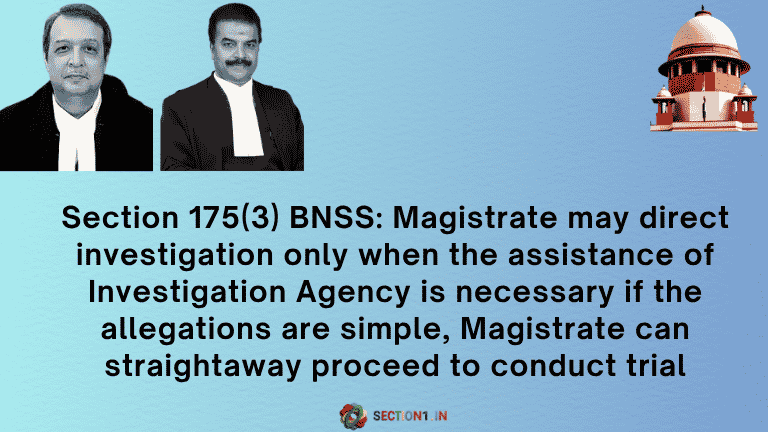
Magistrate may direct investigation only when the assistance of Investigation Agency is necessary if the allegations are simple, Magistrate can straightaway proceed to conduct trial
25. In fact, the Magistrate ought to direct investigation by the police only where the assistance of the Investigating Agency is necessary and the Court feels that the cause of justice is likely to suffer in the absence of investigation by the police. The Magistrate is not expected to mechanically direct investigation by the police without first examining whether in the facts and circumstances of the case, investigation by the State machinery is actually required or not. If the allegations made in the complaint are simple, where the Court can straightaway proceed to conduct the trial, the Magistrate is expected to record evidence and proceed further in the matter, instead of passing the buck to the Police under Section 156(3) of the Cr.P.C. Of course, if the allegations made in the complaint require complex and complicated investigation which cannot be undertaken without active assistance and expertise of the State machinery, it would only be appropriate for the Magistrate to direct investigation by the police authorities. The Magistrate is, therefore, not supposed to act merely as a Post Office and needs to adopt a judicial approach while considering an application seeking investigation by the Police.
Section 156 CrPC to s.175 BNSS
Changes in section 156 CrPC to section 175 BNSS
28. However, before we part with the matter, we deem it necessary to discuss the changes brought to the scheme of Section 156 of the Cr.P.C. by the enactment of the Bharatiya Nagarik Suraksha Sanhita, 2023 (for short, “the BNSS”).
29. Section 175 of the BNSS corresponds to Section 156 of the Cr.P.C. Sub-section (1) of Section 175 of the BNSS is in pari materia with sub-section 156(1) of the Cr.P.C. except for the proviso which empowers the Superintendent of Police to direct the Deputy Superintendent of Police to investigate a case if the nature or gravity of the case so requires. Sub-section (2) of Section 175 the BNSS is identical to Section 156(2) of the Cr.P.C. Section 175(3) of the BNSS empowers any Magistrate who is empowered to take cognizance under Section 210 to order investigation in accordance with Section 175(1) and to this extent is in pari materia with Section 156(3) of Cr.P.C. However, unlike Section 156(3) of the Cr.P.C., any Magistrate, before ordering investigation under Section 175(3) of the BNSS, is required to:
a. Consider the application, supported by an affidavit, made by the complainant to the Superintendent of Police under Section 173(4) of the BNSS;
b. Conduct such inquiry as he thinks necessary; and
c. Consider the submissions made by the police officer.
New addition to the scheme is section 175(4) BNSS
30. Sub-section (4) of Section 175 of the BNSS is a new addition to the scheme of investigation of cognizable cases when compared with the scheme previously existing in Section 156 of the Cr.P.C. It provides an additional safeguard to a public servant against whom an accusation of committing a cognizable offence arising in the course of discharge of his official duty is made. The provision stipulates that any Magistrate who is empowered to take cognizance under Section 210 of the BNSS may order investigation against a public servant upon receiving a complaint arising in course of the discharge of his official duty, only after complying with the following procedure:
a. Receiving a report containing facts and circumstances of the incident from the officer superior to the accused public servant; and
b. Considering the assertions made by the accused public servant as regards the situation that led to the occurrence of the alleged incident.
Comparing section 175(3) BNSS and section 156(3) CrPC
31. A comparison of Section 175(3) of the BNSS with Section 156(3) of the Cr.P.C. indicates three prominent changes that have been introduced by the enactment of BNSS as follows:
a. First, the requirement of making an application to the Superintendent of Police upon refusal by the officer in charge of a police station to lodge the FIR has been made mandatory, and the applicant making an application under Section 175(3) is required to furnish a copy of the application made to the Superintendent of Police under Section 173(4), supported by an affidavit, while making the application to the Magistrate under Section 175(3).
b. Secondly, the Magistrate has been empowered to conduct such enquiry as he deems necessary before making an order directing registration of FIR.
c. Thirdly, the Magistrate is required to consider the submissions of the officer in charge of the police station as regards the refusal to register an FIR before issuing any directions under Section 175(3).
32. The introduction of these changes by the legislature can be attributed to the judicial evolution of Section 156 of the Cr.P.C. undertaken by a number of decisions of this Court. In the case of Priyanka Srivastava v. State of U.P. reported in (2015) 6 SCC 287, this Court held that prior to making an application to the Magistrate under Section 156(3) of the Cr.P.C., the applicant must necessarily make applications under Sections 154(1) and 154(3). It was further observed by the Court that applications made under Section 156(3) of the Cr.P.C. must necessarily be supported by an affidavit sworn by the applicant. The reason given by the Court for introducing such a requirement was that applications under Section 156(3) of the Cr.P.C. were being made in a routine manner and in a number of cases only with a view to cause harassment to the accused by registration of FIR. It was further observed that the requirement of supporting the complaint with an affidavit would ensure that the person making the application is conscious and also to see that no false affidavit is made. Once an affidavit is found to be false, the applicant would be liable for prosecution in accordance with law. This would deter him from casually invoking the authority of the Magistrate under Section 156(3). The relevant observations made by the Court are reproduced hereinbelow:
“paras. 27 to 31”
Magistrates are advised to verify the truth and also verify the veracity of the allegations
33. In a recent pronouncement of this Court in the case of Babu Venkatesh v. The State Of Karnataka reported in (2022) 5 SCC 639, the observations made in Priyanka Srivastava (supra) were referred to and it was held as follows:
“24. This Court has clearly held that, a stage has come where applications under Section 156(3) Cr.P.C. are to be supported by an affidavit duly sworn by the complainant who seeks the invocation of the jurisdiction of the Magistrate.
25. This Court further held that, in an appropriate case, the learned Magistrate would be well advised to verify the truth and also verify the veracity of the allegations. The Court has noted that, applications under Section 156(3)Cr.P.C are filed in a routine manner without taking any responsibility only to harass certain persons.
26. This Court has further held that, prior to the filing of a petition under Section 156(3)Cr.P.C., there have to be applications under Sections 154(1) and 154(3)Cr.P.C. This Court emphasises the necessity to file an affidavit so that the persons making the application should be conscious and not make false affidavit. With such a requirement, the persons would be deterred from causally invoking authority of the Magistrate, under Section 156(3)Cr.P.C.. Inasmuch as if the affidavit is found to be false, the person would be liable for prosecution in accordance with law.”
(Emphasis supplied)
Based on the above judgments the changes are introduced in section 175(3) BNSS
34. In light of the judicial interpretation and evolution of Section 156(3) of the Cr.P.C. by various decisions of this Court as discussed above, it becomes clear that the changes introduced by Section 175(3) of the BNSS to the existing scheme of Section 156(3) merely codify the procedural practices and safeguards which have been introduced by judicial decisions aimed at curbing the misuse of invocation of powers of a Magistrate by unscrupulous litigants for achieving ulterior motives.
Conclusion
35. Further, by requiring the Magistrate to consider the submissions made by the concerned police officer before proceeding to issue directions under Section 175(3), BNSS has affixed greater accountability on the police officer responsible for registering FIRs under Section 173. Mandating the Magistrate to consider the submissions of the concerned police officer also ensures that the Magistrate applies his mind judicially while considering both the complaint and the submissions of the police officer thereby ensuring that the requirement of passing reasoned orders is complied with in a more effective and comprehensive manner.
36. In the result, this appeal succeeds and is hereby allowed.
37.The impugned order passed by the High Court is set aside. The order passed by the Magistrate directing police investigation under Section 156(3) of the Cr.P.C. is also set aside.
Resources
Cited and Quoted Judgments
- Bhavarabai W/o Parashramji Atal v. Sanjay Ramchandra Gundhewar (2011 Vol. 4 Mh. L.J. (Crl.) 283): Cited by the counsel before the Magistrate regarding the application of cognizable offences under the IPC.
- Narayandas S/o Hirlalji Sarda and Ors v. State of Maharashtra (2008 All MR (Cri). 2737): Cited regarding the establishment of cognizable offences from allegations.
- Nandkumar S. Kale v. Bhaurao Chandrabhanji Tidke (2007 All MR (Cri) 2737): Relied upon to argue that there is no bar to register an offence against a police officer under Section 197 Cr.P.C. when the act is not in the discharge of official duties.
- State of Maharashtra v. Devhari Devsingh Pawar and others (2008 All MR (Cri) 518 SC): Referenced concerning official duty protection and prior sanction requirements.
- N.S. Madhanagopal and Another v. K. Lalitha ((2022) 17 SCC 818): Quoted to explain the true purport, scope, and test of obscenity under Section 294(b) IPC, establishing that mere abusive, humiliating, or defamatory words without lascivious elements or annoyance to others do not attract the offence.
- P.T. Chacko v. Nainan Chacko (1967 SCC OnLine Ker 125): Referenced for adopting the Hicklin test of obscenity regarding whether matter tends to deprave and corrupt minds.
- R. v. Hicklin ((1868) LR 3 QB 360): Established the foundational legal test for “obscenity” based on the tendency to deprave and corrupt.
- Ranjit D. Udeshi v. State of Maharashtra (1964 SCC OnLine SC 52): Accepted the correctness of the Hicklin test of obscenity in India.
- Roth v. United States (354 US 476): Quoted regarding the substantial tendency to corrupt by arousing lustful desires.
- Mohammad Wajid & Anr. v. State of U.P. & Ors. (Criminal Appeal No. 2340 of 2023): Quoted extensively to outline the statutory essentials of criminal intimidation under Section 503 and intentional insult under Section 504 of the IPC.
- King Emperor v. Chunnibhai Dayabhai ((1902) 4 Bom LR 78): Pointed out that public peace can be broken by angry words capable of making a party lose their temper.
- Ramdev Food Products (P) Ltd. v. State of Gujarat ((2015) 6 SCC 439): Emphasized that directions under Section 156(3) Cr.P.C. must be issued only after active judicial application of mind by the Magistrate where police investigation is actually required.
- Priyanka Srivastava v. State of U.P. ((2015) 6 SCC 287): Held that Section 156(3) applications must be preceded by applications under Sections 154(1) and 154(3) and mandatorily supported by a sworn affidavit to prevent frivolous and routine litigation meant to harass.
- Lalita Kumari v. State of Uttar Pradesh ((2014) 2 SCC 1): Referenced regarding categories of cases and abnormal delays in initiating criminal prosecution.
- Babu Venkatesh v. The State Of Karnataka ((2022) 5 SCC 639): Reiterated the mandatory requirement of supporting Section 156(3) Cr.P.C. applications with a sworn affidavit to deter casual invocation.
Acts and Sections Involved
- Code of Criminal Procedure, 1973 (Cr.P.C.): Sections 154(1), 154(3), 156, 156(1), 156(2), 156(3), 190, 197, 200, 203, and 482.
- Bharatiya Nagarik Suraksha Sanhita, 2023 (BNSS): Sections 173(4), 175, 175(1), 175(2), 175(3), 175(4), and 210.
- Indian Penal Code, 1860 (IPC): Sections 294, 294(b), 323, 500, 503, 504, 506, and Chapter XXII.
Party
Om Prakash Ambadkar (Appellant) versus The State of Maharashtra & Ors. (Respondents) - Criminal Appeal No. 352 of 2020 - 2025 INSC 139 - 16th January, 2025 – Hon’ble Mr. Justice J.B. Pardiwala and Hon’ble Mr. Justice R. Mahadevan.