

Sign In
Notification
Font ResizerAa
  • Latest
    • Supreme Court
    • Madras High Court
    • Madurai Bench
  • Quick Recall
    • Arms Act
    • BNSS
    • BNS
    • BSA
    • Evidence
    • Drugs Act
    • Cr.P.C
    • IPC
    • N.I.Act
    • PMLA
    • NDPS
    • Corruption Laws
    • General
    • Passports Act
    • Pocso
    • MCOP
    • Writ
  • Acquittal
    • S.C
    • Madras High Court
  • 3 judge bench
  • Resources
    • Notes
      • Cr.P.C 1973
      • Crimes
    • Articles
      • P.G.Rajagopal (Judge Rtd)
      • Ad. Ramprakash Rajagopal
      • Ad. Karunanithi
      • Ad. Ravindran Raghunathan
      • Ad. James Raja
      • Ad. M.S.Parthiban
      • Ad. Rajavel
      • Ad. Azhar Basha
      • Mr. Lokkeshvaran
      • Prasath
    • Digest
      • Monthly Digest
      • Weekly digest
      • Subject wise
    • Bare Acts
      • BSA 2023
      • BNS 2023
      • BNSS 2023
    • Legal Drafting
  • Must Read
  • Author’s note
  • E-Booklet
    • Legal words
  • About
    • Terms
    • Privacy policy
    • Cancellation & Refund Policy
    • Team
  • Civil
    • s. 91 cpc
  • My Bookmarks
Reading: N.I Act appeal compensation: Deposit of 20% is not an absolute rule may be reduced or even exempted
Share
Font ResizerAa
  • Latest
  • Acquittal
  • Digest
  • Resources
Search
  • Latest
    • Madras High Court
    • Madurai Bench
    • Supreme Court
  • Quick Recall
    • Evidence
    • Cr.P.C
    • IPC
    • N.I.Act
    • Pocso
    • PMLA
    • NDPS
    • Corruption Laws
    • General
    • Passports Act
  • Acquittal
    • S.C
    • Madras High Court
  • Digest
    • Monthly Digest
    • Weekly digest
  • Resources
    • Notes
    • Articles
  • 3 judge bench
  • Must have
  • Author’S Note
  • E-Booklet
  • Legal words
  • About
    • Terms
    • Privacy policy
    • Cancellation & Refund Policy
    • Team
  • Mobile APP
  • My Bookmarks

Get Notifications

Notification
Follow US
> Latest> Madras High Court> N.I Act appeal compensation: Deposit of 20% is not an absolute rule may be reduced or even exempted

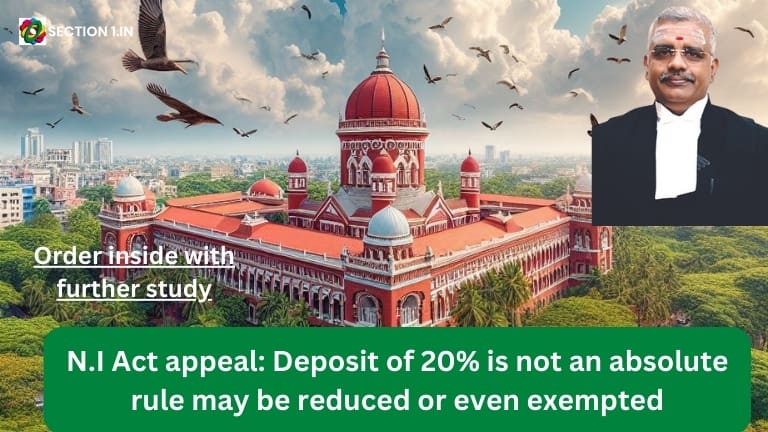
N.I Act appeal compensation: Deposit of 20% is not an absolute rule may be reduced or even exempted

Prayer - Present challenge - Main ground - Deposit of 20% is not an absolute rule – Conclusion - Hon’ble High Court’s direction to the District Judiciary.
Ramprakash Rajagopal January 24, 2024 8 Min Read
Share
Prayer

Criminal Original Petition filed under Section 482 of the Code of Criminal Procedure praying to set aside and modify the condition passed in Crl.M.P.No.3983 of 2023 in C.A.No.372 of 2023, dated 09.11.2023 on the file of Principal District and Sessions Judge, Erode.

Contents
PrayerPresent challengeMain groundDeposit of 20% is not an absolute ruleConclusionHon’ble High Court’s direction to the District JudiciaryPartiesFurther studyDeposit of minimum 20% is not absolute rule for suspension of sentence or to admit appeal

This petition has been filed as against one of the condition that was imposed by the Court below directing the petitioner to deposit 20% of the cheque amount while suspending the sentence imposed against the petitioner u/s.138 of the Negotiable Instruments Act.

Present challenge

The petitioner faced trial for offence u/s.138 of the Negotiable Instruments Act before the Judicial Magistrate, Fast Track Court II, Erode, in STC No.523 of 2019. The trial Court, by judgment dated 22.09.2023, convicted the petitioner and sentenced him to undergo three months simple imprisonment and to pay the cheque amount as compensation, in default, to undergo one month simple imprisonment. Aggrieved by the same, the petitioner filed C.A.No.372 of 2023 before the Principal District and Sessions Judge, Erode. Along with this appeal, the petitioner also filed an application for suspension of sentence in Crl.M.P.No.3983 of 2023. The Court below, while suspending the sentence, imposed certain conditions. One such condition that was imposed by the Court below to the effect that the petitioner must deposit 20% of the cheque amount has been put to challenge in the present petition.

Main ground

The main ground that was urged by learned counsel for petitioner is that the petitioner had already filed an insolvency petition before the concerned Court and the respondent/complainant after being aware of the same misused the cheque and deposited in the bank. The insolvency petition that was filed was also marked as Ex.D1. Therefore, this was one of the main ground that was taken in the grounds of appeal. It was contended that even without considering the same, the Court below had mechanically imposed the condition of deposit of 20% of the cheque amount

Deposit of 20% is not an absolute rule

The Apex Court in Jamboo Bhandari v. M.P.State Industrial Development Corporation Ltd. and others [2023 (3) MWN (Cr.) DCC 104 (SC)] has held that deposit of 20% of the compensation amount is not an absolute rule and it can be reduced or even exempted in exceptional cases by assigning reasons. The Kerala High Court also taken into consideration the scope of Section 148 of the Negotiable Instruments Act and it was held that reasons must be assigned while directing deposit of 20% of the fine amount/compensation amount imposed by the trial Court. Useful reference can be made to the judgment in Baiju v. State of Kerala [2023 (3) MWN (Cr.) DCC 140 (Ker.)]

In the light of the above judgments, it is clear that there is an element of application of mind that is involved while directing deposit of 20% of the amount as contemplated u/s.148 of the Negotiable Instruments Act. If the accused person is able to make out a ground for reduction of this percentage or for exemption of deposit, the same has to be considered by the appellate Court before directing deposit of compensation amount as a condition while suspending the sentence/ granting bail.

Conclusion

Hon’ble High Court left open to the District court to decide by proper application of mind based on the above said judgments.

Hon’ble High Court’s direction to the District Judiciary

Before drawing the curtains in this case, this Court thought it fit to bring to the notice of the District Judiciary the above two judgments, particularly, the judgment of the Apex Court. While dealing with an application for suspension of sentence or for grant of bail when an appeal is filed against the conviction for offence u/s.138 of the Negotiable Instruments Act, the Courts must not mechanically impose a condition of deposit of 20% of the compensation amount/cheque amount u/s.148 of the Negotiable Instruments Act. When any ground has been raised by the appellant for reducing the percentage or for exempting the deposit of such amount, it has to be dealt with by the appellate Court and a reasoned order must be passed if the Court wants to direct the appellant to deposit 20% of the compensation amount/cheque amount. A copy of this order shall be circulated to all the Principal District Courts across the State of Tamil Nadu.

Parties

C.R.Balasubramanian S/o.C.R.Raju P.Eswaramoorthi S/o.N.Palaniyappan Vs. … Petitioner … Respondent – Crl.O.P.No.947 of 2024 – DATED : 22.01.2024 CORAM THE HONOURABLE MR.JUSTICE N.ANAND VENKATESH – 2024:MHC:5897

https://mhc.tn.gov.in/judis/index.php/casestatus/viewpdf/1097516

C.R.Balasubramanian Vs. P.Eswaramoorthi – N.I Act appeal

Further study
Deposit of minimum 20% is not absolute rule for suspension of sentence or to admit appeal

“6. What is held by this Court is that a purposive interpretation should be made of Section 148 of the N.I. Act. Hence, normally, Appellate Court will be justified in imposing the condition of deposit as provided in Section 148. However, in a case where the Appellate Court is satisfied that the condition of deposit of 20% will be unjust or imposing such a condition will amount to deprivation of the right of appeal of the appellant, exception can be made for the reasons specifically recorded.

Therefore, when Appellate Court considers the prayer under Section 389 of the Cr.P.C. of an accused who has been convicted for offence under Section 138 of the N.I. Act, it is always open for the Appellate Court to consider whether it is an exceptional case which warrants grant of suspension of sentence without imposing the condition of deposit of 20% of the fine/compensation amount. As stated earlier, if the Appellate Court comes to the conclusion that it is an exceptional case, the reasons for coming to the said conclusion must be recorded.

We disagree with the above submission. When an accused applies under Section 389 of the Cr.P.C. for suspension of sentence, he normally applies for grant of relief of suspension of sentence without any condition. Therefore, when a blanket order is sought by the appellants, the Court has to consider whether the case falls in exception or not.

In these cases, both the Sessions Courts and the High Court have proceeded on the erroneous premise that deposit of minimum 20% amount is an absolute rule which does not accommodate any exception”.

[JAMBOO BHANDARI vs. M.P. STATE INDUSTRIAL DEVELOPMENT CORPORATION LTD. & ORS – CRIMINAL APPEAL NO(S). 2741 OF 2023 (@ SLP(CRL.) NO(S). 4927 OF 2023) – SEPTEMBER 04, 2023 – 2023INSC822].

Further Study

Compensation over incarceration in special circumstance of 11 years after the incident

NDPS: Mere non-compliance or delayed compliance with section 52-A is not fatal unless irregularity affecting the integrity of the seized substance

Imposed Cost: There is no infirmity in cancelling the suspension of sentence since the order of the High court was not obeyed

Cheque case: Director cannot be prosecution if the cheque was issued by the company after his resignation

N.I Act: S.143A (interim compensation during trial) cannot be ordered before accused ‘plead guilty’

TAGGED:20appealcompensationconvictiondepositdeposit of amountexemptedN.I Actnot compulsoryreduce the amount
Previous Article Juvenile Justice act: Issue of Juvenility can be claimed even before the Hon’ble Supreme court
Next Article Quash: Cheating: In order to constitute an offence of cheating, the intention to cheat must be available from the inception
Leave a Comment

Leave a Reply Cancel reply

Your email address will not be published. Required fields are marked *

Popular Study

section 195A IPC

The offence under Section 195A IPC is a cognizable offence so the power of the police to take action in relation thereto under Sections 154 CrPC and 156 CrPC cannot be doubted

Ramprakash Rajagopal November 21, 2025
Litigants come to court expecting the justice delivery system to function in accordance with law and not to obtain absurd or irrational orders
The Tamil Nadu Rent Act, 2017 Needs Constitutional Correction
Section 223 BNSS: Whether cognizance on offence or includes offender?
Accused is armed and the deceased is unarmed hence exception 2 (private defence) to section 300 IPC not applicable

Related Study

Omission to take photograph of vehicle by the I.O is not fatal TNPPDL Act
November 9, 2024
The prosecutor has to put the contradictions to the Investigation Officer
April 20, 2023
Basics of Criminal Law – Part.3 – Criminal Jurisprudence
January 12, 2024
S. 319 Cr.P.C
June 3, 2023
Magistrate shall consider both the final report submitted under section 173(2) Cr.P.C and supplementary final report filed under section 173(8) Cr.P.C for prima facie
April 19, 2023
Murder: Common intention (section 34 IPC) & Appreciation of eye-witness: Explained
February 26, 2023
Section 306 IPC: There must be either an instigation or an engagement or intentional aid to ‘doing of a thing’ and based on that accused must have encouraged the person to commit suicide
July 14, 2024
PMLA & PC Act: Prosecuting the person accused of an offence under Section 13(1)(e) of the PC Act as well as for an offence under Section 3 of PMLA would not amount to double jeopardy
April 25, 2024
No Sanction Quash: The appellant’s official duty would be in furtherance of the act and covered with section 197 Cr.P.C r/w 83 M.P Housing Board Act 1972
January 6, 2025
Disposal of criminal cases more than 3 years involving offences punishable with imprisonment of upto 3 years pending at trial appeal or revision stage
August 26, 2025

About

Section1.in is all about the legal updates in Criminal and Corporate Laws. This website also gives opportunity to publish your (readers/users) articles subject to the condition of being edited (only if necessary) by the team of Advocates. Kindly send your articles to paperpageindia@gmail.com or WhatsApp to +919361570190.
  • Quick Links
  • Team
  • Terms
  • Cancellation Policy
  • Privacy Policy
  • My Bookmarks
  • Founder

section1.in is powered by Paperpage.             A product of © Paperpage Internet Services. All Rights Reserved. 

Subscribe Newsletter for free

Subscribe to our newsletter to get judgments instantly!

Check your inbox or spam folder to confirm your subscription.

About

Section1.in is all about the legal updates in Criminal and Corporate Laws. This website also gives opportunity to publish your (readers/users) articles subject to the condition of being edited (only if necessary) by the team of Advocates. Kindly send your articles to paperpageindia@gmail.com or WhatsApp to +919361570190.
  • Quick Links
  • Team
  • Terms
  • Cancellation Policy
  • Privacy Policy
  • My Bookmarks
  • Founder

section1.in is powered by Paperpage.             A product of © Paperpage Internet Services. All Rights Reserved. 

Subscribe Newsletter for free

Subscribe to our newsletter to get judgments instantly!

Check your inbox or spam folder to confirm your subscription.

ஓர்ந்துகண் ணோடாது இறைபுரிந்து யார்மாட்டும் தேர்ந்துசெய் வஃதே முறை [541].

_திருவள்ளுவர்
Welcome Back!

Sign in to your account

Username or Email Address
Password

Lost your password?