

Appeal
Appeals against the common judgment and order of the High Court dismissing the quash application
2. The present appeals arise out of the common judgment and order dated 07.11.2023 passed by the High Court of Gujarat at Ahmedabad in Criminal Misc. Application No. 780 of 2010 and Special Criminal Application No. 620 of 2010, whereby the High Court declined to exercise its jurisdiction under Section 482 of the Code of Criminal Procedure, 1973 (hereinafter referred to as “the CrPC”) for quashing the criminal proceedings initiated at the instance of respondent No. 2.
3. SLP (Crl.) No. 15537 of 2023 was filed by accused Nos. 3 and 4 and SLP (Crl.) No. 16049 of 2023 was filed by accused No. 6. Since the appeals arise from a common judgment and involve interconnected facts and issues, they are being disposed of by this common judgment.
Facts
4. The brief facts as per the appellants are that the land bearing Survey No. 157 situated at Village Panas admeasuring approximately 5.5 acres was jointly purchased on 03.06.1957 by the six children of Nemabhai Patel, including the father of the appellants, Govindbhai Patel and the father of respondent No. 2, Chhaganbhai Patel. As per respondent No. 2, the said property belonged exclusively to his Hindu Undivided Family.
5. A settlement decree dated 21.07.1987 passed in Special Civil Suit No. 339/1985 was never acted upon and became unenforceable by limitation under Article 136 of the Limitation Act. Thereafter, on 19.02.1988, the competent authority under the Urban Land Ceiling Act, 1976 (hereinafter referred to as “the ULC Act”) recognised ⅓rd shares in favour of the branch of appellants and respondent No. 2, thereby overriding the earlier settlement decree under Section 42 of the ULC Act. According to the appellants, this order was never challenged by respondent No. 2.
6. It is the case of the appellants that respondent No. 2 thereafter procured a fraudulent compromise decree dated 28.11.1988 in Special Civil Suit No. 176/1988 by using a fictitious person described as “Kishorbhai Govindbhai Patel” and forged compromise documents. Based on the said decree, Mutation Entry No. 2183 dated 01.06.1991 was mutated in the revenue records without following the prescribed procedure under the Gujarat Land Revenue Code, 1879.
7. The appellants instituted Special Civil Suit No. 377/2000 on 05.08.2000 seeking declaration of their ⅔rd share in the property. In the said suit, the High Court of Gujarat granted ad-interim injunction on 20.02.2002, which was subsequently made absolute on 22.07.2003. It is the case of the appellants that in the written statement filed by respondent No. 2 on 12.09.2000, he claimed exclusive ownership solely on the basis of the fraudulent 1988 decree and no allegation of criminal intimidation, extortion or forgery was made against the appellants at that stage.
8. On 01.11.2001, accused nos. 1 to 5 executed a Power of Attorney in favour of accused no. 6 for conducting the civil proceedings. According to the appellants, the execution of the Power of Attorney was consistently affirmed before various courts and was never disputed by respondent No. 2 during the civil litigation.
FIR and charge sheet registered for fraudulent decree
9. Subsequently, on 13.04.2003, the Mamlatdar lodged FIR No. 136/2003 against respondent No. 2 in relation to forgery committed in the ULC Act proceedings and the fraudulent decree obtained in Special Civil Suit No. 176/1988, pursuant to which a chargesheet came to be filed on 10.08.2004.
Allegation of extortion or monetary demand
10. It is the case of the appellants that despite the subsisting injunction order operating in their favour, respondent No. 2 lodged a complaint after a delay of about nine years before the DCB Police Station on 21.05.2009 without making any allegation of extortion or monetary demand. Thereafter, suppressing the earlier complaint, respondent No. 2 lodged another complaint before the Special Operations Group, which came to be registered as FIR No. I-CR No. 504/2009 on 31.12.2009, under Sections 420, 465, 467, 468, 471, 504, 120B, 384, 511 ans 144 of the Indian Penal Code, 1860 (hereinafter referred to as “the IPC”), wherein for the first time allegations of extortion of Rs.1.5 crores were introduced.
Quash filed
11. Aggrieved thereby, the appellants approached the High Court of Gujarat by filing Criminal Miscellaneous Application No. 780/2010 with the prayer to quash the FIR No. I-CR No. 504/2009 dated 31.12.2009, wherein the High Court initially stayed further proceedings on 29.01.2010 and later modified the order on 14.02.2014 directing that no arrest shall be effected and no charge sheet shall be filed without permission of the High Court.
Quash dismissed
12. By the impugned judgment and order dated 07.11.2023 passed by the High Court of Gujarat in Criminal Miscellaneous Application No. 780/2010, the High Court dismissed the appellants’ application and permitted filing of the chargesheet.
13. The appellants thereafter approached this Court by way of the present Special Leave Petitions challenging the refusal of the High Court to quash the criminal proceedings.
Counsels arguments
The learned senior counsel for the appellants submitted that the impugned FIR was a textbook misuse of the criminal machinery designed to exert undue pressure regarding a long-standing civil property dispute over Survey No. 157, which had been actively litigated in civil courts since 2000 with injunction orders operating in their favor. They argued that the foundational legal ingredients for the alleged offenses were entirely absent; the disputed Power of Attorney had been knowingly executed by the involved family branches and repeatedly confirmed before authorities, meaning no forgery took place. Furthermore, they contended that no property was ever delivered because of deception to attract a cheating charge, and that the grave financial extortion claims were an afterthought introduced seven months later in an improved second complaint to artificially give a criminal color to a stale matter after an unexplained delay of nearly nine years.
Conversely, the learned counsel for the respondents maintained that the FIR allegations clearly disclosed a prima facie case of systematic conspiracy, cheating, and land forgery that demanded a full trial rather than a premature dismissal. They defended the eight-to-nine-year delay in lodging the FIR by relying on a State Government Circular dated July 23, 2003, which explicitly discouraged local police stations from registering FIRs over matters bearing a heavy civil complexion, thus explaining the initial administrative hesitation. They strongly urged that because the investigation was complete and revealed a triable case, the High Court acted properly within its legal boundaries under Section 482 of the CrPC by refusing to run a “mini-trial” or adjudicate disputed questions of civil title at a preliminary stage.
Analysis
Principal question: Whether the High Court is justifying in dismissing quashing application
36. The principal question which arises for our consideration is whether the High Court was justified in refusing to exercise its jurisdiction under Section 482 of the CrPC for quashing FIR No. I-CR No. 504/2009 dated 31.12.2009 registered with Umra Police Station, Surat, for offences punishable under Sections 420, 465, 467, 468, 471, 504, 120-B, 384, 511 and 114 of the IPC and the consequential criminal proceedings.
Dispute between the parties pertains to title and ownership over ancestral immovable property
37. At the outset, it is required to be noted that the dispute between the parties pertains to title and ownership over ancestral immovable property bearing Survey No. 157 situated at Village Panas, Surat. The record reveals that civil proceedings in respect of the said property have remained pending since the year 2000. The appellants instituted Special Civil Suit No. 377/2000 asserting their claim to ⅔rd share in the suit property and that the dispute has travelled through multiple rounds of litigation before the civil courts, the High Court and even this Court.
Throughout the civil litigation for several years respondent never alleged commission of offences shown in the FIR
38. It is pertinent to note that throughout the civil litigation for several years, respondent No. 2 never alleged commission of offences such as extortion, criminal intimidation, forgery or conspiracy by the appellants. On perusal of the written statement filed by respondent No. 2 in the civil proceedings, being Special Civil Suit No. 377/2000, it is true that respondent No. 2 asserted exclusive ownership over the property but did not contain the allegation of any criminal conduct committed by the appellants. To our minds, this circumstance is of importance because the said allegations were levelled in the impugned FIR and are related to events occurring in or around the year 2001, i.e., during the period of the civil litigation.
Even the respondent did not raise any allegation in his complaint before DCB police station
39. On perusal of the chronology of events, it is also revealed that respondent No. 2 initially lodged a complaint dated 21.05.2009 before the DCB Police Station. Admittedly, the said complaint did not contain any allegation of extortion, demand of money, criminal intimidation or threats. However, after a gap of nearly seven months, respondent No. 2 lodged the impugned FIR dated 31.12.2009, introducing, for the first time, allegations that accused No. 6 had demanded Rs.1.5 crores and threatened respondent No. 2 with dire consequences.
The High Court failed to examine the legal effect of suppressing the earlier complaint and the material improvements introduced in the subsequent impugned FIR
40. The High Court in the impugned judgment, despite noting down this sequence of events, failed to examine the legal effect of suppression of the earlier complaint and the material improvement introduced in the subsequent impugned FIR. In our view, the subsequent introduction of allegations of extortion, demand of money and intimidation in the second complaint materially alters the nature and complexion of the dispute and supports the contention of the appellants that the criminal proceedings are an afterthought intended to give criminal colour to a longstanding civil dispute. Though respondent No. 2 contended that the subsequent FIR merely elaborated upon earlier allegations, we find that the allegation of extortion, which is one of the grave accusations in the FIR, was absent in the first complaint and surfaced only subsequently. Thus, such material improvements cannot be ignored while examining whether the criminal process is being abused or not.
Delay in registration of FIR after nine years is another circumstance cannot be ignored
41. The delay in registration of the FIR is another circumstance which cannot be ignored. The incidents in question pertain to the year 2001 whereas the FIR came to be registered only on 31.12.2009 after a delay of nearly eight to nine years. The High Court accepted the explanation offered by respondent No. 2 that a Government Circular dated 23.07.2003 discouraged registration of FIRs involving civil disputes. In our view, the said explanation is not wholly satisfactory. The circular itself cannot explain the inaction by respondent No. 2 between 2001 and 2009, particularly when respondent No. 2 was actively litigating before competent courts throughout the said period and had access to all legal remedies including under Sections 154(3), 156(3) and 200 of the CrPC.
Judgment reference when regarding delay in lodging the complaint will lead for quashing
42. Recently, this Court, in Mohd. Wajid v. State of U.P. (supra), held that where delay is coupled with circumstances creating serious doubt about the genuineness of the prosecution, the proceedings may warrant quashing. The relevant paragraphs read as under:
“36. At this stage, we would like to observe something important. Whenever an accused comes before the Court invoking either the inherent powers under Section 482 of the Code of Criminal Procedure (CrPC) or extraordinary jurisdiction under Article 226 of the Constitution to get the FIR or the criminal proceedings quashed essentially on the ground that such proceedings are manifestly frivolous or vexatious or instituted with the ulterior motive for wreaking vengeance, then in such circumstances the Court owes a duty to look into the FIR with care and a little more closely.
37. We say so because once the complainant decides to proceed against the accused with an ulterior motive for wreaking personal vengeance, etc. then he would ensure that the FIR/complaint is very well drafted with all the necessary pleadings. The complainant would ensure that the averments made in the FIR/complaint are such that they disclose the necessary ingredients to constitute the alleged offence. Therefore, it will not be just enough for the Court to look into the averments made in the FIR/complaint alone for the purpose of ascertaining whether the necessary ingredients to constitute the alleged offence are disclosed or not.
38. In frivolous or vexatious proceedings, the Court owes a duty to look into many other attending circumstances emerging from the record of the case over and above the averments and, if need be, with due care and circumspection try to read in between the lines. The Court while exercising its jurisdiction under Section 482CrPC or Article 226 of the Constitution need not restrict itself only to the stage of a case but is empowered to take into account the overall circumstances leading to the initiation/registration of the case as well as the materials collected in the course of investigation. Take for instance the case on hand. Multiple FIRs have been registered over a period of time. It is in the background of such circumstances the registration of multiple FIRs assumes importance, thereby attracting the issue of wreaking vengeance out of private or personal grudge as alleged.”
43. We shall now examine whether the allegations contained in the impugned FIR, even if taken at face value, disclose the ingredients of the alleged offences.
Essential ingredient of forgery is making of a ‘false document’ within the meaning of section 464 IPC
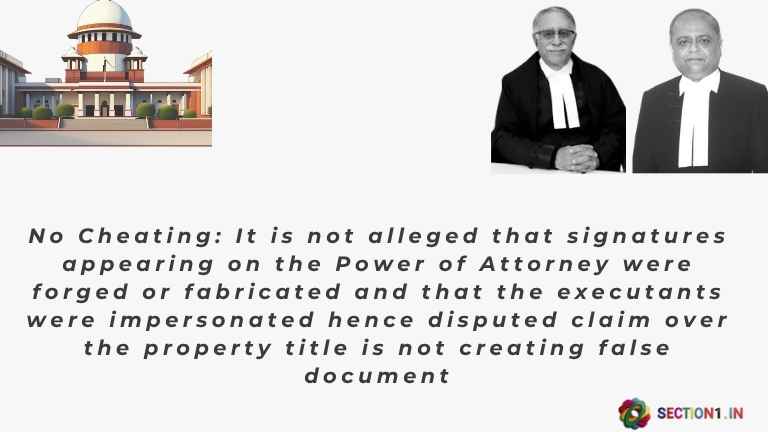
44. Insofar as offences under Sections 465, 467, 468 and 471 of the IPC are concerned, the principal allegation relates to the execution of the Power of Attorney dated 01.11.2001 by accused Nos. 1 to 5 in favour of accused No. 6. The High Court proceeded on the premise that since accused Nos. 1 to 5 lacked title over the property, execution of the Power of Attorney and institution of civil proceedings amounted to forgery. In our opinion, the approach of the High Court is legally unsustainable. The essential ingredient of forgery under Section 463 of the IPC is the making of a “false document” within the meaning of Section 464 of the IPC. It is not the case of respondent No. 2 that the signatures appearing on the Power of Attorney were forged or fabricated and it is not alleged that the executants were impersonated or that the document was fabricated by someone pretending to be another person. On the contrary, the execution of the document by accused Nos. 1 to 5 is admitted. The consistent case of the appellants has been that they possessed a subsisting claim and share in the ancestral property pursuant to the ULC Act proceedings and related revenue entries. Whether such a claim is ultimately sustainable in law or not is a matter for adjudication before the competent civil court. Therefore, the High Court erred in equating a disputed claim of title with the making of a false document.
When a person executes a document claiming property as his own there is no making of a false document
45. The law on this issue is settled by this Court in Mohd. Ibrahim v. State of Bihar (supra), wherein it was held that when a person executes a document claiming property as his own, there is no making of a false document merely because the claim is ultimately found to be incorrect. The relevant paragraph reads as under:
“17. When a document is executed by a person claiming a property which is not his, he is not claiming that he is someone else nor is he claiming that he is authorised by someone else. Therefore, execution of such document (purporting to convey some property of which he is not the owner) is not execution of a false document as defined under Section 464 of the Code. If what is executed is not a false document, there is no forgery. If there is no forgery, then neither Section 467 nor Section 471 of the Code are attracted.”
Offence of cheating explained
46. Similarly, the ingredients of the offence of cheating punishable under Section 420 of the IPC are also absent, i.e. to constitute the offence of cheating, there must exist deception, fraudulent inducement and consequential delivery of property coupled with dishonest intention at the inception of the transaction. There is no allegation in the FIR that respondent No. 2 delivered any property, money or valuable security to the appellants pursuant to deception or inducement and importantly, the material on record does not disclose dishonest intention at inception. The High Court in the impugned judgment observed that “false representation” was made by the accused persons despite knowing that they had no title. However, the foundation of the pending civil suit is the claim of the appellants that they possessed ⅓rd share in the property pursuant to the ULC Act proceedings and related revenue records and thus, a disputed civil claim cannot automatically be treated as fraudulent representation so as to attract Section 420 of the IPC.
47. The allegations regarding extortion under Section 384 of the IPC are also unsustainable. In the FIR, respondent No. 2 alleges that accused No. 6 demanded Rs.1.5 crores or alternatively partnership in the property. However, the FIR neither specifies the date, place or circumstances of such demand nor there is an allegation that respondent No. 2 actually delivered any property or money pursuant to such threat, which as an essential ingredient of extortion.
48. The High Court in the impugned judgment further observed that the accused persons “tried” to extort money and therefore Section 511 of the IPC would apply. However, we are unable to accept such reasoning. The allegations under Sections 504 and 506 of the IPC are also vague in nature. The FIR does not disclose the exact words uttered, the nature of the threat administered or the surrounding circumstances constituting intimidation.
If substantive offence are not made out conspiracy u/s 120B IPC fails
49. Once the substantive offences themselves are not made out, the allegations of conspiracy under Section 120-B of the IPC necessarily fails in the present case.
Criminal antecedents cannot constitute the sole or even the primary basis to decline quashing of criminal proceedings
50. It is pertinent to note that the High Court has placed reliance upon the criminal antecedents of accused No. 6 while declining to exercise jurisdiction under Section 482 of the CrPC. The law on the issue was settled recently by this Court in Mohd. Wajid v. State of U.P. (supra), wherein it has been held that criminal antecedents cannot constitute the sole or even the primary basis to decline quashing of criminal proceedings. The High Court in the impugned judgment, though observing that antecedents were not the “sole criterion”, has made general observations regarding “modus operandi” and “proclivity” of accused No. 6, the pendency of earlier complaints and the circumstance that certain proceedings had previously been quashed on the basis of settlements. In our considered view, it is for the Court to see whether the essential ingredients of the alleged offences in the impugned FIR are made out or not. As observed hereinabove, we have discussed in detail with respect to the delay in filing the impugned FIR, absence of ingredients of the alleged offences, the dispute is purely civil in nature and therefore, in such circumstances, antecendents of accused No. 6, cannot be a ground for dismissal of the present appeals.
High Court is not expected to conduct a mini trial under section 482 crpc
51. We are also unable to agree with the findings recorded by the High Court regarding ownership and title over the suit property, which are all matters squarely falling within the jurisdiction of the competent civil court. While exercising jurisdiction under Section 482 of the CrPC, the Court is not expected to conduct a mini trial or adjudicate disputed questions of title and ownership.
Present case is a civil property dispute
52. The present case, viewed in its peculiar facts and circumstances, constitutes all the characteristics of a civil property dispute, which is sought to be converted into criminal proceedings, after several years of civil litigation. We are of the opinion that the criminal process cannot be permitted to become a weapon of harassment and coercion in disputes concerning title over immovable property.
Considering Neeharika Infrastructure case
53. We are conscious of the principles laid down by this Court in the recent decision of Neeharika Infrastructure Pvt. Ltd. v. State of Maharashtra (supra) that courts should ordinarily refrain from interfering at the threshold stage of investigation. However, the said judgment itself recognises that where the allegations do not disclose the commission of cognizable offences or where criminal proceedings manifestly amount to abuse of process, the High Court is duty-bound to exercise its inherent jurisdiction under Section 482 of the CrPC.
Applying Bhajan Lal case
54. The present case falls squarely within the well-settled categories warranting interference under Section 482 of the CrPC as delineated in State of Haryana v. Bhajan Lal, namely, where the dispute is predominantly civil in nature, where the allegations fail to disclose the essential ingredients of the alleged offences, where the criminal proceedings are manifestly attended with mala fide intention, where there is extraordinary and unexplained delay, and where continuation of the prosecution would amount to abuse of process of court.
Conclusion
Case Quashed
55. In view of the aforesaid discussion, we are of the considered opinion that the High Court, in the impugned judgment, committed an error in refusing to exercise its jurisdiction under Section 482 of the CrPC for quashing the impugned FIR and consequential criminal proceedings and thus warrants interference of this Court.
56. The present appeals are accordingly allowed.
Resource
Judgments cited or involved
- Mohd. Ibrahim v. State of Bihar, (2009) 8 SCC 751: Cited to clarify the legal requirements for “forgery” and the creation of a “false document” under the Indian Penal Code, emphasizing that a mere claim of ownership in a document does not constitute forgery.
- Joseph Salvaraja v. State of Gujarat, (2011) 7 SCC 59: Used to highlight the Court’s duty to intervene and quash criminal proceedings when allegations do not disclose the commission of cognizable offences, preventing the misuse of the criminal process for settling civil disputes.
- Pooja Ravinder Devidasani v. State of Maharashtra, (2014) 16 SCC 1: Cited in the context of inherent powers, reiterating that criminal proceedings should not be allowed to become a tool for harassment or coercion in matters that are essentially civil in nature.
- Devendra v. State of U.P., (2009) 7 SCC 495: Referenced to discuss the parameters of inherent jurisdiction under Section 482 CrPC, particularly regarding the need to prevent abuse of the process of law.
- Isaac Isanga Musumba v. State of Maharashtra, (2014) 15 SCC 357: Quoted to support the principle that criminal law should not be weaponized in disputes concerning the title or ownership of immovable property.
Party
Bhikhubhai Govindbhai Patel & Anr. versus The State of Gujarat & Anr - Criminal Appeal No. 2792 of 2026 (arising out of SLP (Crl.) No. 15537 of 2023) - 2026 INSC 532 - May 22, 2026, by Hon'ble Mr. Justice Sanjay Karol and the Hon'ble Mr. Justice Vipul M. Pancholi.