
Appeal
Appeal against the final judgment dismissing seeking discharge
2. This appeal at the instance of the accused calls into question the correctness of the final judgment and order in Criminal Appeal No. 3945 of 2025, dated 3rd July 2025 by the High Court of Madhya Pradesh at Indore. In terms of the impugned judgment, the High Court dismissed the accused’s appeal arising out of the proceedings before the learned Special Judge, Scheduled Castes and Scheduled Tribes (Prevention of Atrocities) Act, 1989 whereby his prayer for discharge under Section 227 of the Code of Criminal Procedure, 1973, was allowed only in part. The chargesheet that was filed upon completion of the investigation in FIR No. 0653 of 2022 dated 15th November 2022 registered at PS Bilpank, District Ratlam. The said chargesheet, being Chargesheet No.1 of 2023 dated 16th February 2023, sent the matter up for trial against the accused on charges under Sections 294, 341, 383, 332, 146, 147, 336, 506, 333, 188, 326 of the Indian Penal Code, 1860 and Sections 3(1)(r), 3(2)(va) of the SCST Act as amended in 2015 and 2018, whereas charges were framed against him under the following Sections 147, 341, 427, 353, 332, 333, 326, 323, 352 read with 149 IPC and 3(2)(v), 3(2)(va) of the SCST Act.
Bail sought by the accused was rejected
4. The accused sought bail which was rejected by the Trial Court. Such conclusion was affirmed by the High Court, but then he was granted bail by this Court on 13th January 2023. Disciplinary proceedings were also initiated against him, and he received notice thereof from the Regional Manager, Health Services, Indore Division. These facts have only been mentioned for completing the factual arc and are not in issue before us.
High Court findings
5. The Trial Court, as we have already observed, partly allowed the application. The High Court dismissed the appeal thereagainst. The findings of the High Court are summarised as below along with the relevant case laws cited by the Court below:
▪ First addressed was the appellant’s objection regarding the legality of the investigation, which was alleged to be vitiated on the ground that it was conducted by an Inspector instead of a Deputy Superintendent of Police6 . Upon examining Section 9 of SCST Act along with the State Government Notification dated 13th October 2017 and the consequential circular issued by the Director General of Police, the Court held that the State Government is expressly empowered to confer powers of investigation on officers below the rank of DSP for specified categories of offences. Since the offences registered against the appellant fell within the ambit of those notified, the investigation conducted by an Inspector was held to be legally authorised and not in violation of Rule 7 of the SC/ST Rules, 1995. The challenge to the investigation was, therefore, found to be without merit. (State of Bihar v. Anil Kumar)
▪ Thereafter, the Court reiterated the settled legal position governing the scope of judicial scrutiny at the stage of framing of charges. It held that, at this preliminary stage, the Court is not required to conduct a detailed appreciation of evidence or adjudicate upon the probable defence of the accused. The exercise is limited to examining whether the material placed by the prosecution, if taken at face value, discloses sufficient ground to presume that the accused has committed the alleged offences. The degree of satisfaction required is only that of a strong suspicion and not proof beyond reasonable doubt. A meticulous analysis of contradictions, credibility of witnesses, or likelihood of conviction would amount to a mini trial, which is impermissible at this stage. (Vinay Tyagi v. Irshad Ali,; Ram Prakash Chadha v. State of U.P.)
▪ While dealing with the applicability of Section 149 of the IPC, the Court observed that the appellant has been implicated as a member of an unlawful assembly, and the offences alleged are stated to have been committed in prosecution of the common object of such assembly. The Court clarified that, at the stage of framing of charges, it is not necessary that a specific overt act be attributed to each individual accused. What is required is prima facie material indicating membership of the unlawful assembly and the likelihood that the accused shared the common object or had knowledge that such offences were likely to be committed. The Court noted that multiple witnesses, including injured police personnel, have categorically stated that the appellant was a participant in the JAYS rally and was present at the place of occurrence when public officials were restrained and assaulted. Whether the appellant merely happened to be present, or whether he shared the common object of the assembly, are matters that can only be conclusively determined after evidence is led during trial. At this stage, the prosecution material was held sufficient to attract Section 149 IPC. (State of Maharashtra v. Kashirao)
▪ The Court further held that challenges raised by the appellant concerning his exact presence at the spot, the credibility of the medical evidence, the qualifications of the doctor who conducted the radiological examination, and the precise role attributed to him, all involve disputed questions of fact. Such issues necessarily require appreciation of evidence and cannot be conclusively adjudicated either at the stage of framing of charges or while exercising appellate jurisdiction against an order framing charge. These matters were held to fall squarely within the domain of trial.
▪ Upon an overall consideration of the impugned order, the High Court found that the Special Judge had applied the correct legal principles, considered the material available on record, and assigned cogent reasons while framing charges against the appellant. The order was found to be free from perversity, procedural impropriety, or patent illegality. Consequently, the High Court held that no case was made out for interference in exercise of appellate jurisdiction under Section 14(A)(1) of the SCST Act, and affirmed the order framing charges. (Amit Kapoor (supra); Vinay Tyagi, (supra)
Analysis
Objects and reasons for enactment of SC/ST Act
8. At this stage, it is important to take note of the objects and reasons for the enactment of the SCST Act. Sujata Manohar J, in State of M.P. v. Ram Kishna Balothia, while dealing with the constitutionality of Section 18 thereof which takes the applicability of the provisions of anticipatory bail housed in the provisions of the Cr.P.C. for offences under this Act, as follows:
“…………..”
Why SC and ST Act was enacted is clarified
9. While the Constitution guarantees equality, freedom from discrimination, and the right to live with dignity, these ideals often remained abstract for SC and ST communities because of centuries of social exclusion, oppression, and violence. Recognizing this gap, the Act provides targeted legal protection, ensuring that the constitutional promises of equality and justice are realized in practice. At its core, the Act embodies the principle of equality before the law, as enshrined in Article 14 of the Constitution. It goes beyond formal equality, acknowledging that SC/ST communities face unique social vulnerabilities. By defining specific offences such as physical assault, sexual abuse, humiliation, and social ostracism, and prescribing stricter punishments, the law ensures substantive equality, allowing these individuals to live with safety, respect, and dignity in a society that has historically denied them these rights. The Act also reinforces the constitutional mandate under Article 17, which prescribed the abolishment of untouchability. Modern forms of caste-based indignity, like forcing individuals into menial or degrading labour, denying them access to public spaces, or socially boycotting them, are specifically criminalized. These provisions help translate the ideals of the Constitution, of freedom from untouchability into actionable legal protection, restoring both social and personal dignity to victims. Furthermore, the Act embodies Article 15’s prohibition against discrimination, ensuring that SC/ST persons can access education, employment, and civic life without fear of prejudice. By shielding these communities from targeted harassment and violence, the law turns the promise of non-discrimination into a lived reality. At the same time, it safeguards the right to life and dignity under Article 21, recognizing that life is not merely about survival, but about living with respect, security, and freedom from humiliation. Relief, rehabilitation, and special protective measures under the Act directly uphold this principle. Finally, the SCST Act advances the broader goals of social justice and positive discrimination, reflected in Articles 38 and 46. By creating a safe and supportive environment, the Act enables SCST communities to participate fully in social, educational, and economic opportunities, helping to break cycles of historical oppression. In this sense, the Act is a transformative instrument, bridging the gap between constitutional ideals and everyday realities, ensuring that SC/ST citizens can live as equal, dignified, and empowered members of society.
Application for discharge in IPC along with SC/ST Act cases
10. We must turn back to the application for discharge and examine the averment regarding changes under the SCST Act. The relevant portion of the application is extracted as under:-
“……………”
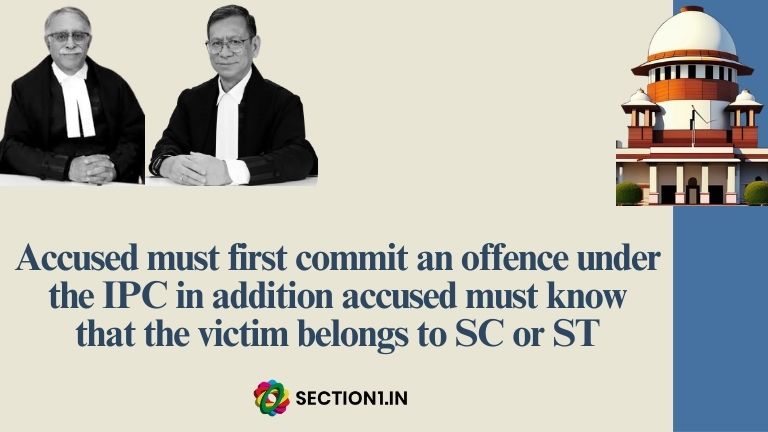
Accused must first commit offence under IPC in addition accused must know the victim belongs to SC or ST: In its judgment on the application, the learned Trial Court dealt with the proposed charge under the SCST Act alongside a number of provisions of IPC. For a charge under the above quoted provisions of the SCST Act to be established, several elements must be present. The accused must first commit an offence under the IPC, such as assault, robbery, or any other crime punishable with ten or more years of imprisonment. The act must be directed against a member of a Scheduled Caste or Scheduled Tribe, or against property that belongs to them, reflecting the special protection the law affords to historically marginalized communities. In addition, the accused must have knowledge that the victim belongs to a Scheduled Caste or Scheduled Tribe or that the property belongs to such a person. This requirement of awareness is essential to the application of the law. Finally, the punishment prescribed under this sub-section is life imprisonment along with a fine, underscoring the gravity of offences committed against vulnerable communities.
Section 3(va) deals with specific atrocities listed in the Schedule of the Act, including forced labour, harassment, social exclusion, or damage to property that target SC or ST persons. To attract liability under this provision, the accused must commit one of the scheduled offences against a member of a Scheduled Caste or Scheduled Tribe or their property. The offender must know the caste identity of the victim or that the property belongs to them, ensuring that the law applies to deliberate acts of caste-based harm. The punishment for these offences is as specified under the Indian Penal Code along with an additional fine, providing flexibility to address a range of atrocities that may not carry ten years or more of imprisonment but still require special protection for the victim.
Framing of charge
The question that then arises, is – who were present before the learned Trial Court that, in its appreciation of the material on record, met the standard required for framing of charge?
11. Section 227 and 228 of the CrPC are as below:
“………………”
Except for express timelines to file discharge applications position continues in BNSS from Cr.P.C
Even though the instant case is governed by the prior regime of substantive and procedural criminal laws, we may observe that in the new legislation, now occupying the field, the position remains the same. On a close reading of the statutory text of the Cr.P.C. and the Bharatiya Nagarik Suraksha Sanhita, 2023, the position is one of continuity rather than change in relation to the Court’s power at the stages of discharge and framing of charge. In both enactments, the governing standards are framed in materially the same language. At the stage of discharge, the Court is required to consider whether there is any sufficient ground for proceeding against the accused in sessions cases, or whether the charge is groundless in Magistrate warrant cases. At the subsequent stage, charges are to be framed only if the Court forms an opinion that there is a ground for presuming that the accused has committed an offence. These formulations, which have long anchored the exercise of judicial discretion under the Cr.P.C., are carried forward in substance in the corresponding provisions of the BNSS, without any textual indication that the level of scrutiny is intended to be either heightened or diluted.
What the BNSS does is to change the procedural setting within which this discretion is exercised. The new statute introduces express timelines for the filing of discharge applications and for the framing of charges, and it expressly recognises the possibility of the accused being heard or examined through electronic means. These changes are regulatory in nature. They are aimed at structuring the process and reducing delay, not at transforming the judicial task itself. The Court’s obligation to apply its mind to the record, to hear both sides, and to record reasons where discharge is ordered remains exactly as before, as does the caution against weighing evidence or conducting a mini trial at these preliminary stages.
Accordingly, the established jurisprudence developed under the Cr.P.C. on the scope and limits of consideration at the stages of discharge and framing of charge continues to hold the field under the BNSS. The statutory language supports the conclusion that the Legislature has retained the same substantive balance between the rights of the accused and the interest of prosecution, while seeking to impose greater procedural discipline and expedition. In substance, the power remains the same; only the manner of its exercise has been more tightly structured.
12. Sajjan Kumar v. CBI, which has been relied upon a bench of three judges in Ghulam Hassan Beigh v. Mohd. Maqbool Magrey, formulated the following principles regarding the scope of the above quoted sections:
“paragraph. 21 (i) … (vii)
13. Having discussed the sections proposed to be charged against the appellant, let us now examine the discussion of the Trial Court. In part D of its order, the learned Trial Court deals with the charges under Sections 341, 146, 147, 353, 333, 326, 332, 336, IPC and charges under the SCST Act. Having considered the above said sections from Paras 26 to 37, para 38 records thus:
“38.Consequently, on the basis of the above discussion, in the light of the evidence collected by the investigation officer on record and the documents presented by the prosecution, the accused were charged under Section 147, 341, 427, 353, 332, 333, 326, 352, 323 of IPC read with Section 149 and Section 3(2)(v) and Section 3(2)(va) of the Scheduled Caste and Scheduled Tribes (Prevention of Atrocities) Act, 1989, there being sufficient grounds for framing charges under these Sections charges were framed separately against the accused under the said Sections. It is noteworthy that apart from accused Dr Anand Rai, other accused have produced their caste certificate declaring themselves to be members of Scheduled Caste or Scheduled Tribes. In such a situation, provisions of the Act, 1989 are attracted only in respect of Dr Anand Rai…”
Here itself it be noted that in Part C of the judgment, the learned Trial Court recorded as follows in respect of Section 3(1)(r) of the SCST Act:-
“23 to 25”
Materials on record does not establish knowledge of caste of victim to the accused
14. In view of the requirements of the sections proposed to be charged, as discussed in para 9 of this Judgment, we are at a loss to understand that when the Trial Court itself acknowledges that none of the statements under Section 161 CrPC, state the specific slurs uttered by the accused with the intent to insult threaten or kill, then how is it found, on the same bundle of evidence, and with the same level of scrutiny thereof, that the alleged acts of the accused were informed by caste awareness. There does not appear to be any other material on record either, to establish knowledge on part of the accused. Once the knowledge on part of the alleged offender is in question, it is but certain that the charge cannot stand.
15. Curiously, the impugned judgment/order of the High Court, although running into eighteen pages, does not deal at all with the charge under SCST Act. All that is said, is that the Trial Court has ‘assigned elaborate reasons’. As demonstrated above, those reasons are lacking and insufficient. Only for the reason that on a facial analysis of the evidence placed on record, some of the charges of the IPC, appear to be met, the SCST Sections have also been charged against the accused. However, we are of the considered view that the apparent evidence on record is in no way sufficient for a facial analysis of the case at hand, or for a ‘prima facie’ view to be taken, or enough to distinguish suspicion from grave suspicion, in so far as the knowledge is concerned that would inform the accused’s alleged misdeeds. That apart, it may also be observed that there is no averment whatsoever that the complainant was a member of the SCST Community. Still further, when the complaint, and the subsequent statements under Section 161 CrPC, both, appear to be lacking in averments for caste motivated acts allegations, one where intent is absent, and the other where knowledge is apparently present, seems difficult to accept.
Section 14A of SC-ST act is a statutory first appeal
17. Even though Sanjay Kumar Rai v. State of U.P., holds that orders framing charge or refusing discharge are neither interlocutory nor final, an appeal thereagainst would fall under Section 14-A above, since the words used are “any judgment, sentence or order, not being an interlocutory order”. An appeal under Section 14-A of the SCST Act is a statutory first appeal. It is well settled that a first appellate Court in criminal matters is a Court of both fact and law and is obliged to independently evaluate the material on record before either affirming or reversing the findings of the Courts below. This Court has consistently emphasised that such an appeal is a valuable right and that its disposal must reflect due application of mind. In Bani Singh v. State of Uttar Pradesh, the Court held that the appellate Court cannot dispose of a criminal appeal in a cursory manner and must itself examine the evidence and the reasoning of the Trial Court. Similarly, in Chandrappa v. State of Karnataka, this Court reiterated that the appellate Court has full power to reappreciate, reconsider, and review the evidence upon which the order of the lower court is founded and to arrive at its own conclusions.
18. This principle applies with equal force to appeals under Section 14-A of the SC/ST Act. The provision does not curtail or dilute the ordinary appellate powers of the High Court. Consequently, the High Court does not function as a revisional or supervisory Court while exercising jurisdiction under Section 14-A but assumes the role of a first appellate court. A mechanical affirmation of the order of the Special Court, without independent scrutiny, would therefore be inconsistent with settled appellate jurisprudence and would amount to a failure to exercise jurisdiction. Even where the appellate Court ultimately agrees with the reasoning of the Courts below, the judgment must disclose that the material was independently examined.
However, the width of the appellate power under Section 14-A must be understood in the context of the nature of the order under challenge. The Supreme Court has repeatedly drawn a distinction between appellate scrutiny of final judgments and judicial intervention at threshold stages of criminal proceedings. Where an appeal arises from a conviction or acquittal, the appellate Court is entitled to undertake a comprehensive reappreciation of evidence and to reassess witness credibility. This flows from the settled principle that the first appellate Court is the final Court of fact, subject of course to self-imposed restraint in appeals against acquittal.
19. A different discipline governs cases arising at the stage of discharge, framing of charge, or prima facie satisfaction. The Court has consistently held that at this stage the Court is not concerned with proof of guilt or the sufficiency of evidence for conviction. In State of Bihar v. Ramesh Singh and later in Union of India v. Prafulla Kumar Samal, the Court clarified that the test is whether the material on record, taken at face value, discloses the essential ingredients of the alleged offence and gives rise to a strong or grave suspicion against the accused. The Court is expressly cautioned against conducting a roving inquiry or weighing the evidence as if at trial. When these generally applicable principles are applied to an appeal under Section 14-A of the SC/ST Act arising from a threshold order, the High Court’s role, though appellate in nature, stands circumscribed by the limits governing discharge. The High Court may examine whether the allegations disclose the basic statutory ingredients of the offence under the Act, including whether the alleged act was committed on account of the victim’s caste and whether other foundational requirements are satisfied. Where these ingredients are conspicuously absent, interference is justified, as continuation of proceedings would amount to an abuse of the process of law. This form of scrutiny does not amount to appreciation of the material but is an exercise in legal evaluation of the allegations as they stand.
Defences available to the accused are matters for trial
At the same time, even while exercising first appellate jurisdiction, the High Court cannot, at the discharge or prima facie stage, adjudicate upon disputed questions of fact, assess the reliability of witnesses, or compare the prosecution case with the defence version. To do so would collapse the distinction between trial and threshold scrutiny and would result in a premature determination of guilt or innocence. The Supreme Court has repeatedly cautioned that defences available to the accused are matters for trial and cannot ordinarily form the basis for discharge unless the material relied upon is of sterling and unimpeachable character.
Thus, the appellate power under Section 14-A of the SC/ST Act must be exercised in harmony with the broader framework of criminal procedure. While the High Court is dutybound, as a first appellate Court, to independently apply its mind and correct errors committed by the Special Court, it must remain conscious of the stage of the proceedings and the corresponding limits of judicial scrutiny. This calibrated approach ensures that the protective object of the SC/ST Act is preserved, while simultaneously safeguarding against mechanical application of its provisions in cases where the statutory ingredients are not even prima facie disclosed.
SC-ST Act quashed
20. In that view of the matter, the charges upon the accused in so far as the SCST Act stand quashed. The matter is remitted back to the Trial Court to proceed in accordance with law regarding the other changes framed against the accused. It stands clarified that no part of the consideration made herein shall be construed as a comment on any of the charges other than the provisions of the SCST Act. The Criminal appeal is allowed to the above extent.
Resource
Judgments Cited in 2026 INSC 141
- State of Bihar v. Anil Kumar: (2017) 14 SCC 304
- Vinay Tyagi v. Irshad Ali: (2013) 5 SCC 590 (Note: Reference to this case is at)
- Ram Prakash Chadha v. State of U.P.: (2024) 10 SCC 651
- State of Maharashtra v. Kashirao: (2003) 10 SCC 434
- State of M.P. v. Ram Kishna Balothia: (1995) 3 SCC 221
- Sajjan Kumar v. CBI: (2010) 9 SCC 368
- Ghulam Hassan Beigh v. Mohd. Maqbool Magrey: (2022) 12 SCC 657
- Sanjay Kumar Rai v. State of U.P.: (2022) 15 SCC 720
- Bani Singh v. State of Uttar Pradesh: (1996) 4 SCC 720
- Chandrappa v. State of Karnataka: (2007) 4 SCC 415
- State of Bihar v. Ramesh Singh: (1977) 4 SCC 39
- Union of India v. Prafulla Kumar Samal: (1979) 3 SCC 4
Acts and Laws
- Indian Penal Code (IPC), 1860:
- Section 147: Punishment for rioting.
- Section 149: Every member of unlawful assembly guilty of offence committed in prosecution of common object.
- Section 188: Disobedience to order duly promulgated by public servant.
- Section 294: Obscene acts and songs.
- Section 323: Punishment for voluntarily causing hurt.
- Section 326: Voluntarily causing grievous hurt by dangerous weapons or means.
- Section 332: Voluntarily causing hurt to deter public servant from his duty.
- Section 333: Voluntarily causing grievous hurt to deter public servant from his duty.
- Section 336: Act endangering life or personal safety of others.
- Section 341: Punishment for wrongful restraint.
- Section 352: Punishment for assault or criminal force otherwise than on grave provocation.
- Section 353: Assault or criminal force to deter public servant from discharge of his duty.
- Section 383: Extortion.
- Section 427: Mischief causing damage to the amount of fifty rupees.
- Section 506: Punishment for criminal intimidation.
- Scheduled Castes and Scheduled Tribes (Prevention of Atrocities) Act, 1989:
- Section 3(1)(r): Intentionally insults or intimidates with intent to humiliate a member of a SC/ST in any place within public view.
- Section 3(1)(s): Abuses any member of a SC/ST by caste name in any place within public view.
- Section 3(2)(v): Commits any offence under the IPC punishable with imprisonment for ten years or more against a person/property knowing such person is a member of SC/ST.
- Section 3(2)(va): Commits any offence specified in the Schedule against a person/property knowing such person is a member of SC/ST.
- Section 9: Conferment of powers of investigation.
- Section 14-A: Provisions regarding appeals to the High Court.
Procedural Laws
- Code of Criminal Procedure (CrPC), 1973:
- Section 161: Examination of witnesses by police.
- Section 227: Discharge of the accused.
- Section 228: Framing of charge.
- Bharatiya Nagarik Suraksha Sanhita (BNSS), 2023:
- Mentioned as the successor legislation maintaining continuity regarding the standards for discharge and framing of charges.
Constitutional Provisions
- Article 14: Equality before the law.
- Article 15: Prohibition of discrimination.
- Article 17: Abolition of untouchability.
- Article 21: Protection of life and personal liberty.
- Article 38 & 46: Directive Principles related to social justice and promotion of educational/economic interests of SC/STs.
Party
Dr. Anand Rai vs. State of Madhya Pradesh & Anr - Criminal Appeal No.814 of 2026 (arising out of SLP (Crl.) No. 10711 of 2025) - 2026 INSC 141 - February 10, 2026 – Hon’ble Mr. Justice Sanjay Karol and Hon’ble Mr. Justice Nongmeikapam Kotiswar Singh.