
Appeal
2. Since the issues raised in all the captioned appeals are the same, those were taken up for hearing analogously and are being disposed of by this common judgment and order.
3. This appeal arises from the judgment and order dated 18.10.2023 passed by the High Court of Judicature at Madras, dismissing the Criminal OP SR No. 40230 of 2023 and Criminal MP No. 13854 of 2023 respectively filed by the appellant herein seeking to get the complaint quashed, which was filed by the respondent herein under Section 138 of the Negotiable Instruments Act, 1881 (the “NI Act”), essentially on the ground that the appellant was undergoing personal insolvency proceedings and that the complaint proceedings under Section 138 of the NI Act were stayed during the interim moratorium period under Section 96 of the Insolvency and Bankruptcy Code, 2016 (the “IBC”).
A. Factual matrix
Appellant is the former MD of SPL: 4. The appellant is the former Managing Director of M/s. Surana Power Ltd. (hereinafter referred to as “SPL”), a company incorporated under the provisions of the Companies Act, 1956. The company is engaged in the business of generation, production and sale of electricity. Presently, SPL undergoing liquidation as per the order dated 19.02.2018 passed by the National Companies Law Tribunal, Chennai.
Appellant availed a loan from the respondent for 5 crores: 5. It appears from the materials on record that the appellant herein availed various financial and credit facilities from the respondent bank which included the opening of Irrevocable Letters of Credit Facility on 26.12.2014 for the purchase of Indonesian Coal from M/s. Natural Coal Private Ltd. for a sum of Rs. 5,03,21,250/-. The respondent bank acceded to the appellant’s request to open an Inland Letter of Credit in favour of SPL for the said purpose.
Appellant provided a blank cheque as security: 6. The appellant had to provide a blank cheque by way of security to the respondent for the issuance of the Inland Letter of Credit with an understanding that the respondent would be at liberty to encash the same if ultimately the liability of paying the sum of Rs. 5,03,21,250/- fell onto the respondent due to non-payment thereof by the appellant and SPL respectively within 90 days of the invoice raised by M/s. Natural Coal Private Limited.
Cheque got dishonoured as ‘funds insufficient’: 7. In view of the devolvement of the Letter of Credit to SPL, the respondent became liable to pay the bills amounting to Rs. 5,03,21,250/- which were originally payable by SPL. In such circumstances, the appellant issued a cheque dated 26.03.2015 drawn on Punjab National Bank in order to clear the aforesaid dues payable to the respondent by the SPL. However, the said cheque got dishonoured on 18.06.2015 with an endorsement of “Funds Insufficient”.
Cheque case was filed after the legal compliance: 8. In view of the aforesaid, the respondent issued a statutory notice dated 23.06.2015 under Section 138 of the NI Act, to the SPL, the appellant and the other accused calling upon them to make good the amount in respect of which the cheque was dishonoured. After 15 days from the issuance of the statutory notice, the respondent filed the C.C. No. 3645 of 2015 before the XIV Metropolitan Magistrate, Egmore, Chennai (the “MM, Egmore”).
Quash dismissed by the High court: 9. On 24.10.2018, the appellant filed Criminal OP No. 24740 of 2019 before the High Court praying for quashing of the complaint filed by the respondent before the MM, Egmore. However, the High Court dismissed the petition vide its order dated 24.10.2018.
NCLT admitted section 95 IBC insolvency application: 10. After about three years, the National Company Law Tribunal, Chennai (the “NCLT”) vide its order dated 15.02.2022, admitted an insolvency application against the appellant under Section 95 of the IBC, during the pendency of the complaint filed before the MM, Egmore.
Petition for quash based on section 96 IBC: 11. On 09.08.2023, the appellant filed Criminal OP SR No. 40230 of 2023 and Criminal MP No. 13854 of 2023 respectively before the High Court for quashing of the complaint under Section 138 of the NI Act pending before the MM, Egmore and stay of the proceedings thereunder, respectively. The appellant prayed for stay of the proceedings under Section 138 of the NI Act on the ground that as per Section 96 of the IBC, the interim moratorium would operate as regards a legal proceeding in respect of any debt. Therefore, the proceedings under Section 138 of the NI Act would be covered by such interim moratorium.
Quash dismissed stating that since section 138 NI Act is not a proceeding for recovery of money and hence section 96 IBC is not applicable: 12. The High Court vide its order dated 18.10.2023 dismissed the said applications on the premise that Section 138 of NI Act is not a proceeding for recovery of money from a debtor and thus, the moratorium under Section 96 of the IBC is not applicable. The High Court opined that Section 138 of the NI Act is a criminal enactment which provides for sentence of imprisonment and fine. Therefore, the proceedings under Section 138 of the NI Act could be said to be criminal in nature and not merely intended to be recovery proceedings against a debtor.
NCLT admitted the appellant’s personal insolvency application: 13. Later, on 30.08.2024, the NCLT admitted the personal insolvency application against the appellant and triggered the operation of the moratorium under Section 101 of the IBC.
14. Upon completion of the insolvency proceedings, the NCLT, on 03.01.2025, closed the matter thereby granting liberty to the appellant under Section 122 of the IBC and the creditor under Section 123 of the IBC who, in the present case, moved the insolvency application, to file a bankruptcy application. The same was preferred by the said creditor and a bankruptcy order was passed on 12.11.2025 by the NCLT. In view thereof, the moratorium under Section 128 of the IBC is currently operating qua the appellant.
C. Issues for determination
45. Having heard the learned counsel appearing for the parties and having gone through the materials on record, the following questions fall for our consideration:
i. Whether the proceedings under Section 138 of the NI Act are initiated with the object to recover the money from the debtor?
ii. Whether the proceedings under Section 138 of the NI Act are protected during the moratorium period provided under Part-III of the IBC, i.e., under Sections 96 and 101 respectively during the insolvency proceedings as well as Sections 124 and 128 respectively during the bankruptcy proceedings?
iii. Whether the proceedings under Section 138 of the NI Act against the individual directors and other persons vicariously liable under Sections 141 of the NI Act for the actions of the corporate debtor would benefit from the moratorium provisions in Part-III of the IBC in cases of personal insolvency or bankruptcy?
E. Determination Of The Issues Identified
I. Whether the proceedings under Section 138 of the NI Act are in the nature of legal action for recovery of money?
194. The answer to this question must be an emphatic ‘No’. We are of the considered view that the discussion on the predominantly criminal nature and objective of Section 138 of the NI Act was not brought to the attention of the three-Judge Bench of this Court in P. Mohanraj (supra). We have held that though proceedings under Section 138 of the NI Act are quasi- criminal, yet the predominant nature of such proceedings is criminal. We have said so after a perusal of the reasons on the strength of which the judgment in P. Mohanraj (supra) described Section 138 as a “civil sheep in criminal wolf’s clothing”. In our considered opinion the three-Judge Bench described Section 138 proceeding inherently civil in nature primarily on the basis of the procedure stipulated under Chapter XVII of the NI Act.
196. On a plain reading of Section 138 of the NI Act, it is limpid that the offence is the act of cheque dishonour which has been saddled with criminal consequences. The non-payment of the debt to the extent of the cheque amount is the injury caused due to commission of the offence. The principal object of Section 138 is to deter persons from using cheques when they have insufficient balance. The provision of punishment is a measure of deterrence. Therefore, the provision was not intended to be used as a recovery of debt mechanism.
II. Whether the proceedings under Section 138 of the NI Act are protected during the moratorium period provided under Part-III of the IBC?
202. We have also dealt with the compensatory aspect of Section 138 proceedings and have taken the view that the same is in the nature of a civil remedy that would result in the depletion of the assets of the individual debtor if not stayed. Therefore, we are of the view that the moratorium provisions under Part III of the IBC must be made applicable in respect of recovery of compensation in Section 138 proceedings.
203. Therefore, operation of moratorium depends upon the stage of the Section 138 proceeding.
Whether director(s) liable under Section 141 of the NI Act would enjoy the benefit of moratorium in respect of Section 138 proceedings, while undergoing personal insolvency?
204. We have answered the aforesaid question in the affirmative. We find it apposite to reiterate that the benefit of moratorium is available only in respect of the compensatory aspect of Section 138 proceedings.
209. In our considered opinion, moratorium under Sections 96 and 101 of the IBC respectively is applicable on the director(s) who are saddled with the liability to discharge the compensatory obligation of the company by virtue of the use of the words “any debt” therein. Further, the moratorium under Sections 124 and 128 of the IBC respectively would also stay any suit or legal proceedings against the properties of the debtor, instituted with the purpose of enforcement of the bankruptcy debt.
F. Conclusion
Matter was referred to larger (3 judge bench) by framing two questions
210. In view of what has been pointed out hereinabove, we are of the opinion that, for a comprehensive consideration and an authoritative pronouncement after taking into account all aspects, including those dealt with hereinabove, the matter needs to be placed before Hon’ble the Chief Justice of India to constitute an appropriate three-Judge Bench.
211. The three-Judge Bench constituted may refer to the following questions:
(i) Whether the provisions of Section 138 of the NI Act and the objective underlying the enactment thereof indicate that it is quasicriminal in nature with a tilt towards the criminal side?
(ii) Whether the moratorium provisions under Part III of the IBC should be made applicable on the entire proceedings under Section 138 of the NI Act or only to the compensatory aspect thereof?
212. The registry is directed to place these matters before Hon’ble the Chief Justice of India for appropriate orders.
References
Judgments involved or cited
1. The Current Judgment: Dineshchand Surana v. UCO Bank – Citation: SLP (Crl.) Nos. 12135-12136 of 2024 (Diary No. 37189/2024), Supreme Court of India – Date: May 27, 2026.
- Context: The 151-page ruling you are currently viewing. It analyzes the conflict between Section 138 of the Negotiable Instruments (NI) Act and the Insolvency and Bankruptcy Code (IBC) moratorium, ultimately referring the matter to a larger bench for a comprehensive constitutional resolution.
2. Precedents Cited & Analysed
Rakesh Bhanot v. Gurdas Agro Pvt. Ltd. Citation: (2025) 6 SCC 781 | 2025 SCC OnLine SC 728.
- Context: Established that the interim moratorium under Section 96 of the IBC applies only to civil debt recovery and does not shield individuals from criminal prosecutions under Section 138 of the NI Act.
P. Mohanraj v. Shah Brothers Ispat Pvt. Ltd. Citation: (2021) 6 SCC 258 | 2021 SCC OnLine SC 152.
- Context: The foundational three-judge bench decision holding that the Section 14 IBC moratorium applies to corporate debtors in cheque dishonor proceedings.
Ajay Kumar Radheyshyam Goenka v. Tourism Finance Corpn. of India Ltd. Citation: (2023) 10 SCC 545 | 2023 SCC OnLine SC 266.
- Context: Reinforced that the personal penal liability of directors and signatories under Section 141 of the NI Act is not extinguished simply because a corporate insolvency resolution plan has been approved.
Narinder Garg v. Kotak Mahindra Bank Ltd. Citation: (2022) 2 SCC 576 | 2022 SCC OnLine SC 517.
- Context: Ruled firmly that moratorium provisions under the IBC protect the corporate entity itself but do not absolve the personal penal consequences for the individuals who issued the dishonored cheques.
Vijay Kumar Ghai v. Pritpal Singh Babbar Citation: 2022 SCC OnLine P&H 1944 (Punjab and Haryana High Court).
- Context: A coordinate High Court judgment referenced in the litigation history concerning procedural attempts by accused individuals to use IBC provisions to stay NI Act trial court proceedings.
Party
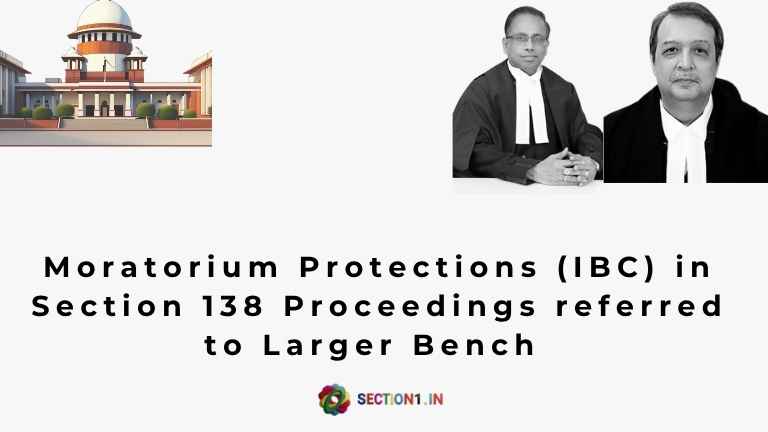
Dineshchand Surana v. UCO Bank - Criminal Appeal No. (Arising out of SLP (Crl.) Nos. 12135-12136 of 2024) - 2026 INSC 579 - May 27, 2026 – Hon’ble Mr. Justice J.B. Pardiwala and Hon’ble Mr. Justice K.V. Viswanathan.