
Appellants and Impugned Order Challenge
The appeal before the Supreme Court of India is preferred by the accused persons, Khalil Pasha and others (Appellants), challenging the judgment and order of remittal passed by a Single Judge of the High Court of Judicature at Bombay in a Criminal Revision Application. The revision application had been instituted by Abdul Rasheed (1st Respondent), the brother of the deceased victim Qavi, challenging the Trial Court’s judgment of acquittal in a murder trial arising from an incident alleged to have occurred on 14.02.1988. By the impugned order, the High Court remitted the matter back to the Additional Sessions Judge to consider afresh the testimony of the eyewitnesses, the recoveries made under Section 27 of the Indian Evidence Act, 1872, and the Chemical Analysis Report, while upholding the Trial Court’s finding refusing credence to the alleged dying declarations. [Paras 1, 2, 3]
Factual Matrix
The criminal prosecution originated from an incident on 14.02.1988 following an initial altercation between A4 and the deceased in the shop of A3, which was intervened by passersby. Later that evening at 08:30 PM, near Sagar Tailoring shop, A2 allegedly held the deceased while A1, A3, A5, and A6 assaulted him with weapons, resulting in penetrating injuries to his left lung and heart that caused his death due to hemorrhagic shock. The Trial Court evaluated the evidence threadbare and acquitted all the accused, observing that key prosecution witnesses (PW3, PW4, PW8) were uncorroborated chance witnesses whose conduct and delayed Section 161 Cr.P.C. statements lacked credibility, the scene of occurrence was doubtful due to the absence of blood seizures, and medical evidence from the treating physician (PW1) contradicted claims that the deceased was conscious to make dying declarations. Although the High Court initially set aside the acquittal, the Supreme Court in an earlier SLP remitted the matter back under Section 401(2) Cr.P.C. for failure to afford the accused an opportunity of being heard, leading to the impugned order of remit upon re-hearing on remand. [Paras 2, 3, 9, 10, 11, 12, 13, 14, 15, 16, 17]
Core Legal Arguments
The core legal issues and arguments focused on the maintainability and scope of revisional jurisdiction under Section 401 of the Code of Criminal Procedure, 1973 (Cr.P.C.) [analogous to Section 442 of the Bharatiya Nagarik Suraksha Sanhita, 2023 (BNSS)] vis-à-vis statutory appeals against acquittal. While Section 401(4) Cr.P.C. prohibits entertaining a revision where an unavailed appellate remedy exists—such as the victim’s statutory right of appeal introduced via the 2009 proviso to Section 372 Cr.P.C.—sub-sections (1) and (5) empower the High Court, in the interest of justice or suo motu, to treat a revision application as an appeal and refer it to the appropriate bench. On the evidentiary merits, the Appellants argued that the Trial Court had adopted a highly plausible view based on fundamental contradictions in the prosecution’s case, whereas the prosecution relied heavily on Section 27 weapon recoveries bearing human blood. The Supreme Court held that converting the revision into an appeal or remitting the matter was wholly unwarranted because recovery of human blood on a weapon under Section 27 of the Indian Evidence Act, 1872, in the absence of a complete, unbroken chain of corroborative circumstantial evidence linking the accused to the crime, cannot legally sustain a finding of guilt. [Paras 4, 5, 6, 7, 8, 18, 20, 33]
Analysis
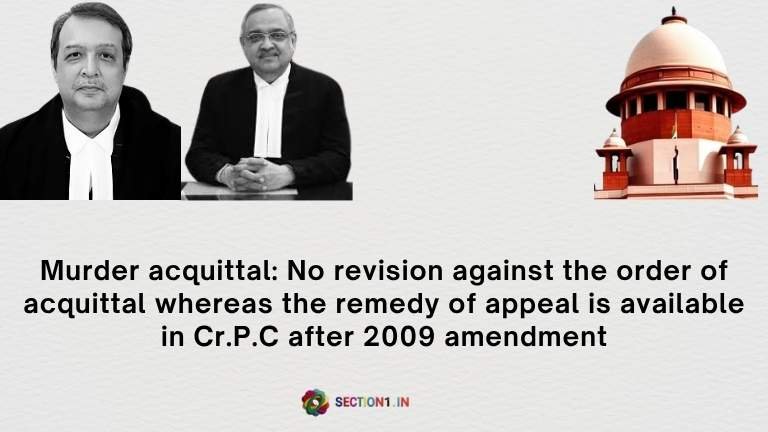
Academic question: No revision against the order of acquittal whereas the remedy of appeal is available in Cr.P.C after 2009 amendment
5. As to the question raised, we find that the same is now academic. As on the date of filing of the criminal revision application, there was no provision for appeal by the victim from an order of acquittal and Section 378 of the Cr.P.C only provided for an appeal in case of acquittal, by the State, that too after obtaining leave of the High Court. However, as pointed out in the written submissions placed before us by the learned Amicus, a proviso was introduced under Section 372 of the Cr.P.C wherein the victim was provided with a right to prefer an appeal against any order passed by the Court, acquitting the accused or convicting for a lesser offence or imposing inadequate compensation; as inserted by Act 5 of 2009. It has also been held by this Court in Mallikarjun Kodagali v. State of Karnataka that the victim is not required to pray for grant of special leave to appeal, as under section 378, since he has been conferred with a statutory right under the proviso to Section 372 which does not provide for obtaining a special leave to appeal unlike in sub-section (4) of Section 378. Joseph Stephen v. Santhanasamy relying on Mallikarjun Kodagali held that no revision can be entertained at the instance of a victim against the order of acquittal where the remedy of appeal is available in the Cr.P.C, after the 2009 amendment.
6. It is also pertinent to note here that while Section 401 of Cr.P.C delineates the power of revision, sub-section (4) prohibits the entertainment of any revision at the instance of a party who has a remedy to file an appeal, which had not been availed of. This does not preclude the High Court from taking up a revision since as per sub-section (1) of Section 401, it could be considered even suo motu as is provided for by the words employed:
“In the case of any proceeding the record of which has been called for by itself or which otherwise comes to its knowledge, the High Court may, in its discretion, exercise any of the powers conferred on a Court of Appeal by Section 386, 389, 390 and 391 or on a Court of Session by Section 307..”
Revision can be treated as a petition of appeal
7. It is also pertinent that sub-section (5) empowers the High Court even in a case where an appeal lies and the appellate remedy available is not availed, but recourse is taken to the revisional remedy, on an erroneous belief that no remedy lies thereto, in the interest of justice, the application for revision can be treated as a petition of appeal and dealt with accordingly.
17. Testimonies of the eyewitnesses and PW10, as found by the Trial Court raises a suspicion about the scene of occurrence; especially when the I.O had just prepared a scene mahazar and not made any seizures from the spot. Definitely the blood of the accused would have been spilled at the scene, since he sustained numerous cut injuries and would have been profusely bleeding at the spot from which he was alleged to have been transported to the hospital. The dying declaration hence, is on a very sketchy premise, was the finding of the Trial Court, especially when there was no clarity as to the conscious state of the injured at the hospital which is also presumably from the very grievous injuries suffered by the deceased, as disclosed from the postmortem report which also speaks of internal injuries in the lung and the heart making it highly improbable that the injured was conscious and was able to speak clearly of the assault made by the five named persons; which is the narration of PW10 – brother and PW4 – father of the deceased. The dying declaration anyway has not been believed by the High Court also.
Prosecution did not confront the eyewitness with the weapon which was not in consonance with the physical appearance of the weapon produced before the court
18. Section 27 recovery of the weapon has been proved, and blood stains were found on it, which on chemical analysis was found to be human blood. The prosecution did not confront the eyewitness with the weapon, which the Trial Court was described in a manner, which was not in consonance with the physical appearance of the weapon produced before the Court. Section 27 recovery alone cannot lead to a conviction and here it fails to implicate A4 since there is no connection to the crime proved, but for the human blood found, not indicated to be that of the accused.
20. The only evidence is the blood stains found on the weapon recovered under Section 27 of the Evidence Act which by itself cannot lead to a finding of guilt without other circumstances which provide a complete chain leading to the hypothesis of guilt being the only one possible, excluding any hypothesis of innocence. The facts proved by the prosecution is the homicidal death, the brutal murder of a person and nothing to inculpate the accused except the eyewitness testimonies which are suspect. Our reappreciation of the evidence, manifestly indicates that this was not a fit case for converting the revision petition filed before the High Court to an appeal.
Conclusion
21. We have absolutely no reason to sustain the impugned order. A brutal murder definitely, and we understand the anguish of the brother who was the revision petitioner. The murder went unavenged, but it is not for the courts to convict the accused on mere assumptions when the evidence led by the prosecution fails to satisfy the judicial mind, of the guilt of the accused. The decisions are legion which speak of what a reasonable doubt is, and it is trite that while an acquittal is handed down by the Trial Court, it fortifies the presumption of innocence that is available to an accused. The principle not to overturn an acquittal if the view taken in the order of acquittal is plausible; even if another view is possible, is not one of mere caution but is a tenet of criminal jurisprudence which ensures no prejudice being caused to the accused and ensures the benefit of any reasonable doubt arising, being conferred on the accused.
22. We allow the appeal and restore the order of the Trial Court. The accused shall stand acquitted. If they are in prison, they shall be released forthwith, if not wanted in any other case and if they are already on bail, their bail bonds shall stand cancelled.
Resources
Judgments Cited in the Document
- Mallikarjun Kodagali v. State of Karnataka, (2019) 2 SCC 752: Held that under the proviso to Section 372 Cr.P.C. (as inserted by Act 5 of 2009), a victim is conferred with a statutory right to prefer an appeal against an order of acquittal without needing to apply for special leave to appeal as required under Section 378 Cr.P.C..
- Joseph Stephen v. Santhanasamy, (2022) 13 SCC 115: Relying on Mallikarjun Kodagali, held that after the 2009 amendment to Section 372 Cr.P.C., no revision petition can be entertained at the instance of a victim against an order of acquittal where the statutory remedy of appeal is available under the Code.
Acts and Sections Mentioned
- Code of Criminal Procedure, 1973 (Cr.P.C.):
- Section 161: Examination of witnesses by police.
- Section 307: Power to grant pardon / Sessions Court powers.
- Section 372 (and 2009 Proviso): Victim’s statutory right of appeal against acquittal.
- Section 378: Appeals in cases of acquittal.
- Sections 386, 389, 390, 391: Powers of Appellate Court.
- Section 401 [Sub-sections (1), (2), (4), and (5)]: Powers of High Court in Revisional Jurisdiction.
- Indian Evidence Act, 1872:
- Section 27: Discovery and recovery of evidence based on information received from the accused.
- Indian Penal Code, 1860 (IPC):
- Section 302: Punishment for murder.
- Bharatiya Nagarik Suraksha Sanhita, 2023 (BNSS):
- Section 442: Revisional powers of the High Court (analogous to Section 401 Cr.P.C.).
Party
Khalil Pasha & Ors. v. Abdul Rasheed & Anr - Criminal Appeal No. 3507 of 2026 (arising out of Special Leave Petition (Crl.) No. 1115 of 2023) - 2026 INSC 754 - July 28, 2026 - Hon'ble Mr. Justice J. B. Pardiwala and Hon'ble Mr. Justice K. Vinod Chandran.