

Appeal
An inept investigation or a scripted enquiry, both are fatal to criminal prosecution; but the latter has lethal consequences when there is a possibility of totally innocent persons being crucified. In the present case 16 persons were charge-sheeted as accused, of which one died during the trial. Out of the remaining, 12 were convicted and sentenced under Sections 147, 341, 326, 307, 323 and 302 read with Section 149 of the Indian Penal Code, 1860. Eighteen witnesses were examined before the trial court, of which six were eyewitnesses: one disbelieved by the trial court and the High Court. The defense examined two witnesses and denied their culpability. The appellants are the convicted accused, two of whom have passed away.
4. The High Court extracted and approved the findings of the trial court that the witnesses were examined on the strength of the GD entry, especially PW2 and PW13 who were eyewitnesses. The trial court found that since such examination was immediately after the incident, there is no reason to discard the evidence of other witnesses also, since otherwise it will send a wrong message. The High Court found that the attempt of the appellants’ counsel to decry the investigation on the ground of a delayed FIR falls flat, since there was already a GD entry recorded in the jurisdictional Police Station immediately after the incident which can be termed as the FIR in the above case thus relegating the statement leading to the registration of the FIR as one under Section 161, which would be hit by Section 162 of the Cr.P.C since it was signed. The High Court upheld the conviction and sentence awarded to the 11 accused except that of the second appellant in Criminal Appeal No.318 of 2017, who stood acquitted.
Case of the prosecution
5. The prosecution case was that on 08.07.2008, the deceased along with the five eyewitnesses (PW2, PW7, PW13, PW14 and PW15) were returning home from Karbala Bazar on four motor bikes. While they were travelling on the Gobindapur-Rabhapara PWD road, nearby the house of accused No.1, a lonely spot, the 4 bikes were waylaid with a thick steel wire tied across the road. The abrupt braking of bikes resulted in the riders falling down, when a sudden attack was launched by the accused on the deceased who was first blinded by throwing chili powder in his eyes. Multiple injuries were inflicted on the deceased with cutting weapons, and his left hand was severed from the wrist. The eyewitnesses spoke in tandem about the incident, but we will deal with that a little later.
Police reached the spot based on GD
6. The police reached the spot based on a GD entry produced as Annexure P1 in Criminal Appeal No.558 of 2021; the documents from which are referred to herein. An inquest was carried out at about 9.30 P.M on 08.07.2008 itself, produced as Annexure P2 and seizures effected as seen from Annexure P3 & P4 from the P.O. Postmortem was conducted on 09.07.2008; the report produced as Annexure P6. A written complaint was filed by PW1, produced as Annexure P8 based on which Annexure P9 FIR was registered. Annexure P8 named 13 accused, all of whom were spoken of as residents of Gobindapur. The FIS by PW1 specifically mentioned the presence of 10 to 12 other accused persons who could be identified on sight.
Analysis
Investigation established death was homicidal
7. That the victim died from a brutal attack with cutting weapons is more than clear from the postmortem report, which speaks of multiple cut injuries on the body of the deceased; specifically three on the head and face, one on the right side of the neck, another below the nipple on the left chest and compound fractures on both the legs. There is also an injury seen on the frontal part of the forehead, which fractured the maxilla, mandible and frontal bone. The hematoma on the frontal lobe of the cerebrum extended to the subdural space. The 4th and 5th ribs were fractured, and the right lung revealed another hematoma on the left side. The left hand was severed at the wrist. That the death was homicidal stands established.
Neither the informant nor the inspector who recorded the GD entry is examined
8. The GD entry is seen to have been made at 09.15 P.M on 08.07.2008, on information received over the phone from the Secretary of VDP, Gobindapur and recorded by the Inspector in-charge of the Goalpara Police Station, one Padma Dhar Chutiya. Neither the informant was examined nor the Inspector who recorded the entry in the general diary maintained at the Police Station; negating the finding of the High Court that this entry is the first information report. The evidence of PW18, the I.O, who was deputed immediately on the GD entry being made clearly indicates that he reached the spot on 08.07.2008 at 9.30 P.M, when PW1 was available at the spot. PW18 conducted an inquest on the spot and sent the body for postmortem to the hospital. However, he did not choose to register an FIR on the basis of the information supplied by PW1, immediately on his return to the Police Station. PW18 also does not speak of any names having been disclosed by PW1 who identified the deceased at the P.O along with PW3, another relative. PW18 does not speak of the presence of the eyewitnesses at the P.O.
PW.1 not cited as an eye witnesess
9. Seizures were made from the spot of a beki dao, lathi, spike and 4 motor bikes, which is evident from the seizure list produced as Annexures P3 and P4. Annexure P4, seizure list not only contained the description of the bikes but also the name of the persons who travelled in each; who are the eyewitnesses. The FIR was registered two days later on 10.07.2008 at 11.50 A.M, the FIS leading to which named 13 accused. It is pertinent that while naming the 13 accused in the complaint produced as Annexure P8, the first informant also spoke of 10 to 12 other accused persons and categorically stated: “I don’t know their names, but I will be able to recognize them at sight”. However, PW1 is not cited as an eyewitness, and he does not claim to have seen the incident. The delay in registering the FIR based on the FIS, which indicated the name of 13 accused is suspect especially since PW1 does not speak of having witnessed the incident.
PW1 deposed that he did not witness the incident and he heard the assault through one Ashad Ali but Ashad Ali was not examined before court
10. We have to pertinently observe that PW1 and the other eyewitnesses are close relatives of the deceased. Even if the five eyewitnesses are found credible; which we are not convinced of, there was due deliberation before the FIS was lodged. The fact that none of the eyewitnesses though it fit to make a statement before the police further raises the suspicion regarding the array of accused as stated in the FIS. It is pertinent that PW1 categorically stated in his deposition that he did not witness the incident and that it was one Ashad Ali who spoke of the assault made by the accused leading to the death of his nephew, Wahab and injuries sustained on Omar; PW14, the son-in-law of the deceased. Ashad Ali was not examined before Court.
11. The High Court termed the GD entry as the FIR based on which the investigation was commenced especially noticing that PW2 and PW13 were examined by the police immediately after the incident. PW2 spoke in tandem with the prosecution story regarding the attack unleashed on the deceased by the named accused and spoke of injuries inflicted on him, one of which led to his left hand being severed at the wrist. He also spoke of Omar Ali, PW14 having sustained injuries. He did not speak of having fled from the P.O but categorically stated that when the villagers gathered the assailants took to their heels and that Abdul Wahab died on the spot. With respect to the statement recorded by the police, he was not sure when he was questioned. He only confirmed that the police questioned him and spoke of his statement having been recorded under Section 164 of the Cr.P.C. If the police had questioned PW2, who is said to have been available at the spot, PW18 who reached the spot at 9.30 P.M would definitely have registered an FIR on his return to the Police Station. PW18 does not speak of the presence of PW2 at the P.O or any statement having recorded from him. The High Court and the trial court egregiously erred in finding the investigation having commenced with the examination of PW2.
PW18 did not recorded the eyewitnesses though they are present at the place of occurrence
12. It is also relevant that PW13 deposed that he was questioned before the dead body was taken from the P.O, but PW18 does not corroborate that. Likewise, PW15 another eyewitness, also spoke of having been questioned at the place of occurrence. The presence of eyewitnesses PW2, PW13 and PW15 at the P.O when the villagers gathered there is affirmed by PW3, PW6 and PW8 who reached the P.O immediately after the incident. But PW18 does not speak of recording a statement from any of them. When the eyewitnesses were present at the P.O there is no explanation as to why their statement was not recorded or the accused arrayed in a proper FIR immediately thereafter.
Prosecution failed to prove the injuries sustained by the witnesses were from same transaction or incident
16. PW6, as we noticed, was disbelieved by the trial court and the High Court and the injury sustained by PW14 has also not been proved in which circumstance, we cannot find the narration of the incident as one proffered by ‘injured eyewitness’. The credibility of an injured eyewitness, as has been held by this Court is a tad higher than an eyewitness who has just seen the incident. The very fact that the witness suffered an injury in the same transaction adds to its credibility. On the other hand, when the prosecution fails to prove the very injuries projected as sustained in the same transaction, not only are we unable to concede a greater credibility than that available to a chance witness, but it also makes doubtful their very presence in the P.O.
Related witnesses presence on a public road where the incident happened cannot be presumed as natural
17. Insofar as the other eyewitnesses are concerned though they supported the prosecution as to the crime proper and identified the assailants, they too spoke of the injuries suffered by PW6 & PW14, raising a cloud of suspicion accentuated by the fact that all of them are related witnesses, in fact close relatives. Related witnesses, as is trite, cannot always be termed to be interested witnesses, but here the incident having occurred on a public road their presence together cannot be presumed as natural. The prosecution case is also that the eyewitnesses having met at the Karbala Bazar were travelling on four motorbikes to their homes in the locality. All the four bikes were seized by the police from the P.O, by the seizure list Annexure P4 detailing the engine number, chassis number and the registration number of the bikes with a description of the make and color along with the owners’ name and specifically indicating who drove each bike and who was travelling pillion. If such an account was made by any of the eyewitnesses, it is strange that the I.O did not record an FIS, then and there with the name of the assailants arrayed as accused. In the given circumstances, we are unable to give any credence to Annexure P4, which proclaims the seizure to have been made at the spot, immediately after the crime; alarmingly doubtful.
Since eye witnesses presence were not believable prosecution’s case is not credible
19. It also assumes relevance that the eyewitnesses never fled from the P.O and most of them claimed their presence even when the villagers gathered at the spot and when the police arrived. PW3 to PW6 and PW8 to PW11 are persons who converged at the P.O immediately after the incident. They spoke of the presence of some of the eyewitnesses which itself is suspect since then the name of the assailants would have been disclosed at that point itself, all of the assailants being of the very same village. But for the deceased having been attacked brutally with grievous injuries inflicted and his left hand severed at the wrist, spoken of by the witnesses who converged on the spot, also evidenced by the inquest and the postmortem report, there is no credible evidence to substantiate the prosecution case. The eyewitnesses paraded before the Court are not believable since their presence in the P.O is highly improbable for not being established unequivocally; in the context of no evidence having been adduced to substantiate the story of the five witnesses, close relatives, having travelled with the deceased on four bikes.
20. Though the police moved to the spot on the basis of a GD entry, there was no FIR registered for two days, waiting for PW1 to make a complaint with the names and asserting identification on sight of the other 10-12 assailants who is said to have participated in the assault when PW1 was not an eyewitness. It is also the evidence at the trial that at least three eyewitnesses were present at the spot when the police arrived.
Seizure of the motor bikes were not proved through the ownership documents
21. The seizure list of the motor bikes; doubtful in its genesis, though indicating the ownership of the respective bikes, there are no documents seized indicating such ownership; which was never proved. The weapons seized were neither sent for forensic analysis, nor were they confronted to the eyewitnesses or the Doctor who conducted the postmortem.
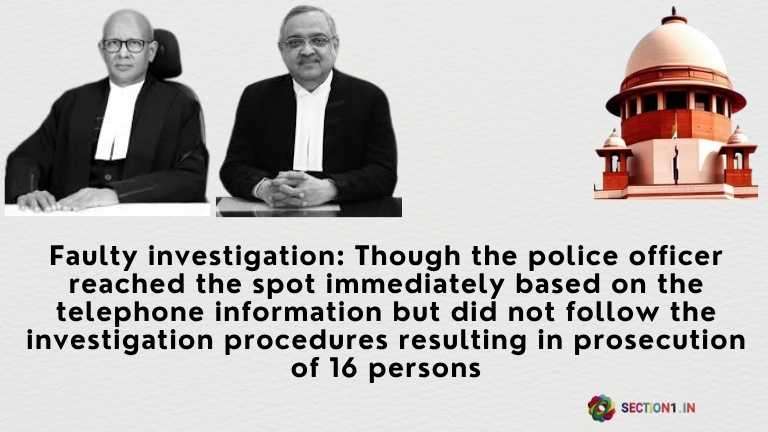
Though the police officer reached the spot immediately based on the telephone information but did not follow the investigation procedures resulting in prosecution of 16 persons
22. It is unfortunate that PW18, the police officer who reached the spot immediately after the incident took place, on the basis of an information over telephone, failed to follow due procedure to put the criminal investigation in motion as per the Code of Criminal Procedure, 1973. Be it ignorance, inefficiency or malicious motivation, the crime is left unresolved and considerable time and money has been spent in the prosecution of 16 persons, some of whom died during trial and the others suffered incarceration for long periods. The State and its Department of Home would do well to better equip their officers in investigating crimes and educating them of due procedure.
23. The appeals are allowed, acquitting the appellants and cancelling the bail bonds of the accused who is/are on bail.
Reference
Indian Penal Code (IPC), 1860
- Section 302: Punishment for murder.
- Section 147: Punishment for rioting.
- Section 148: Rioting, armed with a deadly weapon.
- Section 149: Every member of unlawful assembly guilty of offence committed in prosecution of common object (used to establish vicarious liability).
- Section 323: Punishment for voluntarily causing hurt.
- Section 447: Punishment for criminal trespass.
Code of Criminal Procedure (CrPC), 1973
- Section 154: Information in cognizable cases (relating to the delay and “scripted” nature of the FIR).
- Section 161: Examination of witnesses by police (concerning material contradictions between police statements and court testimony).
- Section 313: Power to examine the accused (regarding the opportunity for the accused to explain incriminating circumstances).
- Section 374(2): Appeals from convictions (under which the original appeals were moved before the High Court).
Indian Evidence Act, 1872
- Section 3: Interpretation clause (specifically regarding “proved,” “disproved,” and the appreciation of oral evidence).
- Section 134: Number of witnesses (addressing the quality versus quantity of evidence, particularly the reliability of “injured” witnesses).
Party
Sadek Ali @ Md. Sadek Ali and Anr. v. The State of Assam and Anr - Criminal Appeal No. 558 of 2021 - 2026 INSC 421 - April 28, 2026 – Hon’ble Justice Sanjay Kumar and Hon’ble Justice K. Vinod Chandran.