
Appeal
Appeal against the dismissal order challenging the charges framed: 2. The appellant is aggrieved by the order dated 08.04.2025 passed by the learned Single Judge of the Chhattisgarh High Court in CRR No.450 of 2025. By the said order, the challenge made by the appellant to the order framing charge against him under Section 306 read with Section 34 of the Indian Penal Code, 1860 on 16.12.2024 has been turned down.
Facts
Final report came to be filed on account of suicide of hanging: 3. As per the First Information Report dated 07.10.2024, information was received of the death of one Komal Sahu by the Police Station In-charge at Pipariya Police Station. The death had occurred on account of hanging from a Babool tree in the village. As per the postmortem report, the cause of death was on account of ‘Asphyxia’. Investigation was thereafter undertaken and a Special Investigation Team was formed for that purpose. After receiving a report from the Investigating Team, final report came to be filed on 05.12.2024. As per the final report, there was no factual evidence noted of the deceased being murdered. However, evidence was found that the death had occurred on account of suicide by hanging. As per the statements of various witnesses, the wife of the deceased Revati Bai had insulted Komal several times in front of the appellant. The appellant and Revati Bai had illicit relations and, hence, it was stated that the deceased had no option but to commit suicide. Accordingly, the final report named the appellant as the first accused while Revati Bai was named as the second accused.
Framing of charges
4. On 16.12.2024, the following charge came to be framed:
“You on 06.05.2024 and 07.05.2024 between 06.00 to 11.30 PM at central gram: Dharampura, Station: Piapriya, District Kabirdham, Chattisgarh, tortured and abetted deceased Komal Sahu to commit suicide resulting which Komal Sahu committed suicide by hanging and through this you have such an act which is punishable under section 306 of Indian Penal Code and this court has taken cognizance of this act” Alternative to this
“You on 06.05.2024 and 07.05.2024 between 06.00 to 11.30 PM at central gram: Dharampura, Station: Piapriya, DistrictKabirdham, Chattisgarh, along with co-accused Revati Bai together with common intention tortured and abetted deceased Komal Sahu to commit suicide resulting which Komal Sahu committed suicide by hanging and through this you have such an act which is punishable under section 306/34 of Indian Penal Code and this court has taken cognizance of this act”
Revision application against the charges framed was dismissed by the Hon’ble High Court
5. The appellant being aggrieved by the framing of the said charge filed a revision application under Section 438 read with Section 442 of the Bhartiya Nyaya Suraksha Sanhita, 2023 for challenging the said order. It was urged that from the material collected by the prosecution it could not be said that the appellant had abetted the commission of suicide by the deceased. Thus, no offence under Section 306 of the Penal Code had been made out. The prosecution opposed the aforesaid application. The High Court after hearing all the parties held that on the basis of statements of various family members of the deceased, it was clear that on account of the behaviour of the accused persons, the deceased was annoyed and, hence, committed suicide. It accordingly dismissed the revision application by holding that, prima facie, the ingredients of Section 306 in the alternative Section 306/34 of the Penal Code had been satisfied and there was sufficient material to proceed with the charge. Thus, by the order dated 08.04.2025 the revision application came to be dismissed. Being aggrieved, the appellant has raised a challenge to the said order in this appeal.
Analysis
Hon’ble Supreme Court appeal deserves to be granted saving reasons for later
8. We have heard the learned counsel for the parties at length and with their assistance, we have perused the entire documentary material on record that forms part of the charge sheet. Having given due consideration to the relevant factual aspects and bearing in mind the legal position as settled, we are of the view that the prayer made by the appellant deserves to be granted and the criminal proceedings qua the appellant deserve to be quashed. We would indicate our reasons hereinafter.
9. For the purposes of examining the challenge as raised by the appellant to the framing of charge under Section 306 of the Penal Code and in the alternative under Section 306 read with Section 34 of the Penal Code, it would be necessary to bear in mind the law as laid down by this Court in its earlier decisions. This Court in R.P. Kapur Vs. State of Punjab8 has held that there are three categories of cases where the High Court in exercise of its inherent jurisdiction can quash criminal proceedings. One such category stipulated is that where the allegations in the First Information Report or the complaint, even if taken at their face value and accepted in their entirety, do not constitute the offence as alleged, the institution or continuation of criminal proceedings against an accused may amount to abuse of the process of the Court or that the quashing of such proceedings would secure the ends of justice.
Similarly, in State of Haryana and others Vs. Ch. Bhajan Lal and others9, this position was reiterated that if even after taking all allegations made in the First Information Report or complaint at their face value and accepting them in their entirety do not prima facie constitute any offence, the proceedings can be quashed.
Referring recent judgment Prakash and others
10. The charge as framed against the appellant is under Section 306 and in alternate under Section 306 read with Section 34 of the Penal Code. In this regard, we may refer to a recent decision in Prakash and others (supra) to which one of us (K.V. Viswanathan, J.) was a party. Therein, the appellants had sought discharge from the criminal proceedings filed under Section 306 of the Penal Code. Dealing with the ingredients of Section 306 read with Section 107 of the Penal Code, it was held as under:
“paras. 18 to 26”
To prove a charge under Section 306 of the Penal Code it must be shown that the accused played a part in causing the suicide
11. From the aforesaid decision, it becomes clear that for sustaining a charge under Section 306 of the Penal Code, it has to be shown that the accused persons had contributed to the suicide by the deceased through some direct or indirect act. Section 107 of the Penal Code has thereafter been referred to hold that there ought to be some instigation or incitement that would reveal a clear mens rea to abet the commission of suicide, thus, leading the victim to such a position that he/she would have no other option but to commit suicide. There ought to be some material to indicate a positive act of instigation, which is a crucial component of abetment. Instigation or incitement on the part of the accused person has been held to be the gravamen of the offence of abetment to suicide. The act of instigation also has to be in close proximity to the act of suicide so as to form the nexus or a chain to indicate that the act of suicide was the direct result of the act of instigation by the accused person. Incidentally, the decision in Ramesh Kumar (supra) cited by the learned counsel for the first respondent has been considered and relied upon in Prakash and others (supra).
According to the materials available proximity and instigation not established against the accused
12. The material forming part of the charge sheet would, therefore, have to be examined keeping in mind the above perspective. Existence of all the ingredients constituting the alleged offence would be necessary. On going through the various statements recorded by the prosecution, the same indicate that deceased Komal was addicted to liquor and that the appellant and Komal used to have liquor together. The son of the deceased, Aakash, had stated that whenever his father used to drink from his money, Revati Bai used to scold him. However, when the appellant used to bring liquor for him, she did not object. In his subsequent statement recorded after about five months from the incident, he suspected that there were illicit relations between his mother and the appellant. Statements of other family members and neighbours indicate the addiction of Komal to liquor. Except such statements and general allegations of illicit relationship between Revati Bai and the appellant, there is no material whatsoever to indicate any instigation or incitement at the instance of the appellant that could lead to Komal committing suicide. On 05.05.2024, the appellant had been to the house of Komal and they had liquor together between 09:00 P.M. to 10:00 P.M. There is no material whatsoever indicating any act of instigation or incitement or abetment by the appellant. The suicide was stated to have been committed in the morning of 07.05.2024. No material whatsoever as regards the proximity between the meeting of the appellant and the deceased, and his committing suicide is available on record. It, thus, will have to be held that the requirements of Section 107 of the Penal Code are not satisfied in the present case.
To bring home a charge under section 306 IPC abetment would require some positive act of instigating or intentionally aiding another person to commit suicide
13. Even if we proceed on the premise that there were illicit relations between the appellant and the wife of the deceased, the clear mens rea to abet the commission of suicide by Komal is absent. As held, to bring home a charge under Section 306 of the Penal Code, the act of abetment would require some positive act of instigating or intentionally aiding another person to commit suicide. There is no allegation that the appellant had instigated Komal to commit suicide or that he had in some way aided any act or illegal omission to bring about the suicide. Further, there is no material on record to infer that Komal was left with no other option except to commit suicide. In the absence of such mens rea on the part of the accused being apparent from the face of record, the charge under Section 306 of the Penal Code cannot be sustained.
Conclusion
Case quashed
14. We, therefore, find that even after accepting the entire material on record at its face value, the ingredients of Section 306 of the Penal Code are not satisfied. Continuation of such criminal proceedings would, therefore, be a futile exercise resulting in the absence of process of law. We may reiterate what this Court said in paragraph 9 in Madan Mohan Singh vs. State of Gujarat and another are as follows:-
“In the prosecution under Section 306, IPC, much more material is required. The Courts have to be extremely careful as the main person is not available for cross-examination by the appellant/accused. Unless, therefore, there is specific allegation and material of definite nature (not imaginary or inferential one), it would be hazardous to ask the appellant/accused to face the trial.”
The proceedings, therefore, deserve to be quashed. The High Court failed to examine the material on record in the light of the law laid down in this regard. It, therefore, erred in not quashing the proceedings. The ratio of the decision in Dammu Sreenu (supra) relied upon by the learned counsel for the first respondent is clearly distinguishable as it arises from a challenge to the conviction of the appellant therein based on the evidence on record.
Quash is limited to the present accused and regarding other accused trial may proceed
15. For the aforesaid reasons, the order dated 08.04.2025 passed in CRR No. 450 of 2025 by the High Court is set aside. The charge framed against the appellant in Sessions Case No.80 of 2024 by the learned Sessions Judge, Kabirdham stands quashed. Consequently, the appellant is discharged from the aforesaid criminal proceedings. It is clarified that the present adjudication is restricted to the case of the appellant-accused No.1. The trial against accused No.2 shall proceed uninfluenced by any observations made herein.
Resources
Judgments cited or involved
Cases Cited by the Appellant
- Sanju @ Sanjay Singh Sengar vs. State of M.P. (2002 INSC 250).
- Prakash and others vs. The State of Maharashtra and another (2024 INSC 1020).
Cases Cited by the Respondents
- Ramesh Kumar vs. State of Chattisgarh (2001 INSC 515).
- Dammu Sreenu vs. State of A.P. (2009 INSC 846).
Cases Cited or Quoted by the Supreme Court in its Analysis
- R.P. Kapur vs. State of Punjab ((1960) 3 SCR 388): Cited regarding the High Court’s inherent jurisdiction to quash criminal proceedings.
- State of Haryana and others vs. Ch. Bhajan Lal and others (1990 INSC 363): Cited to reiterate the legal position on quashing First Information Reports.
- Prakash and others vs. The State of Maharashtra and another (2024 INSC 1020): Extensively quoted regarding the ingredients of Section 306 IPC and the requirement of mens rea.
- Jayedeepsinh Pravinsinh Chavda and Others vs. State of Gujarat (2024 INSC 960): Quoted to emphasize that mens rea for abetment cannot be merely presumed.
- Ramesh Kumar vs. State of Chhattisgarh (2001 INSC 515): Quoted to define “instigation” as an act to goad, urge forward, or provoke.
- Madan Mohan Singh vs. State of Gujarat and another (2010 INSC 521): Quoted to highlight the need for specific allegations and definite material in Section 306 prosecutions.
Acts and Sections
Indian Penal Code, 1860 (IPC)
- Section 34: Pertains to acts done by several persons in furtherance of common intention.
- Section 107: Defines abetment, involving instigation, conspiracy, or intentional aiding.
- Section 306: Relates to the abetment of suicide, which was the primary charge challenged in this appeal.
Bhartiya Nyaya Suraksha Sanhita, 2023 (BNSS)
- Section 438: Cited in the context of the appellant’s revision application filed to challenge the framing of charges.
- Section 442: Also cited regarding the procedural authority for the revision application.
Party
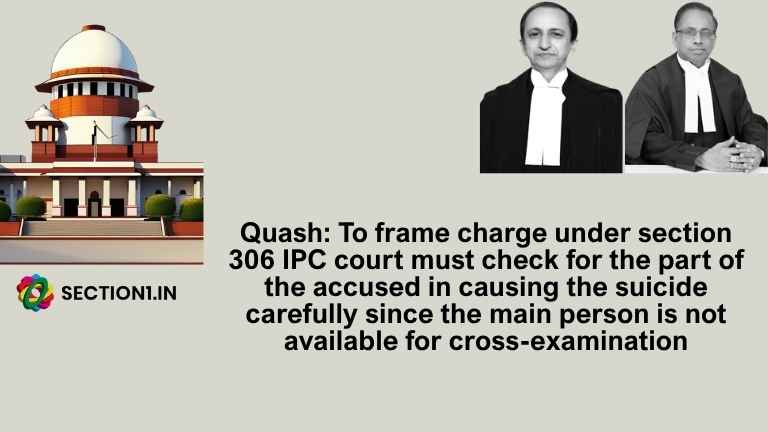
Balaji Jaiswal vs. State of Chattisgarh and another - Criminal Appeal No. 1966 of 2026 (@SLP (Crl.) No.14640 of 2025) - 2026 INSC 375 - April 16, 2026 - Hon’ble Mr. Justice K.V. Viswanathan and Hon’ble Mr. Justice Atul S. Chandurkar.