
Appeal
The appellant-convict seeks 8 lakh compensation for the delayed grant of permanent parole despite compliance with all stipulated conditions
2. This appeal arises from an unfortunate set of circumstances. The appellant-convict has been sentenced to Rigorous Imprisonment of four years for offences under Sections 148, 448, 304 Part II r/w Sections 149, 323, Indian Penal Code, 1860 by the Additional Sessions Judge, No.1, Alwar in connection with Sessions Case No.22 of 1967 in terms of judgment dated 8th December 1988. Such findings and sentence were confirmed by the dismissal of his appeal thereagainst being Criminal Appeal No.451 of 1988 in 2021 whereafter he was arrested on 23rd December 2021. He applied for permanent parole on 3rd December 2023 (not having applied for regular parole) which was rejected on 18th January 2024 on that very ground. This rejection was challenged before the High Court. The learned Single judge allowed the petition vide order dated 5th November 2024 and directed his release on furnishing personal bond of Rs.1,00,000/- and two sureties of Rs.50,000/- each. At this point in time, he had already served three years two months and twenty days out of a total four-year sentence. By 25th November 2024 he had still not been released despite complying with the conditions stipulated in the order of the learned Single Judge. As such, he approached the Division Bench whereby vide order dated 6th December 2024 he was ordered to be released forthwith.
3. Before us, the sum and substance of the appellant-convict’s case is that the time in between the order of the learned Single Judge dated 5th November 2024 and the subsequent verification of the sureties which took place on 13th November 2024, and the order of the Division Bench on 6th December 2024 i.e., 24 days, was his illegal detention and consequently he is entitled to compensation.
Rs.8 lakh compensation was claimed against the state officials illegally kept the appellant in prison even after complied with the permanent parole conditions is against Article 20 of the Constitution
4. In praying for Rs.8 lakhs as compensation, it has been submitted on behalf of the appellant-convict that State officials who ‘take the law in their hands should be made accountable’. Despite the statutory provision and the order of the Court, the appellant-convict was illegally kept in prison affecting his human rights and, therefore, have violated Article 21 of the Constitution of India. Reliance has been placed on Article 9(5) of the International Covenant on Civil and Political Rights, 1966 which stipulates that any person who has been unlawfully arrested or detained is entitled to compensation. In making such a prayer, reliance is also placed on number of judgments of this Court inter-alia DK Basu v. State of West Bengal, Khatri (2) v. State of Bihar and Rudal Shah v. State of Bihar.
Along with other grounds state submitted that state was considering challenging the grant of permanent parole and thus could not be timely informed
5. On the other hand, the State of Rajasthan submits that the order releasing the appellant-convict on parole is in violation of Rule 9 of the Rajasthan Prisoners Release on Parole Rules, 1958. It is further submitted that Asfaq v. State of Rajasthan has observed that the purpose of parole is to maintain family and social ties and as such what happened in the case of the appellant-convict is not illegal detention since the effect of parole is not suspension of sentence. The purpose of there being three stages of parole before the permanent parole is granted is to observe the conduct of the parolee outside of jail which has not been followed in this case. Also, as per the State this is a case of erroneous similarity that is tried to be exhibited by the appellant-convict with either innocent persons or an undertrial directed to be released or a person who has been acquitted neither of which is the situation in this case and for that reason none of the judgments relied on, shall be of any aid. Lastly, it has been submitted “that though there was judicial order to release the petitioner on parole but the same being erroneous and against the Rules, the State was considering challenging the same and therefore, the order for releasing the petitioner on parole could not be timely informed to the Respondent no.2.’
6. In view of the afore-recorded submissions and undisputed facts, the question that arises for consideration pertains to entitlement, if any, and quantum of compensation payable to the appellant-convict by the State for illegal detention.
What constitutes illegal detention? Forcing someone to stay in particular place which is not sanctioned by law
7. At the outset, we must consider what constitutes illegal detention. It appears that there is not a recognised definition of illegal detention. Detention is defined as an act of officially detaining someone or the act or condition of being officially forced to stay in a place [https://dictionary.cambridge.org/dictionary/english/detention]. Illegal is that which is not allowed by law. Reading them together, it can be observed that illegal detention is that act of forcing someone to stay in a particular place, which is not sanctioned by law. Another aspect would be if the detention is in violation of the procedure established by law. In our view, perhaps, it may be termed as follows:
“The deprivation of liberty by the State without lawful authority or in violation of provisions of the Constitution is illegal detention.”
It involves actual custody such that the individual is not free to leave. The detention lacks a valid legal basis such as where there is a lack of authorisation, or where any said authority is void/expired. Even where a law permits detention, it becomes illegal if the procedure followed is not just, fair, and reasonable, including failure to observe essential safeguards. It would also cover situations where the power to detain is exercised arbitrarily, for an improper purpose, or in bad faith.
8. Before proceeding to consider whether all the requirements mentioned above are met or not, we must consider what is the meaning of ‘parole’ and also ‘permanent parole’.
After considering the dictionary meanings from various dictionaries such as Oxford, Black’s Law and The Law Lexicon the Hon’ble Supreme Court has held that:
As per a document[1] prepared under the leadership of Dr. Ranbir Singh and G.S Bajpai[2] under the Ministry of Human Resource Development, Government of India, parole is:
“… temporary release of a prisoner for short period so that he may maintain social relations with his family and the community in order to fulfil his familial and social obligations and responsibilities. It is an opportunity for a prisoner to maintain regular contact with outside world so that he may keep himself updated with the latest developments in the society. It is however clarified that the period spent by a prisoner outside the Jail while on parole in no way is a concession so far as his sentence is concern. The prisoner has to spend extra time in prison for the period spent by him outside the Jail on parole. Parole may be of the following two types, depending upon the purpose behind it – i) Emergency parole under police protection: to cater to the familial and social responsibilities of emergent nature like death/ serious illness/ marriage of a family member or other close relative. ii) Regular parole: to take care of the familial and social obligations and responsibilities of regular nature as well as for the psychological and other needs of the prisoner to maintain contact with the outside world like house repair, admission of children to school/ college, delivery of wife, sowing and harvesting of crops, etc.”
After referred to some judgments Hon’ble Supreme Court has held as:
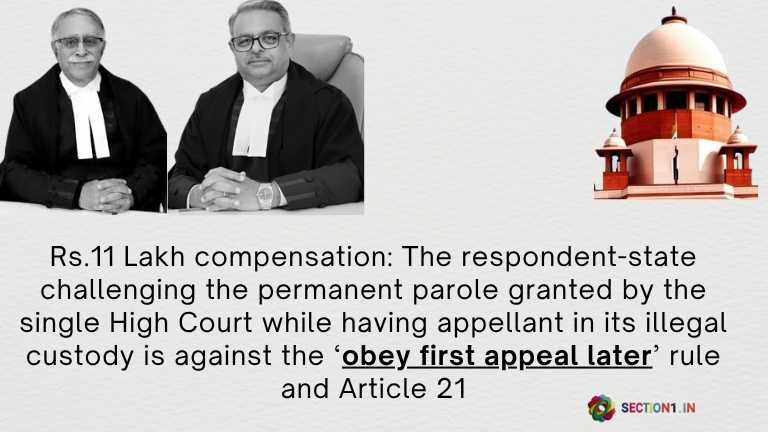
The respondent-state challenging the permanent parole granted by the single High Court is against the ‘obey first appeal later’ rule
9. Having understood the meaning of the word as above; we may at this stage itself deal with one of the contentions of the respondent State. As noticed supra, it has been argued that the order of the learned Single Judge is contrary to law since the appellant was never released on the three prior paroles as required by law, and so the question of permanent parole does not arise. We are of the considered view that such a contention must be forcefully negated for the simple reason that the respondent State has never, on its own, challenged the findings of the learned Single Judge. That being the case, it is not open for the respondent State to raise a question regarding the legality of the order at this belated stage.
In our considered view, the principle of “obey first, appeal later” ought to have been applied. Going a step further, it is well settled that mere preferring of an appeal would not, by itself, operate as a stay of the order impugned therein. See Atma Ram Properties (P) Ltd. v. Federal Motors (P) Ltd. In fact, this Court has observed:-
73) It is the sole discretion of the appellate authority under the Act to decide the appeal based on the facts involved in the appeal, and legal provisions which eventually result in passing a judicial order. No higher court can pass such directions merely on anticipation of an order being passed by an appellate authority. It is only after the order is passed, that the aggrieved person has a legal right to take recourse to a legal remedy available in law against such order by approaching to a higher forum and pray for grant of appropriate relief against such order.
74) A fortiori, the Court cannot stay or/and quash the orders in anticipation, before they are passed. We cannot, therefore, uphold such writ/directions issued by the High Court.
Impact of judicial decree
A judicial order or decree remains in operation unless stayed, modified, or set aside; mere filing of an appeal or application would not, by itself, automatically keep the order in abeyance.
Question of compensation discussed
11. Having perused the judicial pronouncements as above, we now move to the main issue at hand i.e., the question of compensation. The respondent State has opposed the appellant’s reliance on some of these judgments by contending that they pertained to people under unlawful detention by the State which the appellant was not since he was in fact in prison under the due process of law and so these judgments are distinguishable on facts. We do not find merit in this submission for the para referred to by us above from Halbury’s Laws of England makes abundantly clear that habeas corpus would be maintainable against any form of detention. Once parole had been granted and sureties produced to the satisfaction of the concerned court, the non-release becomes illegal detention. That apart, reference to these judgments is to establish clearly that payment of compensation is an acceptable and recognised public law remedy.
[See: Sube Singh v. State of Haryana27] There can be no qualms with this position. A few judgments of this Court are ubiquitous with compensation under public law, and so, naturally, we must discuss those first.
“ ………………. “
Conclusion
12. Having considered instances of award of compensation as above, as also the discussion preceding that we are of the considered view that the appellant is entitled to compensation for the twenty-four days of illegal custody suffered by him at the hands of the respondent State. The liberty of an individual is not a trivial matter. The State cannot continue curtailing the same in the face of a court order, on account of its slow bureaucratic processes of taking decisions whether to file appeals in a particular matter or not. If such a view is agreed to by us, it would amount to the liberty of a person being placed sub-par to the decision whether or not to file an appeal which is purely an administrative call. That cannot be countenanced. We may only observe that in Baradakanta Misra v. Bhimsen Dixit34 , it has been observed by a Bench of three Judges that merely because a certificate of appeal had been sought from the High Court against an order and the same was pending, the binding character of the High Court order does not lose its lustre. This would squarely apply in this case. Once the detenue has been ordered to be released, the same has to be followed no matter what. The only scenario in which it would not be so done was if a superior Court has granted stay in the matter. Just because a person had been convicted does not mean that his rights weigh less on the scales of justice. We say so for the reason that the due process of verification of sureties had already taken place and despite the same there is an unexplained delay. This Court is oblivious of the fact that such official processes do require some time however, it is incumbent upon the State to ensure its processes do not negatively impact an individual who has secured his liberty.
Rs.11 lakh compensation awarded
We award compensation to the tune of Rs.11,00,000/- (Eleven lakhs Only). Amount to be deposited directly into the bank account of the appellant, details of which shall be furnished by the learned counsel for the appellant to the learned counsel for the State.
Appeal allowed
Appeal is allowed. Pending application(s) if any shall stand disposed of.
Resources
- DK Basu v. State of West Bengal, (1997) 1 SCC 416: Cited by the appellant-convict to support the prayer for monetary compensation regarding the violation of fundamental human rights and illegal detention.
- Khatri (2) v. State of Bihar, (1981) 1 SCC 627: Relied upon by the appellant-convict as legal precedent to claim compensation for the infringement of Article 21 rights during detention.
- Rudal Shah v. State of Bihar, (1983) 4 SCC 141: Involved as a prominent public law precedent where the Supreme Court established that monetary compensation can be awarded under Article 32 as a palliative for the flagrant violation of Article 21 after a petitioner was kept in jail for 14 years after his release order.
- Asfaq v. State of Rajasthan, (2017) 15 SCC 55: Cited by the State of Rajasthan to observe that the fundamental purpose of parole is to allow a prisoner to maintain family and social ties, arguing that the effect of parole is not a suspension of sentence.
- Poonam Lata v. M.L. Wadhawan, (1987) 3 SCC 347: Used to trace the historical and criminal justice context of ‘parole’, establishing it as an administrative act of grace, a reformative process, and a partial liberty that does not alter the formal status of the prisoner.
- State of Haryana v. Mohinder Singh, (2000) 3 SCC 394: Cited to delineate the distinct legal connotations between the terms “bail”, “furlough”, and “parole”, noting that a prisoner’s period on parole does not count toward the total sentence duration.
- Sunil Fulchand Shah v. Union of India, (2000) 3 SCC 409: A Constitution Bench judgment used to further analyze and affirm the legal distinctions between the administrative action of granting parole versus the judicial nature of bail.
- Atma Ram Properties (P) Ltd. v. Federal Motors (P) Ltd., (2005) 1 SCC 705: Cited to support the principle that merely preferring an appeal does not automatically operate as a stay on an impugned judicial order.
- Karnataka Housing Board v. C. Muddaiah, (2007) 7 SCC 689: Quoted to emphasize the rule of law, stating that once a direction is issued by a competent court, it must be obeyed and implemented without reservation by the concerned party.
- Prithawi Nath Ram v. State of Jharkhand, (2004) 7 SCC 261: Quoted to establish that the rightness or wrongness of a court order cannot be urged as a defense for non-compliance, and flouting it renders a party liable for contempt.
- Mohd. Iqbal Khanday v. Abdul Majid Rather, (1994) 4 SCC 34: Referenced to highlight that an aggrieved party must invoke prompt appellate procedures rather than ignoring a judicial order and later pleading implementation difficulties.
- Cox v. Hakes, (1890) LR 15 AC 506 (HL): An English case propounded by Lord Halsbury, quoted to highlight the historical importance of the writ of habeas corpus as a vital safeguard of personal liberty.
- Ghulam Sarwar v. Union of India, 1966 SCC OnLine SC 18: A Constitution Bench judgment quoted to explain the wide procedural scope, immemorial antiquity, and predominant position of the writ of habeas corpus in protecting personal liberty.
- Kanu Sanyal v. Distt. Magistrate, (1973) 2 SCC 674: A Constitution Bench judgment cited to explain that habeas corpus is essentially a procedural writ designed to secure immediate judicial inquiry into an alleged unlawful restraint.
- ADM, Jabalpur v. Shivakant Shukla, (1976) 2 SCC 521: Features the famous dissenting opinion of Justice H.R. Khanna, which is quoted to define habeas corpus as an effective process for securing immediate release from unjustifiable detention.
- Sunil Batra (2) v. State (UT of Delhi), (1980) 3 SCC 488: Quoted for its emphasis on prison justice, stating that the rule of law is broken when the State’s minions become law-breakers, thereby broadening habeas corpus jurisdiction to secure human rights behind bars.
- Union of India v. Paul Manickam, (2003) 8 SCC 342: Cited to characterize the writ of habeas corpus as a fundamental facet and representation of the due process of law.
- Sube Singh v. State of Haryana, (2006) 3 SCC 178: Referenced to establish that the payment of monetary compensation is a well-recognized public law remedy for the deprivation of fundamental rights.
- Sebastian M. Hongray v. Union of India, (1984) 3 SCC 82: Involved as a precedent where the Supreme Court awarded exemplary monetary compensation ({Rs. 1,00,000/-} each) to the wives of two missing persons due to the torture and mental agony they suffered.
- Bhim Singh v. State of J & K, (1985) 4 SCC 677: Involved as a precedent where a legislator was maliciously detained by the State, and the Court awarded {Rs. 50,000/-} in monetary compensation for the invasion of his constitutional rights.
- Nilabati Behera v. State of Orissa, (1993) 2 SCC 746: Involved as a landmark case where the Court awarded {Rs. 1,50,000/-} for a custodial death, distinguishing public law monetary amends (exemplary damages for breach of public duty) from private law tort actions.
- Sohan Singh @ Bablu v. State of Madhya Pradesh, Special Leave to Appeal (Crl.) 11244/2025: Involved as a recent precedent where the Court granted {Rs. 25,00,000/-} in compensation to an individual whose detention was prolonged beyond the formal completion of his sentence.
- S. Nambi Narayanan v. Siby Mathews, (2018) 10 SCC 804: Involved as a precedent where an ISRO scientist was wrongfully arrested on false espionage charges, and a three-judge bench of the Supreme Court awarded him {Rs. 50,00,000/-} in compensation for his wrongful custody.
- Baradakanta Misra v. Bhimsen Dixit, (1973) 1 SCC 446: Cited to affirm that the binding character of a High Court order is not diminished merely because an application or certificate of appeal is pending before a higher forum.
Acts and Sections
- Indian Penal Code, 1860 (IPC)
- Section 148: Relating to rioting, armed with a deadly weapon.
- Section 149: Relating to every member of an unlawful assembly being guilty of an offence committed in prosecution of a common object.
- Section 323: Relating to the punishment for voluntarily causing hurt.
- Section 448: Relating to the punishment for house-trespass.
- Section 304 Part II: Relating to the punishment for culpable homicide not amounting to murder, committed with the knowledge that it is likely to cause death but without any intention to cause death.
- Constitution of India
- Article 21: Guaranteeing the fundamental right to protection of life and personal liberty.
- Article 32: Dealing with remedies for the enforcement of fundamental rights by approaching the Supreme Court.
- Article 226: Dealing with the power of High Courts to issue certain writs for the enforcement of fundamental rights and other purposes.
- Code of Criminal Procedure (CrPC)
- Section 432: Referred to in a cited judgment regarding the power of the State Government to remit the whole or any part of a punishment.
- Section 433: Mentioned in the context of the commutation of a death sentence into one of life imprisonment.
- Chapter XXXIII: Referenced in cited precedents as the chapter containing elaborate statutory provisions relating to the grant of bail.
- Rajasthan Prisoners Release on Parole Rules, 1958 (Rajasthan Parole Rules)
- Rule 9 (Parole period): Elaborating on the completion of sentence portions (one-fourth) required for regular parole eligibility (1st parole for 20 days, 2nd for 30 days, 3rd for 40 days) and the procedure/conditions for recommendations to the Government for permanent release on parole.
- Conservation of Foreign Exchange and Prevention of Smuggling Activities Act, 1974 (COFEPOSA)
- Involved as the underlying statutory framework in the cited precedent Poonam Lata v. M.L. Wadhawan concerning a detention matter.
Party
Daudayal v. The State of Rajasthan & Ors - Criminal Appeal No. 2973 of 2026, arising out of SLP (Crl.) No. 5036 of 2025) - 2026 INSC 599 - May 29, 2026 - Hon'ble Mr. Justice Sanjay Karol and Hon'ble Mr. Justice Augustine George Masih.
[1] [11https://epgp.inflibnet.ac.in/epgpdata/uploads/epgp_content/S001608/P001812/M027790/ET/1521 116786Bail,ParoleFurloughremission-(2.Upneet.Lalli.pdf]
[2] The former and current vice-chancellors of National Law University, Delhi