

Appeal
Appeal by mother of the victim against the order of the High Court confirming discharge
2. This appeal is by a minor victim’s mother impugning an order of the High Court dated 08.03.2022 in Criminal Revision Petition No.6 of 2021, whereby the discharge order passed by the Trial Court dated 19.02.2021 has been affirmed.
Background Facts
3. A first information report was lodged by the appellant on 17.04.2020, inter alia, alleging that on 07.04.2020, her daughter, aged 8 years, complained of pain in her private part. Upon enquiry, the victim told the appellant that in the month of November 2019, while the victim was in SRS school (a pseudonym), her senior, a Juvenile boy, had sexually assaulted her in the classroom; the incident was reported by her to her elder sister, a student of the same school, who, in turn, informed the Head Girl; thereafter, the Head Girl scolded the boy and reported the matter to the school authority. It was alleged that the school authority did not take action and did not even inform the informant, rather the boarders of that school were told not to disclose about the incident to anyone. It was also alleged that when the informant came to know about the incident, to ascertain the truth, she took the victim to the District Hospital where the Doctor, after check-up, confirmed that informant’s daughter is a victim of rape. On the aforesaid allegations, the informant (i.e., the appellant herein) prayed for action against the offender(s) including the school authorities/ staff.
4. The matter was investigated. During investigation, statements of the victim; her sister; the Head Girl of the School; and few witnesses were recorded. Thereafter, the police report, dated 29.05.2020, was submitted under Section 173(2) of the Code of Criminal Procedure, 1973 enlisting eight witnesses, namely, (i) the informant; (ii) the victim; (iii) (iii) Elder sister of the victim; (iv) Y S, the Head Girl of the School; (v) RT, Chairperson of the management of the School; (vi) Medical Officer; (vii) another Medical Officer; and (viii) Smt. S. Nabam, the Investigating Officer. Relevant portion of the police report, containing the narration of the facts and the nature of evidence collected during investigation is extracted below:
“……….”
5. The aforesaid extract of the police report, makes it clear that besides the main offender, who was a juvenile in conflict with law (JCWL) qua offences punishable under Section 376 AB of the Indian Penal Code, 1860 read with Section 6 of the Prevention of Children from Sexual Offences Act, 2012, the other accused persons were indicted for offences punishable under Sections 176/ 201/ 120B read with Section 21 (2) of POCSO Act for omission to furnish information regarding commission of the offence, causing disappearance of evidence of the offence, conspiring not to disclose the incident to anyone and for failing to report the commission of a cognizable offence.
6. All those accused who were indicted in the final report for offences under Sections 176/201/120B and Section 21(2) of the POCSO Act applied for discharge before the Trial Court.
7. The Trial Court discharged the aforesaid accused vide order dated 19.02.2021. Relevant portion of the order dated 19.02.2021 is extracted below:
“…….”
Revision before the High Court
9. Before the High Court, on behalf of the appellant, it was argued that a prima facie case is made out against the discharged accused who were teachers and staff members of the School where the victim and the main accused were studying. Besides, the victim, her elder sister and her mother had supported the allegations made in the FIR. Their statements are consistent and find support from the statement of the victim recorded under Section 164 CrPC, therefore there was no justification for the Trial Court to discharge the aforesaid accused.
10. Whereas, on behalf of the discharged accused, it was argued that in so far as the Principal and Teachers of the School are concerned, they had no personal knowledge of the incident and though the matter might have been reported to them, they did not find any evidence to infer that an offence of the nature reported has been committed; besides, they could not notice anything abnormal in the behaviour of the victim and the alleged offender. As such, they had no reason to believe that any offence was committed. As far as the remaining accused are concerned, there is no specific allegation against them. Even if it is assumed that they had examined the victim, in absence of visible signs of sexual assault, knowledge that an offence has been committed cannot be imputed to them. Besides, there is no positive act of causing disappearance of evidence of commission of offence alleged to have been committed by them. Thus, the necessary ingredients of offences punishable under Sections 176/201/120B of the IPC read with Section 21 (2) of the POCSO Act are not made out against them.
Dismissal of revision by the High Court
11. The High Court dismissed the revision reasoning thus:
“…………….”
12. Aggrieved by the order of the High Court, the victim’s mother is in appeal before us.
Discussion/ Analysis
Materials raised by the defence which are not part of the police report is not liable to be considered
20. As the present appeal arises out of an order of discharge, before we proceed to test the correctness of the discharge order in the context of rival submissions, we must remind ourselves of the settled legal position that in a case instituted on a police report, at the stage of considering a prayer for discharge made by an accused, the Court must only consider the materials collected during investigation and which form part of the police report. A plea of defence raised by the accused on some material not part of the police report is not liable to be considered. At this stage, the court is concerned not with proof but with a strong suspicion that the accused has committed an offence, which, if put to trial, could prove him guilty. The final test of guilt is not to be applied at this stage. Further, the court must proceed on an assumption that the material which has been brought on record by the prosecution is true. On the scope of the proceedings at the stage of framing of charge under Sections 227 and 228 of the Code of Criminal Procedure, 1973 (CrPC), in State of Tamil Nadu v. N. Suresh Rajan and Ors., this Court observed:
“29. … True it is that at the time of consideration of the application for discharge, the court cannot act as a mouthpiece of the prosecution or act as a post office and may sift evidence in order to find out whether or not the allegations made are groundless so as to pass an order of discharge. It is trite that at this stage of consideration of an application for discharge, the court has to proceed with an assumption that the materials brought on record by the prosecution are true and evaluate the said materials and documents with a view to find out whether the facts emerging therefrom taken at their face value disclose the existence of all ingredients constituting the alleged offense. At this stage, probative value of the materials has to be gone into and the court is not expected to go deep into the matter and hold the materials would not warrant a conviction. In our opinion, what needs to be considered is whether there is a ground for presuming that the offence has been committed and not whether a ground for convicting the accused has been made out. To put it differently, if the court thinks that the accused might have committed the offence on the basis of the materials on record on its probative value, it can frame the charge; though for conviction, the court has to come to the conclusion that the accused has committed the offence. The law does not permit a mini trial at this stage.” (Emphasis supplied)
21. The test, therefore, is whether the materials forming part of the police report if taken at their face value have sufficient probative value to create a grave suspicion that the accused to be charged has committed that offence. For the purpose of satisfying itself whether the material put forth in the police report creates grave suspicion about commission of the offence by the accused, the Court has the power to sift and weigh the evidence. However, at this stage, the Court is not required to be satisfied that the material is sufficient to record conviction.
22. In that light, we propose to consider the final police report to find out whether it contains material sufficient to create grave suspicion against the accused respondents of committing the offence(s) alleged to have been committed by them in the police report.
Final Police Report
23. The police report indicts JCWL for offences punishable under Section 376 AB IPC read with Section 6 of the POCSO Act and the respondents, namely, ABL (Principal of the School), Smt. Linda Sema (Respondent No.1 i.e., wife of the Principal/ alleged Head Mistress of the School), Shri CB (Vice Principal cum teacher in the School), Shri RJK (teacher in the School), Miss PD (teacher in the School), Miss JA (teacher in the School cum Girls’ School Warden) and Miss L S (teacher in the School), under Sections 17616, 20117, 120-B18 of IPC and Section 21(2)19 of the POCSO Act.
Documents in the police report: 25. What is clear from the police report is that,- (a) the victim was a minor, a child within the meaning of section 2(d) of the POCSO Act; (b) the victim had complained about JCWL, a student of Class VIII, sexually assaulting her; (c) the said complaint was first made to her elder sister, thereafter she and her elder sister contacted the Head Girl (Y S); (d) the Head Girl thereafter informed Smt. Linda Sema (Respondent No.1), who is alleged to be the Headmistress of the School; (e) Smt. Linda Sema thereafter took the victim to L S’s room where N, Linda Sema, LS and P D were present; (f) Linda Sema and others, who were present in that room, physically checked the private part of the victim and noticed that private part had turned reddish and was slightly swollen; (g) later, when the Principal arrived, the accused persons had a meeting and it was decided that the matter should not be disclosed to anybody till it is resolved; (h) in the month of April 2020, the victim’s mother came to know about the incident and sought to verify the details of it from Y S; (i) the School management including teachers had instructed Y S that if anybody asks her about the incident, she must say that the incident may have occurred, but it is not clear as to who the culprit is.
Relevant Provisions of the POCSO Act
26. Section 19 of the POCSO Act, inter alia, provides that any person, who has ‘knowledge’ that an offence under this Act has been committed, he shall provide such information to (a) the Special Juvenile Police Unit; or (b) the local police. Sub-section (6) of Section 19 provides that the Special Juvenile Police Unit or the local police shall, without unnecessary delay but within a period of twenty-four hours, report the matter to the Child Welfare Committee and the Special Court or where no Special Court has been designated, to the Court of Session, including need of the child for care and protection and steps taken in that regard. Sub-section (7) of Section 19 gives protection to the person who gives the information in good faith by providing that no person shall incur any liability, whether civil or criminal, for giving the information in good faith for the purpose of sub-section (1).
27. Section 21 of the POCSO Act provides for punishment in case of failure to report or record the case. Sub-section (1) of Section 21 provides that any person, who fails to report the commission of an offence under sub-section (1) of Section 19 or Section 20, or who fails to record such offence under sub-section (2) of Section 19, shall be punished with imprisonment of either description which may extend to six months or with fine or with both. Sub-section (2) of Section 21 provides that if any person, being in-charge of any company or an institution, who fails to report the commission of an offence under sub-section (1) of Section 19 in respect of a subordinate under his control, shall be punished with imprisonment for a term which may extend to one year and with fine. Sub-section (3) of Section 21 clarifies that the provisions of sub-section (1) shall not apply to a child under this Act.
Construction of phrase ‘Knowledge that such an offence has been committed’ used in Section 19(1) of POCSO Act
28. The word ‘knowledge’ used in Section 19 is not defined in the POCSO Act. Section 2 (2) of the POCSO Act states: “The words and expressions used herein and not defined but defined in the Indian Penal Code (45 of 1860), the Code of Criminal Procedure, 1973 (2 of 1974), the Juvenile Justice (Care and Protection of Children) Act, 2015 (2 of 2016) and the Information Technology Act, 2000 (21 of 2000) shall have the meanings respectively assigned to them in the said Codes or the Acts”. However, knowledge is not defined in either of the two Codes or the Acts mentioned in Section 2(2).
29. A conjoint reading of Section 19 and Section 21 of the POCSO Act, inter alia, indicates that if any person has knowledge that an offence has been committed under the Act, it is the mandate of law to provide such information to the Special Juvenile Police Unit or the local police. If such person, other than a child, fails to report, he is liable to punishment under Section 21.
30. Therefore, the crucial question is, as to when can it be said that a person has knowledge that an offence under the POCSO Act has been committed.
31. In A.S. Krishnan and Ors. v. State of Kerala, this Court with reference to Sections 471 and 26 of IPC had an occasion to expound the expressions “knowledge” and “reason to believe”. It was observed that “knowledge” is an awareness on the part of the person concerned indicating his state of mind. “Reason to believe” is another facet of the state of mind. “Reason to believe” is not the same thing as “suspicion” or “doubt” and mere seeing also cannot be equated with believing. “Reason to believe” is a higher level of state of mind than suspicion or doubt and “knowledge” is on a higher plane than “reason to believe”. It was also observed that a person can be supposed to know where there is a direct appeal to his senses, and a person is presumed to have a reason to believe if he has sufficient cause to believe the same. It was observed:
“10. In substance, what it means is that a person must have reason to believe if the circumstances are such that a reasonable man would, by probable reasoning, conclude or infer regarding the nature of the thing concerned. Such circumstances need not necessarily be capable of absolute conviction or inference; but it is sufficient if the circumstances are such as creating a cause to believe by chain of probable reasoning leading to the conclusion or inference about the nature of the thing. These two requirements i.e., ‘knowledge’ and ‘reason to believe’ have to be deduced from various circumstances in the case.”
32. In SR. Tessy Jose and Others v. State of Kerala, this court, had the occasion to deal with the word “knowledge” as used in Section 19 of the POCSO Act. In that case, according to the allegations, A-1 had raped the victim in 2016 when she was a minor. As a result, she became pregnant. As per the victim’s mother, when the victim started complaining about pain in her stomach, she brought her to the hospital where the appellants before this Court were working. The victim being found at an advanced stage of pregnancy was taken to the labour room, where she delivered a child. The role of appellants who were before this Court was that one of them had conducted the delivery, as a Gynaecologist, and the other had attended to the child of the victim after the delivery, as a Paediatrician. The third accused was in the administrative block of the hospital. The prosecution case against the said appellants was that they had knowledge about the rape of the victim, yet they did not report the matter. In that context, this Court considered the provisions of Section 19 of the POCSO Act and held that there is no evidence to implicate the appellants. It was also observed that to frame charge, evidence should be such which should at least create grave suspicion regarding commission of the offence by the accused. Consequently, this Court allowed the appeal and quashed the proceedings of the case. While deciding the aforesaid case, this Court observed that the provisions of Section 19(1) of the POCSO Act uses the expression ‘knowledge’, “which means that some information received by such a person gives him/her knowledge about the commission of the crime”. The court observed that there is no obligation on such a person to investigate and gather knowledge. The court thereafter relied on the decision of this Court in A.S. Krishnan (supra) expounding the expression ‘knowledge’ as to mean an awareness on the part of the person concerned, indicating his state of mind. It was observed that a person can be supposed to know only where there is a direct appeal to his senses. The Court went on to observe:
“13. The knowledge requirement foisted on the appellants cannot be that they ought to have deduced from circumstances that an offense has been committed.”
33. In State of Maharashtra and another v. Dr. Maroti minor tribal girls who were students of an educational institution, residing in girls’ hostel, were sexually assaulted by unknown persons. They were taken to hospital and attended by a medical practitioner, who was informed about the sexual assault on them. Sexual assault on them was also clear from their medical examination conducted by the said medical practitioner, yet no report, as per the mandate of Section 19(1), was made by the medical practitioner. During investigation, the said medical practitioner was found prima facie guilty of an offence punishable under Section 21 of the POCSO Act. However, the High Court quashed the proceedings qua the said medical practitioner. Aggrieved therewith, the State came before this Court. This Court allowed the appeal and set aside the High Court’s order holding that whether one has ‘knowledge’ or not is a question of fact. In that context, this Court observed that conclusion in that regard must not ordinarily be drawn by perusing statements collected during investigation. Importantly, this Court had noticed that the victim(s) had disclosed to the medical practitioner of them being subjected to sexual assault, and the medical examination had disclosed ruptured hymen.
Knowledge is not defined in POCSO or any of the Codes/Acts
35. Notably, the expression ‘knowledge’ is not defined in either the POCSO Act or any of the Codes/ Acts specified in Section 2(2) thereof. Even the General Clauses Act, 1897 does not define it. Therefore, a contextual meaning of the word ‘knowledge’, which serves the avowed purpose of the Act, would have to be ascertained.
36. Before we consider the avowed purpose of the Act and discuss as to what meaning to the phrase “has knowledge that such an offence has been committed” must be ascribed to achieve the object of the Act, it would be useful to notice how the expression ‘knowledge’ has been expounded in legal dictionaries.
37. In Black’s Law Dictionary, knowledge is defined as an awareness or understanding of a fact or circumstance.
38. In P. Ramanatha Aiyar’s Advanced Law Lexicon, different meanings of the word ‘knowledge’ as found in various judicial pronouncements have been compiled. Relevant amongst them are extracted below:
(a) The certain perception of truth; belief which amounts to or results in moral certainty indubitable apprehension; information, intelligence, implying truth, proof and conviction; the act or state of knowing; clear perception of fact; that which is or may be known; acquaintance with things ascertainable; specific information; settled belief; reasonable conviction; anything which may be the subject of human instruction.
(b) Knowledge signifies a state of mental realization with bare state of conscious awareness of certain facts in which human mind remains supine or inactive.
(c) Knowledge is an awareness on the part of the person concerned indicating his state of mind. Reason to believe is another facet of the state of mind. Knowledge will be slightly on a higher plane than ‘reason to believe’.
(d) The word knowledge is sometimes used also in the sense of information. It describes the state of mind. Knowledge is not satisfaction. Information not believed to be false is knowledge.
(e) Knowledge is nothing more than men’s firm belief and is distinguished from ‘belief’ in that the latter includes things which do not make a very deep impression on the memory. The difference is ordinarily merely in degree.
(f) The meaning of the words ‘belief’ and ‘knowledge’, as defined by lexicographers, will show that there is a distinct and well-defined difference between them. ‘Believe’ is defined by Webster to mean to exercise trust or confidence; and by the Century dictionary, to exercise belief in; to be persuaded upon evidence, arguments, and deductions, or by other circumstances other than personal knowledge. ‘Knowledge’ according to Webster, is the act or state of knowing; clear perception of fact; that which is or may be known. According to the Century Dictionary it means acquaintance with things ascertained or ascertainable; specific information. (Emphasis supplied)
39. Those extracts from Advanced Law Lexicon (supra) make it clear that the word ‘knowledge’ has been variously expounded in judicial pronouncements. Importantly, ‘knowledge’ has also been understood as an information not believed to be false. In such circumstances, and in absence of any specific definition of the word ‘knowledge’ in the POCSO Act or in any of the Codes/ Acts specified in Section 2(2) thereof, and also the General Clauses Act, 1897, the meaning that would best serve the purpose of the Act must be adopted.
41. It is clear from above that the legislative intent was to enact a self-contained comprehensive legislation, inter-alia, to provide for protection of children from the offences of sexual assault, sexual harassment and pornography, with due regard for safeguarding the interest and well-being of the child at every stage of the judicial process, incorporating child-friendly procedures for reporting, recording of evidence, investigation and trial of offences and provision for establishment of Special Court for speedy trial of such offences. To ensure that the provisions of the POCSO Act have overriding effect, to the extent of inconsistency with the provisions of any other law, Section 42A was inserted in the Act with effect from 03.02.2013. Further, to ensure that there is public awareness about the Act, Section 43 of the Act provides that the Central Government and every State Government, shall take all measures to ensure that –
(a) the provisions of this Act are given wide publicity through media including the television, radio and the print media at regular intervals to make the general public, children as well as their parents and guardians aware of the provisions of this Act;
(b) the officers of the Central Government and the State Governments and other concerned persons (including the police officers) are imparted periodic training on the matters relating to the implementation of the provisions of the Act.
42. Besides, Section 44 of the Act provides for monitoring the implementation of the provisions of the Act. According to Section 44, the National Commission for Protection of Child Rights constituted under Section 3, or as the case may be, the State Commission for Protection of Child Rights constituted under Section 17, in addition to the functions assigned to them under that Act, were required to monitor the implementation of the provisions of the Act in such manner as may be prescribed.
43. Section 45 of the Act empowers the Central Government to make rules for carrying out the purposes of this Act. Sub-rule (2) of Section 45, inter alia, provides that without prejudice to the generality of the foregoing powers, such rules may provide for all or any of the matters enumerated therein including “care and protection and emergency medical treatment of the child under subsection (5) of Section 19” (see clause (b) of sub-section (2) of Section 45).
45. A conjoint reading of the provisions of Section 19 of the POCSO Act and the 2012 Rules makes it clear that the information contemplated under sub-section (1) of Section 19 may be in respect of an offence committed, or attempted, or likely to be committed. Such information may be provided by any person (including the child) who has apprehension that an offence under the Act is likely to be committed or has knowledge that such an offence has been committed. If the child could make a report, could it be said that the person under whose care and protection the child is placed would not lodge report, despite receiving complaint from that child, only because the offence has not been committed in his or her presence or to his understanding? In our view, if such an interpretation is accorded to the phrase ‘has knowledge that such an offence has been committed’ the provisions of sub-sections (5) and (6) of Section 19 and of Rule 4 of the 2012 Rules would be rendered non-functional because the person in whose custody and care the child is placed, and to whom report is made, would waste time in seeking the truth when it is not his or her task to investigate. To save time and to ensure prompt reporting with a view to secure the child, the person who reports under sub-section (1) of Section 19 is protected under sub-section (7) of Section 19 from any liability, whether civil or criminal, for giving the information in good faith. Thus, in our view, if we construe the expression “knowledge”, as used in sub-section (1), as something which a person knows on the basis of his own senses, and exclude knowledge based on receipt of credible information, the purpose of the POCSO Act would stand defeated. This we say so because the purpose of the Act is not only to punish the offender but also to protect a child from sexual offences. Besides, it is a matter of common understanding that sexual offences are rarely committed in public gaze. These offences usually occur in the confines of secrecy. Therefore, for the purposes of this Act, when a child victim reports to a person that he or she has been subjected to an offence, or is likely to be subjected to an offence, punishable under the Act, it could safely be concluded that the person to whom such information is provided by the child victim has knowledge that such an offence has been committed or is likely to be committed.
46. There may be instances where a child may report without understanding the nature of the act to which the child has been subjected to. In such cases, and also where the information provided by the child is either not clear or confusing, a brief questioning of the child may be justified to derive a lucid picture of the nature of the information which the child wishes to convey. However, such questioning should not be with a view to rubbish the complaint made by the child, rather it must be to understand the true and correct nature of the complaint.
47. In light of the discussion above, in our considered view, to serve the avowed purpose of the POCSO Act, the phrase “has knowledge that such an offence has been committed”, as used in sub-section (1) of Section 19, would have to be construed as to include awareness based on the receipt of credible information with regard to commission of an offence punishable under the Act. And where such information is received directly from the victim, who is capable of communicating/ reporting/ informing, it will be deemed credible.
Whether accused respondents had knowledge and were under legal obligation to report
48. Based on the aforesaid exposition of law, we shall consider whether the accused-respondents herein, based on the information received from the victim, had knowledge that such an offence has been committed and, therefore, were under an obligation to make a report in terms of Section 19(1) of the Act.
49. In the statement of the victim recorded under Section 164 CrPC, she stated that she was subjected to sexual assault in the month of November 2019 and her undergarments had got wet after the incident. According to her, she first informed her sister and her friend (C T), not a witness listed in the police report, and the Head Girl. The Head Girl took her to JCWL and confronted him with the information. JCWL got infuriated and attempted to assault the Head Girl. Thereafter, the Head Girl informed Linda Sema, the Headmistress of the School. Miss. Linda Sema did a verification exercise in LS’s room. According to the victim, when that exercise was carried out, some sticky substance was found on her undergarments, and her private part was bruised and was reddish in colour. But Linda Sema told the victim not to make disclosure about it to anyone. Thus, from the statement of the victim, it is clear that she informed as many as four persons about the incident, namely, her own elder sister; her friend (C T); her senior i.e. the Head Girl; and Miss. Linda Sema i.e. the Headmistress.
51. The statement of the victim’s elder sister is in line with the statement of the Head Girl. She also makes a statement that she received information that the school management tried to confirm the incident from the CCTV footage but nothing was found.
52. What is clear from above is that the information about sexual assault was provided by the victim directly to four persons, namely, her own elder sister, who is a minor; her own friend (CT), who is also a minor; the Head Girl (YS) of the institution, who is also a minor; and Miss. Linda Sema (Respondent No.1), who is alleged to be the Headmistress of the School. The material collected in the police report does not indicate that the victim imparted information of the incident to any other teacher or office bearer of the institution. Though it appears from the material collected during the course of investigation that other teachers and office bearers of the institution were aware that such an incident was reported by the victim to Miss. Linda Sema.
55. The defence case further is that if the prosecution story about sexual assault is correct, then the medical report would have indicated some signs of sexual assault. However, the medical report discloses no sign of past sexual assault, and therefore, the decision taken not to report the matter is a bona fide decision. Hence, on this ground alone, they are not liable to be prosecuted, particularly when there was no commission of any offence to their knowledge. Defence case also is that knowledge of a fact would only arise if there is any reason to believe in its existence. As the verification exercise did not reveal any sign of sexual assault, there was no reason to believe that such an offence has been committed. Thus, the act of not reporting the incident must not beget punishment as contemplated under Section 21 of the POCSO Act.
56. As we have held that the phrase “has knowledge that such an offence has been committed” is not limited to direct knowledge of the commission of the offence, but would include awareness of its commission based on direct information received from the victim, in our view, the person who received information about its commission from the victim could be said to have knowledge that such an offence has been committed. The defence that an effort was made to ascertain the truth and in absence of signs of sexual assault, report was not made is not acceptable, at this stage, to stifle a prosecution under Section 21 of the POCSO Act. More so, when the Act does not contemplate any such exercise. Besides, in our view, an investigation to ascertain whether such an incident has actually occurred or not must take place after reporting of the incident and not before, as such an exercise would defeat the very purpose for which the POCSO Act has been enacted. Otherwise also, if investigative exercise is carried out by a person before reporting the incident, the signs of such an offence may disappear, resulting in the accused going scotfree. Prompt reporting of the incident is a sine qua non for effective implementation of the Act. This position is clear from the provisions of sub-section (6) of Section 19 and Section 27 of the POCSO Act.
Significance of section 27 POCSO Act (Medical Examination)
58. What is significant in Section 27 is that a medical examination of the child in respect of whom any offence has been committed under this Act is required notwithstanding that the first information report or complaint is not registered for the offences under the POCSO Act. This would imply that the information regarding commission of an offence punishable under the Act has to be provided at the earliest so that necessary steps could be taken for medical examination, and for protective measures, if required.
59. In our view, the High Court and the Trial Court fell in error in holding that as there were no noticeable signs of sexual assault, there was no reason to believe that such an offence has been committed; therefore, the accused were not under a legal obligation to report.
Section 21 POCSO Act
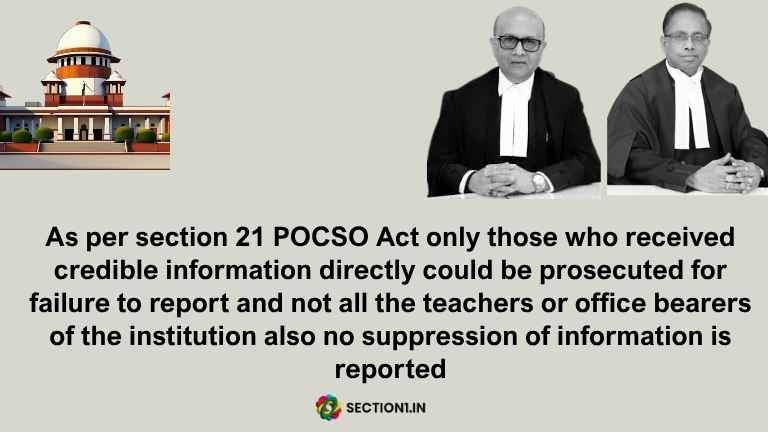
As per section 21 POCSO Act only those who received information directly from the victim could be prosecuted for failure to report and not all the teachers or office bearers of the institution
60. However, not all teachers or office bearers of the institution need to be prosecuted for the offence punishable under Section 21 of the Act. Only those who received information directly from the victim, of her being subjected to sexual assault, could be prosecuted for failure to report. Others, who are not the ones before whom offence was committed or to whom complaint was made, are not liable to be prosecuted merely because of their alleged presence in the room where verification was carried out. This we say so, because in absence of a direct complaint to them, and there being no signs of sexual assault according to their understanding as also the medical report, they cannot be considered liable for not reporting.
61. As noticed above, the victim had imparted information about the incident to as many as four persons, namely, her elder sister; her friend (C T); the Head Girl (YS); and Miss Linda Sema. Admittedly, the victim’s sister; the victim’s friend and the Head Girl were minors and therefore, a child within the meaning of section 2(b) of the POCSO Act. Subsection (3) of Section 21 provides that provisions of subsection (1) of Section 21 shall not apply to a child under the Act. In such circumstances, the victim’s sister; victim’s friend; and the Head Girl of the institution are not liable to be prosecuted for an offence punishable under Section 21 read with Section 19(1) of the POCSO Act.
62. In so far as Linda Sema (Respondent No.1) is concerned, the allegations are that she was given information about the incident but, instead of reporting the incident, she conducted her own verification exercise and suppressed the information. Although, it is stated on behalf of Respondent No.1 that she is not the Headmistress of the institution, but the prosecution case is that she was the Headmistress of the institution. Even otherwise, she falls in the category of ‘any person’ who has knowledge that such an offence has been committed. In such circumstances, we are of the view that qua Linda Sema the police report had sufficient material to create grave suspicion against her for the purposes of framing charge of an offence punishable under Section 21 of the POCSO Act / Section 176 of IPC, and therefore, she was not entitled to be discharged.
Whether other teachers and office bearers liable – NO – No direct credible information received
63. In so far as other teachers and office bearers of the institution are concerned, it is not the prosecution case that they were given information about the sexual assault by the victim. No doubt, the prosecution case is that they tried to suppress the information from spreading. But this allegation would be sustainable only when it is demonstrated that they had credible information about the incident. In absence of credible information, it is natural that anyone who is part of the institution would advise not to act in a manner that tarnishes the image of the institution, particularly when the Head Mistress who received the information directly took a decision not to report based on her own understanding of the situation. Therefore, this allegation, in our view, is not sustainable qua those other teachers and office bearers who had no direct credible information from the victim about the incident and, admittedly, the incident had not occurred to their knowledge.
No conspiracy to suppress the information
64. Besides, there is no worthwhile material on record to indicate a conspiracy to suppress the information. The material only indicates that after considering all materials including CCTV footage, a decision was taken not to report. Such a decision may be incorrect, but, prima facie, it was on the own understanding of the situation; therefore, those who had no direct knowledge of the incident and had not received information about it directly from the victim, cannot be considered part of the criminal conspiracy. At this stage, we may also notice that making false accusation against a child is also an offence punishable under sub-section (3) of Section 22 of the POCSO Act. Notably, JCWL is a child. Therefore, in absence of direct information from the victim, if they had erred in favour of caution, it would be travesty of justice to prosecute them for criminal conspiracy to suppress information of the commission of an offence under the POCSO Act. Besides, we do not find cogent material in the police report regarding accused persons causing evidence of the offence to disappear. Because, firstly, to their understanding and knowledge as required under Section 201 of IPC no offence was committed, and, secondly, it is not the prosecution case that they destroyed the clothes, etc to cause disappearance of the evidence. Consequently, we do not find a good reason to interfere with the order of the High Court and the Trial Court to the extent it discharges the accused persons of that accusation.
Conclusion
Appeal allowed
65. For all the reasons above, this appeal is partly allowed. The judgment of the High Court and the Trial Court to the extent it discharges Miss. Linda Sema (Respondent No.1) from prosecution, under Section 21 read with Section 19 (1) of the POCSO Act and Section 176 of IPC, is set aside. The Trial Court shall now proceed against the Respondent No.1 in accordance with the law for the above offences.
66. We make it clear that any observation made by us shall not be taken as an opinion expressed on the merits of the allegations. The Trial Court shall deal with the merits of the allegations strictly in accordance with law.
Resources
List of Judgments involved
1. Lower Court Orders Directly Involved in this Case
- Trial Court Order (Court of Session, Bomdila, West Kameng District, Arunachal Pradesh) – Date: February 19, 2021 – Brief: The initial order that discharged all the school teachers and staff members from offenses under Sections 176/201/120B of the IPC and Section 21(2) of the POCSO Act, concluding that no prima facie case was established since they lacked eye-witness knowledge or visible physical/medical proof of the assault at the initial stage.
- High Court Order (Gauhati High Court, Itanagar Bench) – Date: March 8, 2022 (Criminal Revision Petition No. 6 of 2021) – Brief: The Revisional Court’s order that dismissed the victim’s mother’s revision petition and affirmed the Trial Court’s discharge order, reasoning that the legal threshold for “knowledge” or “reason to believe” required under the POCSO Act was not established against the school staff.
2. Legal Precedents Cited Regarding the Principles of Discharge/Framing of Charge
- Amit Kapoor v. Ramesh Chander and Anr., (2012) 9 SCC 460
- Brief: Used to establish the legal standard that during a discharge application, the court is concerned with a “strong suspicion” that the accused committed the offense rather than absolute final proof of guilt.
- State of Gujarat v. Dilipsingh Kishorsinh Rao, (2023) 17 SCC 688
- Brief: Cited for the rule that at the stage of discharge, the court must proceed under the assumption that the material brought on record by the prosecution is true.
- State of Tamil Nadu v. N. Suresh Rajan and Ors., (2014) 11 SCC 709
- Brief: Quoted at length to establish that evaluating a discharge application involves testing if the prosecution’s facts disclose the ingredients of the offense at face value, explicitly barring the court from conducting a “mini-trial” at this stage.
- Tarun Jit Tejpal v. State of Goa & Anr., (2020) 17 SCC 556
- Brief: Cited in tandem with N. Suresh Rajan regarding the restricted scope of proceedings during the framing of charges under Sections 227 and 228 of the CrPC.
- Sajjan Kumar v. Central Bureau of Investigation, (2010) 9 SCC 368
- Brief: Used to affirm that while the court has the authority to sift and weigh evidence at the discharge stage, it is strictly to satisfy itself whether a grave suspicion exists, not to ensure the material is sufficient for conviction.
3. Legal Precedents Cited for Interpreting “Knowledge” and POCSO Act Provisions
- A.S. Krishnan and Ors. v. State of Kerala, (2004) 11 SCC 576
- Brief: Originally relied upon by the High Court and analyzed by the Supreme Court to expound on the terms “knowledge” and “reason to believe” under the IPC. It establishes that “knowledge” indicates an awareness of mind on a slightly higher plane than a “reason to believe” and must be deduced from the circumstances.
- Sr. Tessy Jose and Others v. State of Kerala, (2018) 18 SCC 292
- Brief: Analyzed to interpret “knowledge” under Section 19 of the POCSO Act. In that case, medical staff who delivered a minor’s child were exonerated because “knowledge” implies an awareness stemming from information directly indicating a crime, and individuals are not legally obligated to independently investigate and deduce that a POCSO offense occurred from general circumstances.
- State of Maharashtra and another v. Dr. Maroti, (2023) 4 SCC 298
- Brief: Cited to show that determining whether an individual possesses “knowledge” is a question of fact. In Dr. Maroti, a medical practitioner was held prima facie liable under Section 21 of the POCSO Act because the victim explicitly disclosed the sexual assault and a physical examination confirmed it, yet the doctor failed to report it.
- Just Rights for Children Alliance and another v. S. Harish and others, 2024 SCC Online SC 2611
- Brief: Cited to underscore the statutory intent of the POCSO Act, emphasizing that Section 19 creates a strict legal obligation to report offenses and Section 21 penalizes the failure to do so to collectively protect children from exploitation and ensure prompt reporting.
Acts and specific sections referenced or cited
The Indian Penal Code, 1860 (IPC)
- Section 26: Definition of “Reason to believe”
- Section 107: Abetment of a thing
- Section 120-B: Punishment of criminal conspiracy
- Section 176: Omission to give notice or information to a public servant by a person legally bound to give it
- Section 201: Causing disappearance of evidence of an offense, or giving false information to screen the offender
- Section 376(AB): Punishment for rape on a woman under twelve years of age
- Section 471: Using as genuine a forged document or electronic record
- Section 506: Punishment for criminal intimidation
The Protection of Children from Sexual Offences Act, 2012 (POCSO Act)
- Section 2(d): Definition of a child
- Section 2(2): Application of words and expressions not explicitly defined in the Act
- Section 6: Punishment for aggravated penetrative sexual assault
- Section 19: Reporting of offenses (including sub-sections 1 through 7)
- Section 20: Obligation of media, studio, or photographic facilities to report cases
- Section 21: Punishment for failure to report or record a case (including sub-sections 1 through 3)
- Section 22(3): Punishment for making false accusations against a child
- Section 27: Medical examination of a child
- Section 42A: Act to have overriding effect
- Section 43: Public awareness mandates about the Act
- Section 44: Monitoring of the implementation of the Act
- Section 45: Power to make rules
The Code of Criminal Procedure, 1973 (CrPC)
- Section 91: Summons to produce a document or other thing
- Section 154: Information in cognizable cases (First Information Report)
- Section 161: Examination of witnesses by police
- Section 164: Recording of confessions and statements
- Section 164A: Medical examination of the victim of rape
- Section 173(2): Report of police officer on completion of the investigation
- Section 227: Discharge of the accused
- Section 228: Framing of charge
- Section 437(A): Bail to require the accused to appear before the next appellate Court
The Protection of Children from Sexual Offences Rules, 2012
- Rule 4: Care and Protection procedures by the Special Juvenile Police Unit or local police
- Rule 5: Arrangement of emergency medical care
Commissions for Protection of Child Rights Act, 2005
- Section 3: Constitution of the National Commission for Protection of Child Rights
- Section 17: Constitution of the State Commission for Protection of Child Rights
Juvenile Justice (Care and Protection of Children) Act, 2000 / 2015
- Section 31(1) (of the 2000 Act): Powers and determination by the Child Welfare Committee
- JJ Act, 2015: Referenced generally under Section 2(2) of the POCSO Act
The Constitution of India
- Article 15: State powers to make special provisions for children
- Article 39: State policy for protecting the tender age of children against exploitation
Other Enactments Referenced
- Information Technology Act, 2000
- General Clauses Act, 1897
Party
AAA versus Linda Sema & Ors - Criminal Appeal No. 3106 of 2026 (arising out of SLP Criminal No. 4772 of 2024) - 2026 INSC 675 - July 9, 2026 – Hon’ble Mr. Justice Manoj Misra and Hon’ble Mr. Justice K.V. Viswanathan.