

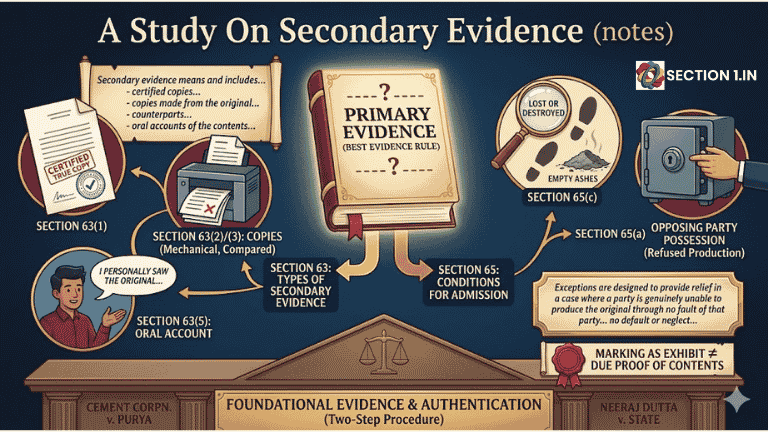
Secondary Evidence Law notes
Before proceeding with the discussion, it is imperative to reproduce the relevant provisions of the Evidence Act and discuss the law relating to secondary evidence:
“Section 61- Proof of contents of documents”
“Section 63-Secondary evidence”
Section 65- Cases in which secondary evidence relating to documents may be given”
General rule on proof of documents by leading primary evidence
15. As a general rule, documents are proved by leading primary evidence. Section 64 of the Evidence Act provides that documents must be proved by the primary evidence except in cases mention in Section 65 of the Evidence Act. In the absence of primary evidence, documents can be proved by secondary evidence as contemplated under Section 63 of the Act which reads as under: –
“Secondary evidence means and includes—
(1) certified copies given under the provisions hereinafter contained;
(2) Copies made from the original by mechanical processes which in themselves ensure the accuracy of the copy, and copies compared with such copies.
(3) copies made from or compared with the original ;
(4) counterparts of documents as against the parties who did not execute them;
(5) oral accounts of the contents of a documents given by some person who has himself seen it.
Illustration:
(a) A photograph of an original is secondary evidence of its contents, though the two have not been compared, if it is proved that the thing photographed was the original.
(b) A copy compared with a copy of a letter made by a copying machine is secondary evidence of the contents of the letter, if it is shown that the copy made by the copying machine was made from the original.
(c) A copy transcribed from a copy, but afterwards compared with the original, is secondary evidence; but he copy not so compared is not secondary evidence of the original, although the copy from which it was transcribed was compared with the original.
(d) Neither an oral account of a copy compared with the original, nor an oral account of a photograph or machine copy of the original, is secondary evidence of the original.”
16. Section 65 of the Act deals with the circumstances under which secondary evidence relating to documents may be given to prove the existence, condition or contents of the documents. For better appreciation Section 65 of the Act is quoted herein below:-
“65. Cases in which secondary evidence relating to documents may be given: Secondary evidence may be given of the existence, condition, or contents of a document in the following cases:-
(a) When the original is shown or appears to be in the possession or power— of the person against whom the document is sought to be proved, or of any person out of reach of, or not subject to, the process of the Court or of any person legally bound to produce it, and when, after the notice mentioned in section 66, such person does not produce it;
(b) when the existence, condition or contents of the original have been proved to be admitted in writing by the person against whom it is proved or by his representative in interest;
(c) when the original has been destroyed or lost, or when the party offering evidence of its contents cannot, for any other reason not arising from his own default or neglect, produce it in reasonable time; (d) when the original is of such a nature as not to be easily movable; (e) when the original is public document within the meaning of section 74;
(f) when the original is a document of which a certified copy is permitted by this Act, or by any other law in force in 40[India] to be given in evidence;
(g) when the originals consist of numerous accounts or other documents which cannot conveniently be examined in court and the fact to be proved it the general result of the whole collection.
In cases (a), (c) and (d), any secondary evidence of the contents of the document is admissible.
In case (b), the written admission is admissible. In case (e) or (f), a certified copy of the document, but no other kind of secondary evidence, admissible. In case (g), evidence may be given as to the general result of the documents by any person who has examined them, and who is skilled in the examination of such documents.”
17. The pre-conditions for leading secondary evidence are that such original documents could not be produced by the party relied upon such documents in spite of best efforts, unable to produce the same which is beyond their control. The party sought to produce secondary evidence must establish for the non-production of primary evidence. Unless, it is established that the original documents is lost or destroyed or is being deliberately withheld by the party in respect of that document sought to be used, secondary evidence in respect of that document cannot accepted. [Rakesh Mohindra Appellant (s) versus Anita Beri and others Respondent(s) – Civil Appeal No. 13361 of 2015 (Arising out of SLP (C) No. 29621 of 2014) – November 06, 2015]
A precondition to prove secondary evidence is to lay a foundation
22. It is well settled that if a party wishes to lead secondary evidence, the Court is obliged to examine the probative value of the document produced in the Court or their contents and decide the question of admissibility of a document in secondary evidence. At the same time, the party has to lay down the factual foundation to establish the right to give secondary evidence where the original document cannot be produced. It is equally well settled that neither mere admission of a document in evidence amounts to its proof nor mere making of an exhibit of a document dispense with its proof, which is otherwise required to be done in accordance with law. [Rakesh Mohindra Appellant (s) versus Anita Beri and others Respondent(s) – Civil Appeal No. 13361 of 2015 (Arising out of SLP (C) No. 29621 of 2014) – November 06, 2015]
23. In the case of M. Chandra vs. M. Thangamuthu, (2010) 9 SCC 712, this Court considered the requirement of Section 65 of the Evidence Act and held as under:-
“47. We do not agree with the reasoning of the High Court. It is true that a party who wishes to rely upon the contents of a document must adduce primary evidence of the contents, and only in the exceptional cases will secondary evidence be admissible. However, if secondary evidence is admissible, it may be adduced in any form in which it may be available, whether by production of a copy, duplicate copy of a copy, by oral evidence of the contents or in another form. The secondary evidence must be authenticated by foundational evidence that the alleged copy is in fact a true copy of the original. It should be emphasised that the exceptions to the rule requiring primary evidence are designed to provide relief in a case where a party is genuinely unable to produce the original through no fault of that party.”
The Constitution Bench clarified the distinctions between primary and secondary evidence
31. Primary and Secondary Evidence stands explained by a Constitutional Bench of this Court in Cement Corpn. of India Ltd. v. Purya [(2004) 8 SCC 270 – 5-Judge Bench) – https://main.sci.gov.in/jonew/judis/26522.pdf] as the former being evidence that the law requires to be given first, the latter being evidence that may be given in the absence of that original evidence when a proper explanation of its absence has been given. The terms “primary and secondary evidence” apply to the kinds of proof that may be given to the contents of a document, irrespective of the purpose for which such contents, when proved, may be received.
32. Section 63 of the Evidence Act gives an exhaustive definition declaring that secondary evidence “means and includes” the five kinds of evidence mentioned therein. Section 65 of the Evidence Act allows secondary evidence to be given of the existence, condition, or contents of documents under the circumstances therein mentioned. It provides for the circumstances in which secondary evidence can be used when the original document is unavailable or inaccessible. It is imperative to adhere to the principles outlined in these sections, including the proper documentation and authentication, to successfully produce secondary evidence in legal proceedings. [Vijay …Appellant(s) versus Union Of India & ors …Respondent(s) – Civil Appeal No. 4910 of 2023 – 2023 INSC 1030 – 29th November, 2023]
Principles for the admissibility of secondary evidence
33. After perusing various judgments of this Court, we can deduce the following principles relevant for examining the admissibility of secondary evidence:
33.1 Law requires the best evidence to be given first, that is, primary evidence [Neeraj Dutta v. State (NCT of Delhi) (5-Judge Bench) (2023) 4 SCC 731; Yashoda v. K. Shobha Rani (2-Judge Bench) (2007) 5 SCC 730]
33.2 Section 63 of the Evidence Act provides a list of the kinds of documents that can be produced as secondary evidence, which is admissible only in the absence of primary evidence [Yashoda v. K. Shobha Rani (2-Judge Bench) (2007) 5 SCC 730]
33.3 If the original document is available, it has to be produced and proved in the manner prescribed for primary evidence. So long as the best evidence is within the possession or can be produced or can be reached, no inferior proof could be given [Yashoda v. K.Shobha Rani (2-Judge Bench) (2007) 5 SCC 730]
33.4 A party must endeavor to adduce primary evidence of the contents, and only in exceptional cases will secondary evidence be admissible. The exceptions are designed to provide relief when a party is genuinely unable to produce the original through no fault of that party [M. Chandra v. M. Thangamuthu (2-Judges Bench) (2010) 9 SCC 712]
33.5 When the non-availability of a document is sufficiently and properly explained, then the secondary evidence can be allowed [Neeraj Dutta v. State (NCT of Delhi) (5-Judge Bench) (2023) 4 SCC 731]
33.6 Secondary evidence could be given when the party cannot produce the original document for any reason not arising from his default or neglect [Surendra Krishna Roy v. Muhammad Syed Ali Matwali Mirza 1935 SCC OnLine PC 56]
33.7 When the copies are produced in the absence of the original document, they become good secondary evidence. Still, there must be foundational evidence that the alleged copy is a true copy of the original [H. Siddiqui v. A. Ramalingam, (2-Judge Bench) (2011) 4 SCC 240]
33.8 Before producing secondary evidence of the contents of a document, the non-production of the original must be accounted for in a manner that can bring it within one or other of the cases provided for in the section [H. Siddiqui v. A. Ramalingam (2-Judges Bench) (2011) 4 SCC 240]
33.9 Mere production and marking of a document as an exhibit by the Court cannot be held to be due proof of its contents [Neeraj Dutta (supra)] It has to be proved in accordance with the law [H. Siddiqui (supra)] [Vijay …Appellant(s) versus Union Of India & ors …Respondent(s) – Civil Appeal No. 4910 of 2023 – 2023 INSC 1030 – 29th November, 2023]
What is the question of fact and law regarding documentary evidence? Explained
16.4 Insofar as documentary evidence is concerned, an inference drawn from the contents of a document is ordinarily a question of fact. However, the legal effect of a document's terms, its construction involving the application of legal principles, or a misconstruction thereof gives rise to a question of law [Hero Vinoth v. Seshammal, (2006) 5 SCC 545].
16.5 While exercising jurisdiction under Section 100 of the CPC, the High Court must be satisfied that the case involves not merely a question of law but a substantial question of law having a material bearing on the rights of the parties. A substantial question of law may arise where the legal position is debatable or unsettled. It may also occur in cases where statutory provisions or binding precedents well settle the legal position. Still, the courts below have decided the matter by ignoring settled principles or by acting in direct contravention of them. In such cases, the substantial question of law arises not because the law is uncertain, but because the decision violates the settled position of law [Hero Vinoth v. Seshammal, (2006) 5 SCC 545].
16.6 Section 103 of the CPC enables the High Court, in a second appeal, to determine an issue of fact, provided the evidence on record is sufficient, in two contingencies: first, where an issue necessary for the disposal of the appeal has not been determined by the lower appellate court or by both courts below; and second, where such issue has been wrongly determined by reason of a decision on a question of law as referred to in Section 100 of the CPC [Sitaramji Badwaik v. Bisaram, (2021) 15 SCC 234].
16.7 Section 103 does not operate as an exception to, or a substitute for, Section 100, but is intended to advance the same legislative purpose. The power under Section 103 CPC can be exercised only in exceptional circumstances and with circumspection. Before invoking this provision, the High Court must record a clear finding that the findings of fact recorded by the courts below are vitiated by perversity. In the absence of such a categorical finding, the exercise of power under Section 103 would fall outside the permissible limits of Section 100 of the CPC [Municipal Committee, Hoshiarpur v. Punjab SEB, (2010) 13 SCC 216].
What is secondary evidence? Explained
19. The crux of the matter depends on whether Exh. B-2 can be treated as documentary evidence warranting interpretation of the clauses and the alleged contradictions with Exh. A-3 and A-4. Exh. B-2 is a photocopy, or a mechanical copy, of the purported PoA. This, therefore, implies that Exh. B-2 is, at best, secondary evidence. Secondary evidence is evidence that proves the contents of an original document through a medium that is one step removed from the source. Section 63 of the Indian Evidence Act provides an exhaustive list of what constitutes secondary evidence. This includes certified copies, copies made from the original by mechanical processes ensuring accuracy, copies compared with such copies, counterparts of documents against parties who did not execute them, and oral accounts of the contents given by a person who has seen the document. [Tharammel Peethambaran and another (Appellants) versus T. Ushakrishnan and another (Respondents) - Civil Appeal No. 856 of 2026 (arising out of SLP (C) No. 11868 of 2024) - 2026 INSC 134 - February 06, 2026]
How to introduce secondary evidence? Procedure given
20. The broad parameters summarising the procedure to be followed for introducing secondary evidence are reiterated and read thus:
20.1 The fundamental principle of the Indian Evidence Act is that facts have to be established by primary evidence [Jagmail Singh v. Karamjit Singh, (2020) 5 SCC 178. (Para 14)]. Section 64 mandates that documents must be proved by primary evidence, which is considered the “best evidence”. Primary evidence is the rule, while secondary evidence is an exception admissible only in the absence of primary evidence. A party is generally required to produce the best evidence available; so long as the superior evidence (the original) is within a party’s possession or reach, they cannot introduce inferior proof (secondary evidence) [Smt. J. Yashoda v. K. Shobha Rani (2007) 5 SCC 730].
20.2 Before secondary evidence can be admitted, the party relying on it must lay a factual foundation. This involves two steps: First, the party must prove that the original document actually existed and was executed. Secondly, the party must establish valid reasons as to why the original cannot be furnished [Ibid; Kaliya v. State of Madhya Pradesh, (2013) 10 SCC 758].
20.3 Secondary evidence is inadmissible until the non-production of the original is accounted for in a manner that brings the case within the specific exceptions provided in Section 65 [H. Siddiqui (D) By Lrs. v. A. Ramalingam AIR (2011) SC 1492]. If the original itself is found to be inadmissible through failure of the party who files it to prove it to be valid, the same party is not entitled to introduce secondary evidence of its contents [Smt. J. Yashoda v. K. Shobha Rani (2007) 5 SCC 730].
20.4 Section 65 of the Evidence Act is exhaustive and states the specific circumstances under which secondary evidence is permissible. To introduce secondary evidence, a party must satisfy the conditions of one of the clauses (a) through (g) of Section 65.
20.5 Further, admitting a document as secondary evidence does not automatically prove its contents. The secondary evidence must be authenticated by foundational evidence showing that the alleged copy is, in fact, a true copy of the original. For instance, if a party wishes to introduce a photostat copy, they must explain the circumstances under which the copy was prepared and who possessed the original at the time the photograph was taken [Ashok Dulichand v. Madahavlal Dube and Another (1975) 4 SCC 664; Chandra v. M. Thangamuthu, (2010) 9 SCC 712].
20.6 Mere admission of a document or making it an exhibit does not dispense with the requirement of proving it in accordance with the law. The court has an obligation to examine the probative value of the document and decide the question of admissibility before making an endorsement on the secondary evidence. If the foundational facts, such as the loss of the original or the explanation for its non-production, are not established, the court cannot legally allow the party to adduce secondary evidence [Rakesh Mohindra v. Anita Beri, (2016) 16 SCC 483].
20.7 There is no requirement that an application must be filed to lead secondary evidence. While a party may choose to file such an application, secondary evidence cannot be ousted solely because no application was filed. It is sufficient if the party lays the necessary factual foundation for leading secondary evidence either in the pleadings or during the course of evidence [Dhanpat v. Sheo Ram 2020 (16) SCC 209].
21. Therefore, the introduction of secondary evidence is a two-step process, wherein, first, the party must establish the legal right to lead secondary evidence, and second, they must prove the contents of the documents through that evidence. The twin requirements are conjunctive. [Tharammel Peethambaran and another (Appellants) versus T. Ushakrishnan and another (Respondents) – Civil Appeal No. 856 of 2026 (arising out of SLP (C) No. 11868 of 2024) – 2026 INSC 134 – February 06, 2026]
Party can claim a presumption after following the procedure for adducing secondary evidence
22. The High Court recorded a finding which is not challenged, that the PoA produced by the 1st Defendant is a notarised photocopy, and not the original document. The 1st Defendant is obligated to follow the procedure for adducing secondary evidence, and thereafter, claim presumption, if any, available to a document so adduced in evidence. It is axiomatic that secondary evidence is permissible only as an exception to the requirement of adducing primary evidence. [Tharammel Peethambaran and another (Appellants) versus T. Ushakrishnan and another (Respondents) – Civil Appeal No. 856 of 2026 (arising out of SLP (C) No. 11868 of 2024) – 2026 INSC 134 – February 06, 2026]
How to appreciate the secondary evidence marked without following procedures? Explained
23. The case on hand falls within the meaning of mechanical copies. In law, the existence of Exh. B-2, in the absence of laying down a factual foundation and following procedure, ought to be ignored for the purpose of appreciating the 1st Defendant’s claim on the power to alienate Plaint A-Schedule Property. It is apposite to refer to one of the views expressed by the First Appellate Court by examining the signature in Exh. B-2, and recording a finding against the plaintiff. It is axiomatic and fairly established by the authorities18 of this Court that courts should not by itself compare disputed signatures without the assistance of any expert, when the signatures with which the disputed signatures compared, are themselves not the admitted signatures. In our considered view, neither Section 33 of the Registration Act nor Section 85 of the Evidence Act would come into application if the primary requirement of adducing secondary evidence is discharged by the party relying on the document. Section 85 of the Evidence Act falls under Chapter V, titled Documentary Evidence. In the absence of an original or at least a secondary evidence, it is impermissible to apply Section 85 of the Indian Evidence Act to conclude the execution and extent of authority given by the plaintiff to the 1st defendant. No order is brought to our notice through which secondary evidence is brought on record before the Trial Court. A photocopy of a document is no evidence unless the same is proved by following the procedure set out. Relying on Exh. B-2, the First Appellate Court acted on inadmissible evidence and accepted the existence of power to alienate. Exh. B-2/photocopy is no evidence, and the incorrect reliance on no evidence, has been rightly corrected by the High Court through the impugned judgment. The High Court has considered the misreading of evidence by the Appellate Court and, by applying the correct principles of law, allowed the second appeal. [Tharammel Peethambaran and another (Appellants) versus T. Ushakrishnan and another (Respondents) – Civil Appeal No. 856 of 2026 (arising out of SLP (C) No. 11868 of 2024) – 2026 INSC 134 – February 06, 2026]